Participation varies by team.
The official offer covers eligible employees at level 70 or below in the U.S., Canada, India and the U.K. Individual offer terms come from Microsoft. [01]
The Anton Stetner Podcast · Research companion
Microsoft’s exit offer, AI investment and Washington’s housing market. The episode, the sources and the data behind your next move.
For tech professionals & property owners
Let’s have a discussion about your property, what’s happening in your local market, and what the real data says about selling now.
Talk with Anton and the RESG team about recent sales, competing listings, pricing and timing—so you can decide what makes sense for you.
Let’s discuss selling my property ↗Or start the conversation here with Ask Anton.
Choose a starting point, edit your question, and send it when you’re ready.
Chat uses Functional cookies. Review to enable them.
If chat still does not appear, email the team. Nothing has been sent from this page.
You’re chatting with our digital assistant. Responses can make mistakes. Chat sessions are recorded. Verify important information before acting. About using Ask Anton
By sending a message, you agree to our Terms of Use, including arbitration and use of your submissions in content, and acknowledge our Privacy Policy.
The answer to the title
The 60,000 figure is an eligible group for a voluntary exit offer. It is not 60,000 confirmed layoffs.
Microsoft announced the program on October 26. It applies to participating teams in four countries; it is not a Washington-only program. [01][02]
Reporting puts expected take-up at 3,000 or fewer employees worldwide. Washington’s participation has not been disclosed. [03][04]
The local story depends on what employees do next: take another job, start a company, retire or relocate.
The official offer covers eligible employees at level 70 or below in the U.S., Canada, India and the U.K. Individual offer terms come from Microsoft. [01]
GeekWire reported that employees have until the first week of December to decide. Employees should use their own written offer for exact deadlines and departure terms. [02]
WARN notices track separate announcements with their own locations and scheduled separation dates. The database lets you follow individual employer filings. [08]
Watch the conversation
The sources and data below are open to everyone.
No signup required.
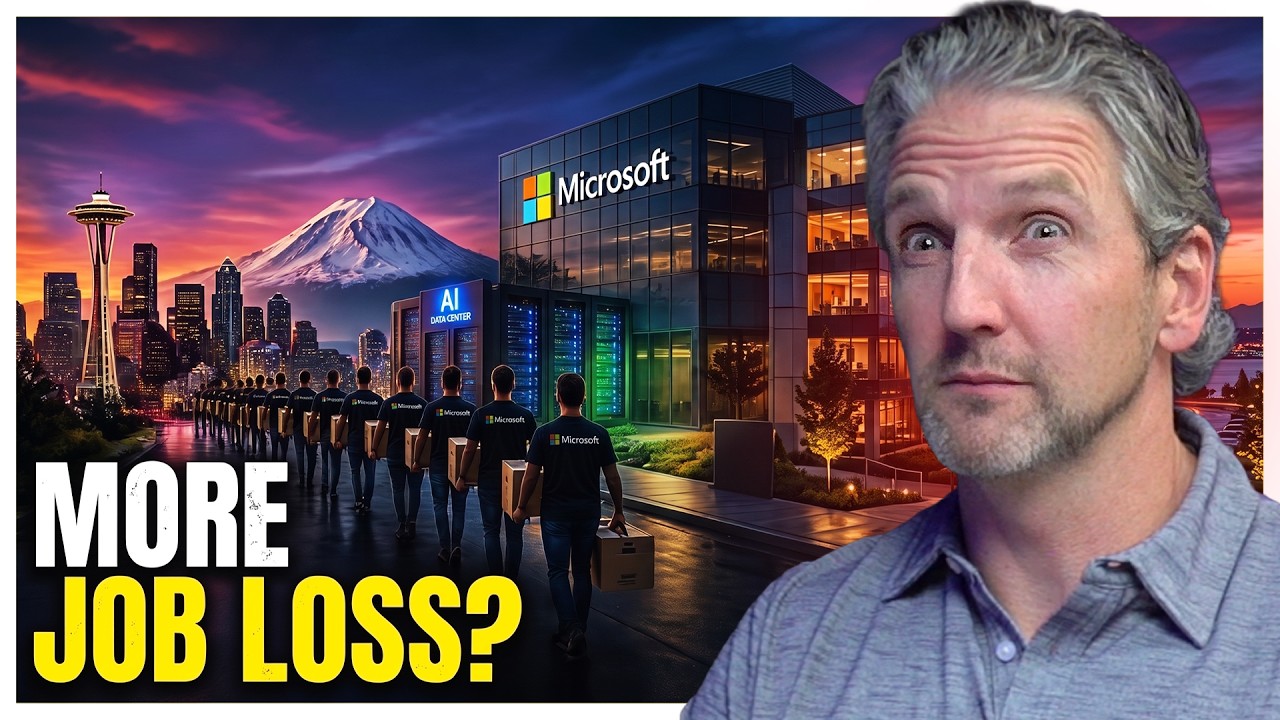
The thumbnail is served by Ask Anton. Choose Play to load YouTube after Functional consent or permission for this video. YouTube/Google may receive browser and IP information when the player loads and playback information while viewing. Google’s Privacy Policy.
Anton and Benji work through the difference between an offer and a layoff, the shift toward AI infrastructure, Washington’s exposure to high-paying jobs, the business-climate debate and local housing opportunities. Explore the discussion by topic, then dig into the data and sources.
Topic times match the original recording. The podcast begins at 00:28:15.
King County · 2025 average annual wages
2.7×the countywide average
These are average wages per covered job, rather than median pay or income per resident. ESD’s information industry is the comparison used in the episode; it does not cover every technology role.
Jobs, earnings & AI investment
Company performance and household job security
answer different questions.
| Measure | Value | Scope & period | Source |
|---|---|---|---|
| Unemployment rate | 4.8% | Washington residents · seasonally adjustedSeptember 2026 | [07] |
| Monthly payroll change | −15,400 jobs | Washington nonfarm jobs · seasonally adjustedSeptember vs. August 2026 | [07] |
| Annual payroll change | +9,200 jobs (+0.3%) | Washington · ESD October 14 release vintageSeptember 2026 vs. September 2025 | [07] |
| Microsoft revenue | $92.3 billion (+19%) | Worldwide · reported year-over-year growthFY27 Q1 · ended September 30, 2026 | [05] |
| Azure revenue growth | +48% | Worldwide · reported year-over-year growthFY27 Q1 · ended September 30, 2026 | [05] |
| Microsoft capital expenditures | $45.2 billion | Worldwide · including finance leasesFY27 Q1 · ended September 30, 2026 | [06] |
| Technology job-cut announcements | 165,925 (+54%) | U.S.-based employers · Challenger technology classificationJanuary–September 2026 vs. same months of 2025 | [15] |
| All-industry job-cut announcements | 573,195 (−39%) | U.S.-based employers · announcements, not net job lossesJanuary–September 2026 vs. same months of 2025 | [15] |
September’s payroll decline included losses in government, education, health services and other sectors. The statewide numbers provide context for the technology employment discussion. [07]
Microsoft’s October earnings call put calendar-year capex guidance at approximately $170 billion. That is forward-looking guidance, distinct from quarterly spending. [05][06]
Source: ESD’s October 14 release, September 2026 employment data.
Puget Sound real estate
September’s housing data comes before the October 26 exit announcement.
Use it as a baseline for what happens next. The broader NWMLS service area is different from Seattle, the Eastside or an individual neighborhood. [09]
| Measure | Value | Geography |
|---|---|---|
| Active inventory, year over year | +24.5% | 27-county NWMLS service area |
| Pending sales, year over year | −15.1% | 27-county NWMLS service area |
| Months of inventory | 4.44 | 27-county NWMLS service area |
| Active inventory, year over year | +31.1% | King County |
| Active inventory, year over year | +44.2% | Snohomish County |
| Median closed-sale price | $850,000 / $720,000 | King / Snohomish County |
Information and statistics compiled and reported by the Northwest Multiple Listing Service. [09]
A household facing income uncertainty may delay a purchase, trade-up or renovation. Whether that becomes a sale depends on savings, financing, other household income and reemployment.
Track new listings, pending sales, price reductions, market time and rental concessions alongside actual departures and new hiring. Local market data helps put those changes in context.
Washington’s business climate
A job change can become the start of a company. Where that company gets built matters to Washington’s economy.
Washington’s business and capital gains tax changes are part of the episode’s debate about future investment. Talent, customers, financing, operating costs and personal preferences also shape where founders build.
The Service and Other Activities classification has rates of 1.5%, 1.75% and 2.1%, based on prior-year qualifying income of the business or affiliated group. Different thresholds and exceptions apply. [10]
Starting in tax year 2025, the first $1 million of taxable Washington capital gains is taxed at 7%; the amount above that is taxed at 9.9%. Taxable gains, deductions and exemptions must be evaluated separately. [11]
Follow where alumni start companies and create jobs. Business applications, new employers, local hiring, funding and completed relocations help tell that story. [13][14]
The 22.9% figure from the episode
106,365 → 81,993 applications
3,826,844 → 4,345,310 applications
January–August 2026 compared with January–August 2025. Ask Anton calculation from Census’s total, not seasonally adjusted business-applications series. [17][18][19]
Download the comparison data (CSV) ↓What to watch next
Look for reported acceptances, their geographic distribution and individual departure terms. A deadline is not an outcome.
Follow time to reemployment and replacement pay alongside retirement, self-employment, relocation and unemployment. Household income can change even when a person finds another job.
Compare the same markets year over year. Follow hiring, actual business formation and completed moves alongside housing supply and demand.
Frequently asked questions
No. ESD reports the 2025 average annual wage across covered jobs in King County. It is a mean, so higher-paid jobs pull the average up; it is not the median, the most common salary, household income or income per resident. The $368,655 comparison is the information industry average, not every technology worker or Microsoft employee. [16]
It could. A longer job search, lower replacement pay, reduced equity compensation or less confidence about future income may change a household’s purchase budget, rent budget or selling timeline. Reemployment and replacement income belong alongside departure counts when assessing the local effect. This is an economic channel to watch, not a measured wage decline or a forecast of home prices.
StartBusinessByState.com's October 12 analysis reports the figure for January–August 2026 versus January–August 2025. We reproduced it from Census's unadjusted total business-applications series: 81,993 versus 106,365 in Washington. It is an eight-month year-over-year comparison, not a trailing-twelve-month measure or a count of companies that opened. [17][18][19]
The 60,000 figure refers to employees eligible for a voluntary exit offer. It does not establish the number who will accept or become unemployed. Microsoft's announcement describes a voluntary program within participating teams. [01][02]
Business Insider reported an expectation of 3,000 or fewer worldwide, also relayed by Newsquawk. That is a reported expectation, not a final departure count. The original Business Insider article was inaccessible during this review; the source register makes that limitation explicit. [03][04]
A Washington eligibility or acceptance count is not established by the reviewed sources. Applying a guessed state share to the worldwide offer would create a scenario, not a company disclosure. [01][02]
The official announcement covers eligible staff at level 70 or below in participating teams in Canada, India, the United Kingdom and the United States. Team participation varies. Individual terms come from Microsoft. [01]
GeekWire reported a decision window ending in the first week of December. The short public Microsoft announcement does not give individual deadlines or departure dates. Eligible employees should check their own written offer. [01][02]
No. A person might take another job, consult, start a business, retire or leave the labor force. An exit count cannot be added directly to unemployment without knowing the person's subsequent employment and job-search status. [07]
AI investment and workforce changes are happening together, but timing alone does not prove which roles AI replaces. Microsoft's earnings show strong cloud growth and substantial infrastructure spending. Those results provide business context, not a role-by-role explanation of the offer. [05][06]
The reviewed evidence does not establish that causal link. The offer spans four countries. Washington tax changes are a separate issue to assess when considering business costs, founder location and future investment. [01][10][11]
The offer alone cannot establish that outcome. September housing data already showed more inventory and weaker pending sales before the October announcement. Watch local demand, pricing, reemployment and actual listings over time before attributing a housing change to Microsoft. [09]
Start with your timeline, cash reserves, current housing payment, likely next income and the market for your specific property. Compare the cost of staying with the cost of moving. Ask qualified financial, tax, employment and lending professionals about decisions in their areas; Ask Anton can help organize the property questions.
Read the podcast
Only the podcast conversation is included: from the introduction at original-recording 00:28:15 through the closing before 01:27:41. Pre-recording conversation and post-recording production feedback are excluded.
Original-recording timestamps and supplied speaker labels are preserved. See the episode notes at the bottom for corrections and updates.
Welcome to the Anton Stetner podcast. Today, I have one question for you: Are more layoffs hitting Seattle?
They are.
And when ten people send me a message about Microsoft possibly letting go of sixty thousand people
And it happened on Monday of this week.
And I just get like text message after DM over and over again. I'm like, oh my goodness, this is something we have to talk about. It's on our listeners' hearts and minds of what's happening.
What is going on with tech here in Washington State? What is Microsoft telling us? Is this part of the canary in the coal mine? How does this relate to AI?
And a lot of the headlines were like it's layoffs. It wasn't exactly layoffs. Sixty thousand people will get to choose in December if they want to take a severance package and then move on.
And is this all happening in?
Seattle specifically
Or globally?
Globally, got it.
This is twenty seven percent of Microsoft's workforce got a notice globally.
Wow, that's crazy.
It's a big number.
And so you have to really immediately ask yourself, what is going on here? We need to do the math, and the math is why is Microsoft replacing headcount with GPUs? Why is Microsoft giving these severance packages? And then what's going to happen to tech? What's going to happen to Washington State? How does this affect housing here locally?
Then stick around because we've got this crazy number. It's not just the sixty thousand. There's a figure that twenty two point nine percent that no one is talking about. So if you live here in Washington State, you invest in Washington State, you got a small business here in Washington State.
Hit that subscribe button. Share this with someone who needs to see it. And guys and gals
If you want to talk seriously about what's happening in your life in your business, reach out to us. I think we've had more real serious discussions about life, about business, about Washington State in the last few months than we've had regularly. So we are here for you.
And we want to have those discussions.
I think one of the things that people are thinking right off the bat is sixty thousand people are getting laid off. When they just see the headline, and even you told me, well, not necessarily. So why don't you break down exactly what these sixty thousand people got in their inbox when they got the email? Whenever was it Monday that they got it?
It was Monday.
Dang, new spread that quickly.
It spread super quick. It was like
So Microsoft sends out the notice. Sixty thousand people.
Have a potential severance package, twenty seven percent of their workforce, but imagine this. Imagine this is like you just dropped a match in a field full of dry, dry wheat or kindling, and just goes woof and just spreads. It was like bing, same message, bing, same message, bing, same message. Also, there's something really telling here.
So when I see a headline
I always tell you. Our listeners, our subscribers, go dig three levels deep. So my first question, Benji
And hopefully this is yours in the audience.
Who is not getting this notice?
And so I had that was the first thing I looked at. Not getting the notice was sales
Marketing
Data centers and security. So they still need people to do sales. They still need people to do marketing to build the data centers and to do the security. When I dug into the security, it was both physical security and cybersecurity. And if all of you saw
What happened last week in the AI world, where basically everything got attacked. Why we need more cybersecurity. For the first time.
Last week caused me to seriously consider what's happening inside of our small businesses and go, man, we got to get really insane about cybersecurity. Because AIs have gotten so good
And it's just relentless how much they'll attack something and attack the code. Humans wrote the code, so there are errors inside of it.
So they basically tried to take the internet down last week.
We have to start taking a lot more seriously. Let me know what you guys are going to be doing.
So the next question was, what are the terms? Cash, career transition support. Some people may even get healthcare. Extended stock.
Microsoft said, "No one is being incentivized to leave."
That's just a bad press release.
It's due here in December. For context, though
Microsoft doesn't expect the thirty percent to go.
Pierce saw five to six percent. Google in twenty five saw three to five percent. So we're going to look at that as our standard numbers, that is, the three to five percent range. A little bit of context is they just cut fifteen thousand in twenty five.
And thirty-two hundred of those were in Washington. In twenty twenty-six, they did early retirement offers to about eighty-seven hundred employees.
And this is all Microsoft.
This is all Microsoft.
And then in July of 2026, it cut 4,800 globally, 605 here in Washington, which was Redmond plus some remote workers. And then in November of this year
277 Redmond positions were on a WARN notice. Washington State has this notice that they have to send out when they're going to let go more than 50 people.
Also, I heard from people inside the Microsoft ecosystem. We have customers in tech who are inside this ecosystem.
One said
Because now I'm doing my research. I'm picking up the phone, calling the network.
Hey, I'm not afraid for my job right now
But I know that I've got to work a lot harder and I got to put in a lot more effort.
I think this is going to create a little more fear and panic, and you may see more people take it this time than you have in the past because the writing is on the wall. And a third one said that they believe part of this is to kill off the remote worker and the work from home stuff because they're trying to force people back into the office, and this is a way to do that. It's just to clip some of them because when they said.
No one has to come into the office anymore. During COVID, people just moved to cheaper locations, so some of them can't even come back.
But here's the twist: in the same week that sixty thousand people get this email, this notice saying, 'Hey, you may want to leave, and we may give you some money'
Microsoft posted one of its best revenue quarters in history.
What? What's going on?
If you got that email, would you take it? Would you say yes? Would you say, man, the writing is on the wall. I'm going to get while the getting's good, and I'm going to go try the job market. Or what would you do?
Depends on what the offer was. Did they say what the offer was?
They don't say what the offer is, and they didn't say how many are specifically in Washington State. So we're just going to infer that with some of this other data.
I don't know if you said it already, but do you know broadly what type of team members were sent this email?
Specific. Pretty much everyone that's a
I believe it's called a level seventy and below.
That can be a broad spectrum. Most broad spectrum tasks.
Do responsibilities.
So there was any unified department.
I think the thing to be thinking about. The unified department kept sales, marketing, data center people, and security.
So administrative people, management potentially.
Exactly.
Like even just like comms. That's another thing too. Like communications kind of people. Like, do you really need them? Especially if you have a whole lot less people.
So we know one thing is happening definitely with AI.
Productivity is going up, and Microsoft is showing their revenue going up.
With that happening, what they're saying is we're saying we need less headcount and we need more GPUs because that's where the money is specifically going.
It's crazy.
Record profits.
Rec record profits, fewer people, and the AI capex trade is really what this is. This is all about. Two days after the exit offer, Microsoft reported record earnings. Okay, let me rephrase that. Microsoft reported record earnings. Revenue was up 19 percent. Profit was up 32 percent, and Azure was up 48 percent, and their stock jumped. First quarter fiscal year 2027
Which is weird. They're quarters. This is the one that ended in September. Revenue was ninety two point three billion, up twenty percent.
Gap net income, thirty six point three billion, thirty two percent. But Azure
Thirty three point two billion, up forty eight percent. The Azure team was just slaying it.
And they're going okay. Where is our CapEx going? They have forty five point two billion in CapEx, up to fifty billion total.
And for calendar twenty twenty six, they're guiding towards a hundred and seventy billion in capex.
Think about this: what the capex per employee is exploding at Microsoft.
And for those of you who don't know, we did do that other episode where we talked about data centers. We talked about the conflict between farmers and power and eminent domain, and that is here on the channel. You can go take a look at it, and that's in Quincy, Washington.
And Microsoft, because they put so many data centers there, has lowered people's property taxes, created jobs, and revived the one-horse town that my dad is from. I have a bunch of family there.
But the moral of the story is there. So in 2023, the capex per employee was about 127,000. For this year
It looks like the revenue was 200 and twelve billion, and now it's three hundred and thirty billion
And their capex is about a hundred and fifteen billion. Previously, twenty-eight billion. So the capex per employee is $520,000 per employee.
Can you explain what capex?
Capex is a large investment. Capex stands for capital expenditure. So when a business goes to build a building or buy a bunch of equipment, it's considered capex.
Invest in infrastructure. It is called CapEx per employee.
Per employee. How many employees do they have?
They have.
How many? I actually put that in the notes somewhere.
Exact number of employees right now. Why can I not find it? Because you just put me on the spot. Two hundred and twenty-three thousand.
So two and oh my God, that's there's they're spending that much on.
Investing in whatever. But a lot of it is AI.
It's mostly AI.
Dang, that's just a three-year difference.
Has that ever even happened in the history?
That is a fourx increase, and this is okay.
And by the way, employees aren't getting this. This is just representing how much per employee is invested into things like data centers, infrastructure, and technology, like more compute.
Yes. Let's digress for a second.
There's so much money going into AI right now.
That this makes all of the other industrial revolutions pale in comparison. This is the largest capex spend we've ever done.
And it's being inflationary. It's so inflationary that I think Kevin Warsh.
P. S. It was such an interesting meeting. I believe on our live that we're going to do later in the next couple of days, we'll go into that a little bit deeper. But Kevin Wash took potshots at AI.
Papa Pal's replacement, literally taking potshots at AI.
It looks like interest rates just get everywhere.
It seeps out into the cracks. And look at that! All of a sudden, all of these AI guys had to.
Adjust what they were willing to pay for money because everyone demanded more, and it kind of slowed down the AI trade. Kevin Walsh was kind of proud of himself because he's hawkish, in my opinion. He was kind of like, "Ladies and gentlemen, we're slowing down AI because we raised rates." He took a little victory lap inside of his speech.
Because AI, there's so much money going into it, that is inflationary. So if I was to give you my ranking of the current inflation, I'm going to say oil.
Next, I'm going to say AI.
So it's coming in at number two in our inflation problems, and I'm very concerned.
I think next month we might see an inflation print with a forehandle on it. It's totally getting worse right now. At this last meeting, he said, "Okay, we'll just wait to see how the data unfolds." When clearly the only reason they didn't raise Was because it's right before the election, and they don't want to seem political.
Why should people care about that?
We should care about that because
As interest rates rise and debt becomes more expensive, all business slows down.
And in an economy that is currently dependent upon the AI trade, just go look at the stock market. How much do you think it's propped up right now because of the AI trade and circular financing? So if rates go up
Oh P. S. Washington State has the fifth highest unemployment in the nation right now. Who's going to get hit? It's us here in Seattle and us Washingtonians, because we are very dependent upon tech, and tech is currently raising money, and they're currently trying to downsize because of AI. But also, a big part of our economy is international trade because we're a port and Boeing.
So we can't have all of these things slowing down at once. It's very painful for us here locally.
All right.
It's very interesting, and I wanted to put this in here as I was doing my notes. So usually, how I do my notes to prepare for these podcasts, I speak into voice to text for like five minutes, and I say, 'This is what I'm thinking about. This is what I've been reading. Here's where I'm going.'
And there, AI had the audacity to say this.
You should steelman this.
Microsoft says this is not AI replacing people.
We should take them at their word.
But you can't ignore the capital allocation.
And I, were you using ChatGPT?
Because remember, ChatGPT is kind of owned
This one right here that came out of Claude.
Because you know what I'm saying, right? There, hey, anybody discussing Microsoft? That lever, and we're gonna try to sway their kind of understanding or belief about this.
I forgot that Microsoft made that large investment in AI. This one came out of Claude.
Oh wow!
So anyway, it went on to it. It says the company is spending five hundred and twenty thousand per year on infrastructure. Every headcount decision now gets measured against a GPU. Last part, totally agree with. The first part, though. AI is not replacing people, so there's this large.
Everyone gets really doomer.
They get AI is going to take all the jobs.
There has not been a technological revolution that we've had that took all the jobs.
What it does is displace jobs and change what people do.
And there is usually some type of a U where the other side of the U ends up higher.
In other words, there's a dip as the new technology comes in.
And then there's an emergence of new jobs and new things coming out of it that then takes everything higher. The problem is, we're probably going to go through that dip for one to five years, and who's going to get disproportionately hit?
Economies that are very dependent upon tech, which is Washington State.
So, if this is the first time you're hearing about these things like capex per employee, and you're hearing that they're talking about how to measure the impact of AI in the workforce, then obviously you need to hit that subscribe button and be along with us on our journey because these are things that the mainstream media is not talking about. I do a ton of research just so I can deliver my nerdy synopsis to you.
Thank you for hanging out with me and allowing me to have these types of conversations because I very much enjoy them. I think this is showing us some stuff about where things are going.
That's my question for you: is this just isolated to Microsoft?
Or is it the other thing, which I think a lot of people probably feel, and that's why they sent you this article?
Does this mean it's a bigger sign for the rest of the industry, especially here in the Seattle area, where we've got so much?
I think it's the proverbial canary in the coal mine.
So Microsoft sending out sixty thousand notices is a canary in the coal mine because all of a sudden you've got one of the hyperscalers saying we are scaling back on our people in order to create more GPUs.
We said before, I do believe that's going to create demand in the future, but it creates a bump today.
And we, I just started looking now. Let's zoom out. Is this Microsoft? Is this the tech industry? What's the data really telling us?
Challenger, Gary, and Christmas in their report that was released October first
Tech job cuts year to date
One hundred and sixty-five thousand nine hundred twenty-five.
You just nailed it, Benji. Fifty-four percent from a year ago.
So the industry as a whole is seeing rising cuts.
The largest of any industry, twenty nine percent of all job cuts.
Total U.S. Cuts year to date are five hundred seventy three thousand and some change, down thirty nine percent.
AI was cited in one hundred twenty thousand of these cuts, approximately twenty-one percent, as the top reason given.
You've seen other big moves from Amazon, Oracle, and Meta. Amazon fourteen thousand, sixteen thousand. From Oracle, Meta approximately eight thousand. So the signal is overall layoffs across the United States are down thirty nine percent.
But tech layoffs are up.
So other industries down, tech up. This is a sector relocating. Capital from human to the robots, to Skynet, and most of the money was going to Nvidia and Jensen.
And we should always look at what's on the other side.
Understand, there is a little bit of a counterbalance to this.
OpenAI went into Bellevue, Anthropic leased.
In Seattle, XAI has an engineering center here in Bellevue.
SpaceX is over there in Woodinville.
We've got
These things are happening
But unfortunately, we got to start asking questions now.
How many jobs are going to leave Washington? What's this specifically kind of look like for us? If you haven't subscribed, come on, hit that subscribe button. We also need the hypes. The hypes help it to spread, because this next section is the one that you're going to literally screenshot on your phone. You want to see these numbers.
How many people do you think will be unemployed? Because my question here is
Don't we have pretty low unemployment right now, historically speaking?
So the whole U.S. has very low unemployment.
Washington State, though, we have the fifth highest in the nation, but it is still historically low.
So you have to ask yourself, why does Washington State have the fifth highest in the nation?
Unfortunately, we're getting hit with that confluence of multiple things happening at the same time, and that is policy not surviving economic realities. It's AI, it's tech, and it's also global trade tariffs. That stuff hitting us all.
What do we know? We know Microsoft here, out of its Redmond campus in Washington State, employs about fifty-two thousand people. We know their global workforce is two hundred twenty-three thousand people. So now I was like, all right, we got to do some napkin math on this bad boy. Let's get some RESG napkin math going.
So Google
What they had about three percent of their people take them up.
In annual wages, it was about 155 million. We talked about the study saying it was about five to six.
If it's five to six percent
That means Washington State, in annual wages
Five to six percent of their 52,000 workforce is going to be between 260 million to 310 million in wages. Washington State does not receive.
That is over a quarter billion dollars.
And at the really high level, the stress case, let's say ten percent of the workforce, that's over a half a billion dollars.
So then I was like, "All right, well"
What's the?
I had heard a stat at one point. This is me and my voice to text.
Hey, I'd heard a stat at one point or I think I read this
That tech workers account for four other jobs. Is that correct?
And so it goes and digs through the data, and it found two studies, and it's like, yes, there are two studies that demonstrate that. P. S. Because there's so much data we're going through in this one, we're going to put a link in the show notes so you can see this information for yourself. You can see where we got the sources.
But tech accounts for four jobs.
And so you look at this.
Let me actually say this a different way.
It accounts for four jobs, and that's the restaurant worker.
That's the construction worker.
That's the other small business that subcontracts to Microsoft. So I sat there and I really looked at it and combined short, choppy sentences into fluid sentences. I was like, so if we lose a quarter billion dollars, two hundred and fifty to three hundred million.
And it's four jobs. So if these jobs are three thousand times four, I was like, holy cow, that could be a lot of money.
It's not enough to cause a recession.
It's not enough to crash the housing market. It's not going to cause an exitus of business, but it should cause us to pause and pay attention to more data.
Then I was like, "All right, well, what's the average tech worker make?
" Wow
Wages, according to King County.
This is the ESD.
In employment, whatever it is, it's something.
Washington's labor force. We have over four million people inside our labor force, and inside King County.
The ESD King County profile for twenty twenty five was the average information sector worker makes three hundred and sixty eight thousand six hundred and fifty five dollars.
That's roughly three times what the average King County worker makes.
So the average King County job only makes one hundred and thirty-six thousand
Eight hundred and one dollars.
So what you're saying is, if these tech people lose jobs, you lose more percentage of tax revenue because of it. Bingo!
You lose sales tax revenue.
You lose property tax revenue and possibly lose B and O tax revenue because these are high earners.
And these high earners
So generally speaking
It's really funny when people talk about these ideas of regressive tax systems.
Generally speaking, high earners will spend more in the economy because they have excess capital.
They're the ones that remodel their homes more.
They go out to dinner more.
They buy more cars. So that you know causes it to spin around a circle. That's why I said that it affects approximately four jobs.
You go wait a second.
If one software job in King County pays two point seven times what the average King County job pays
So if you lose seven thousand of those jobs, just to be slightly on the high end, let's say around six to seven percent.
That means you're not just losing that; you're losing the spending power of roughly nineteen thousand people inside King County.
And then, as we said, that becomes a direct hit to the budget. It's just less tax revenue coming in. Where Seattle is already not going to hit their budget, and Washington State is also still overspending and not going to hit their budget.
So the next thing that kind of pops into our list is
How does this relate to the economy?
How does this relate to its budget? What about our dependency upon tech and what's happening here in Washington State?
And what we have in Washington State, Benji, our listeners, our subscribers, is we have a massive concentration problem. The concentration of the tech sector because it.
Amounts to about 22% of our state's GDP.
This is like if you're an investor and you've got a million-dollar portfolio or a hundred-thousand-dollar portfolio, and 80% of it is all in one stock. You're so concentrated that it's scary.
The majority of the capital gains collection comes from these high earners, which is about 1.5 billion from 9,000 payments.
Prior years
Sorry.
The Research Council calls the tax very volatile because much of it will move with the stock market and tech liquidity. We've got the Jumpstart Payroll Tax. Seventy percent of it comes from ten companies. That's why downtown Seattle got hit so hard. There
It's interesting to listen to these politicians and their rhetoric right now.
Because it's election season.
They're hinting in the background that if the income tax gets repealed, we'll just start a payroll tax. Ladies and gentlemen, the Seattle ideological experiment of the payroll tax has already shown you it doesn't work.
If that spreads to the rest of Washington State, because we take one tax away, and assuming the Supreme Court doesn't turn it over, just like the gas ban or the gas initiative.
Then they're like, "Oh, we'll just go to a payroll tax."
" The OFM, which is the Office of Financial Management, in June of twenty twenty-six said there will be significant budget shortfalls in the next biennium.
No dollar figure yet, and the governor's budgets were due here in December. But the problem is
This layoff is coming at a time when it's going to literally end right here in December.
And then they're going to be gone for next year, so the question I keep thinking about is, all right, how many of them are going to stay in the state?
How many of them are going to now start a business here? How many of them are going to hit the market and our local job market, or how many of them are just going to move out of state?
This is not two thousand seven, two thousand eight, two thousand nine.
The media likes to say that on a regular basis, but there are definitely cracks in our foundation, and that's what we're talking about here. We're going to go into this next crack because this is the twenty-two point nine percent that I promised you.
And is Washington's policy
Environment pushing businesses out? Like, what's happening?
I feel like in Seattle because I go to downtown a lot.
Visit different businesses, restaurants, and talk to the owners.
Because I'm always just assuming things are really bad, and I feel like there's two parts of Seattle at least. There are the parts that are very connected to tourist areas and tourist influx, as well as the FIFA World Cup. You could even put sports
And then there's the rest of the city that is attached to employment.
Big companies, even like South Lake Union, which is Amazon
And they're not doing that well because what I always hear about the environment there
So many taxes, so many fees. I talked to somebody that said they were
It was supposed to take six months to open up a business. It took them almost two years. I talked to one who literally wanted to be open.
At the beginning of FIFA World Cup, but it was going to take weeks more.
We're just going to open because we can't wait. We can't afford to miss this opportunity. They were going rogue, and everything was fine because they had everything in order. They were just waiting.
On the bureaucracy.
Exactly.
That is a sentiment right now that I hear. But I'm only talking about anecdotal evidence. I'm not roaming the whole city or anything like that. I'm just talking to the ones I know or ones I run into just because I'm in their business. But I always ask, how are things? And then my other question is, is it a good time to start because things are so bad? But can you even start because things are so bad?
This is the business climate debate that's going on in Washington State right now.
And once again, it's just coming to loggerheads.
Here's what's changed in the tax code. This is facts.
In 2025
All of you will remember Bob Ferguson, campaign saying, "I'm a moderate"
And all of a sudden he looks worse than Inslee.
He voted through
And approved after the legislature put the bills through.
The largest tax increase in Washington State's history.
Period of discussion. That's a fact. B and O went up. Surcharges on taxable income, but not sure if that's relevant here. Advanced computing surcharges went up. Sales tax got extended to IT software, temp staff, advertising.
Capital gains
Is it now nine point nine million dollars?
And.
In addition to that
The state legislature passed Washington state's first income tax.
And they said, "Oh no, no, it's not an income tax."
But they hired three hundred people. Why? Because the Department of Revenue in Washington state hired three hundred people if it's not an income tax for everyone. And everyone's now going to have to file tax returns. You just get a standard million-dollar deduction.
Don't worry, you can trust us. We've never held up our end of the bargain.
We've never broken a pie crust promise. We won't lower it in the future.
Then the AI model
And I don't remember which one did this.
You should just explain what I six four five is, and then don't tell people which way to vote.
" And I was like.
I actually replied 'f you' to it. I was like, 'f you.' You're being unfair. You're being really biased. Don't tell me what I should or shouldn't say inside my episode about something I'm highly passionate about. You should 100% vote yes to repeal the income tax.
I 645. Literally on initiatives. Initiatives are brought by the people.
We interviewed Brian Haywood to talk about this, the founder of Let's Go Washington. The people bring you an initiative. It's almost always yes because you're pushing back against the authoritative regime of the legislature because they stepped outside of their bounds.
Hilarious too.
So I like to read social media comments. I'm sure some of you do. Hit me up in the comments if you agree with me.
So on Facebook, I've been seeing these ads: vote no for 6:45.
Keep the income tax, stick it to the man.
If you open any of the comments, because I literally, instead of going relevant, I click the button that says all, and I'll just flick through them and read them.
Ninety-nine percent of the comments on it. So once again, it has. There's no way it's all just one political party.
It's Democrat. It's Republican. It's Libertarian. It's pink fluffy unicorn party.
And they're like, you're lying to me. I don't believe you. You can just read the comments. Nobody wants an income tax.
And the fact that they didn't even exclude pensions.
They're like, "Oh, don't worry"
You're not going to have a million dollar pension. Look at how expensive inflation is.
A million dollars ten years from now might be like a hundred grand.
Even if they don't change the exemption. Let me know if you've been seeing the same thing in other people's comments.
The problem now is Washington is becoming a hard place to build a business because of our political climate and tax climate.
So we know that they have raised B and O. They've created additional taxes. They've created a new tax on medical devices, which is a regressive tax. They expanded the sales tax. They increased the upper limit. And then the Tax Foundation said that Washington ranks forty-fifth overall in its state competitive index.
Our state tax competitiveness.
We are 47th for corporate taxes, 49th for sales tax, and 49th for unemployment insurance taxes.
Once again, you can go look at the data.
So I was like, all right, well, what's happening with business formation? Business formation in Washington State is down 22.9 percent.
While the U. S. Business formation is up 13.5.
That is the trailing twelve months through August.
Maybe it's venture capital.
Venture capital deals, one hundred sixty-three deals
Versus two hundred and ten last year. Venture capital deals are officially down.
And then, according to Washington
Excuse me, the Association of Washington Businesses
Twenty-four percent of businesses are considering relocating. Seventy-two percent name taxes, as their top challenge.
So what the data is supporting is that business formation is down. Our competitive rankings are down.
And what that means for Washington's economy overall is we got to start now digging into how many people work in tech.
Three hundred sixty thousand people approximately work in our technology related jobs.
We have eighteen thousand tech companies here in Washington State. That's literally everything that's labeled as that.
It's twenty one point eight percent of our state's economy, twenty four percent of our state's wages. That's why I call it twenty two.
Technology workers represent approximately nine point four percent of the workforce.
And that's what created this prosperity. That's what allowed us to happen.
And like we said before, the problem is, is because these people are making a little less than four hundred grand on average
While the average worker in King County is only making one hundred thirty-six thousand. If you're not here to spend the money, what happens to the restaurants? What happens to the businesses? What happens to car sales? What happens to flower shops?
Everything at a certain level becomes a luxury item.
Those are the people who are going to remodel their homes more.
Those are the people who buy investment properties.
They're the ones who rent the expensive rentals. Here's an interesting thing I was thinking about.
If we pull back on tech, what does that do to the real upper end of A class multifamily?
A class multifamily will probably have to discount some of its prices because remember, some of these tech workers don't own homes, and they're young.
And they're here for that walkability. They're here for the vibe
But they're also probably paying three to five grand a month in rent.
If you take out seven thousand of them, now that doesn't sound like much, but seven thousand jobs, even if it's three to five thousand, geographically located, and let's just say thirty, forty percent of them are renters, that could definitely hit the A class.
Apartments.
The last, or not the last, the next thing I want to really communicate is
Let's think about what happens when they get laid off.
What do you think they're going to do, Benji?
I assume they're going to make the most of unemployment.
Of course.
A lot of people do. They just take a little hiatus. Usually, I think people start looking for jobs. But if their job was cut
Potentially AI replacing aspects of them. I always think about the businesses. I don't do this, but I'm sure this is something a corporation would do.
Where they'll lay off high paying people
Utilize AI to not replace their whole position, but just parts of their responsibilities, and then bring in fresh new workers that they can pay a lot less. And then they save money, but they still also get a new employee.
If that's a trend, we've been talking about this enough to see that the trend is actually playing out.
The next thing they're doing is potentially removing any sentences that end with function words. The next thing they're doing is potentially getting a lower paying job or going to wherever the higher paying jobs are, which doesn't seem like right now is Seattle because even if there are higher paying jobs and you're like let me go to this other company, there's going to be way more competition.
So even if you get it, how many people are not getting it? If I say, like, the market is booming, then you might have to move somewhere where things are booming.
I feel bad because I love this city and area, but it's not a place that's really growing in a healthy manner.
Not right now.
It's like a beautiful city. We have to think about the World Cup, right? Right. We just got done with World Cup. Waterfront is awesome. And you know, with El Nino, our summers are longer. It's just more sunny. But my gosh, when I walk around, I keep saying this: when I walk around downtown.
It's like empty.
Let's clarify for people.
How often are you in Seattle?
Probably once or twice a week, at least.
So this doesn't happen once a month.
Benji has another office in Seattle. And another location, and so he's there to work with creators throughout the Seattle area. So he's there on a regular basis. Here's what I think is going to happen, because I want to reiterate what you just said. Whenever people hit a life event, their head pops up, and you just question. You go, "What am I doing? Why am I doing it? What makes me happy, and what do I want to do next?" And they're going to say, "Hey, guess what? I'm talent." Now, some of them are going to be highly talented people.
They're gonna get a severance package. They may have equity. They may have stock.
They have technical expertise. They have relationships.
They may have entrepreneurial experience. They may also have management experience, which creates the ability for them to join a startup or start one.
Remember, I'm a small business operator, so this is how my brain works. There's a certain level of talent. This is opportunity. There's opportunity because there's talent going to hit the market.
But the problem is now they're going to look around and go, "Well, what does Washington have to offer"
And what other states should I be considering?
And then, of course, now they're going to consider Texas, Florida, Idaho
Arizona. They're going to consider some of these other states, Tennessee.
And they're going to go, should I move to Austin, another tech hub
Or should I stay here? Or should I go to San Francisco? This is a video that one of my sales guys just brought up to me.
Bro, you should do a video about San Fran versus Seattle.
It's the tale of two cities. San Fran, their market is appreciating.
And they're coming back a little bit
And they're coming back, and they got venture capital and AI like rocking and rolling. And all of a sudden, we are not doing as well as them. Ladies gentlemen, that kind of pisses me off.
I think they're just at the end of that arc
Meaning that the downward arc was so bad.
It was so bad.
I remember going there five or six years ago and seeing downtown compared to ten years ago, which was so bad that I didn't really feel comfortable with my kids walking with me when I was visiting with them. And then throughout the pandemic, it got worse and worse to the point where it was like rock bottom. But I've been seeing stories about how they're cleaning up downtown.
The whole and their commercial real estate has come back.
Is it really?
Their commercial real estate's coming back. It's filling back up.
You want to know why people move back in?
They move back in because they feel safe. They feel like they can start a business.
Keep it even more simple. What's the other reason people move in? That's one of the reasons I moved to Seattle. Why? Tell me. Rent just got so low.
It became affordable.
That's the thing. Price sometimes is more important than the other things that you're talking about. But what the funny little thing that happens is, as more people move in, things can get safer because there's more people walk around. The most dangerous thing for a city is empty streets.
Amen. Because you know who does stay down there? All the riffraff, or that's just what we'll call it. Exactly.
And I'm not attacking these people and what's happening to them, but the reality is, when there's no one there, there's no reason for police to even be around. You know what I'm saying? There's no one. So then it just becomes this area that everyone avoids. All the other businesses move out until it gets so cheap.
I just got laid off. I got this affordable. Because compared to ten years ago when it was booming.
It was impossible. This is why, for me, and this just kind of going off topic. I've been telling people this because I talk to a lot of restaurant owners and they do food content.
And they're saying it is the worst time to start a restaurant. I was like, if it's truly the worst time, that means there's less competition. So if you know what you're doing, or you can get some really cheap rent.
It's a great time to experiment and be the best. In an environment where there's not a lot of competition, that might not be as hard. I'm not going to take away the fact that it is difficult in this environment compared to ten years ago. But you see what I'm saying? Absolutely. I think that's what happened to San Francisco.
It gives me hope for Seattle, but not in the next five years.
I have hope.
If the income tax gets repealed
And I have hope. Because all of a sudden, Gary Locke and Christine Gregoire
Democrats are pushing back against the other far-left Democrats. They're saying, 'Hey, ladies and gentlemen, yeah, you went too far to one side, and now you're losing the people.'
What we're going to do next is we're just going to bring this home. What does this look like? What does it literally look like in Edmonds, in Redmond?
In Marysville
Because this greatly affects housing data.
Seattle is now the weakest major housing market in America.
By three different measures.
I just threw up in my mouth saying that.
Case-Shiller index
Has us last of the twenty metros.
Redfin on their weekly. You can go to the Redfin data center.
And you can go to the metro. You will see that we are number one in the bottom ten.
Sales price down 5.1 percent. Pendants down 32 percent.
And then of course Realtor.com.
Seattle prices falling faster than any other metro.
What does this mean? Expect fewer buyers and more negotiations.
But don't expect the doom and gloom for sales.
These people have equity.
I want to point something out because you mentioned this. You said the restaurant industry isn't working that well.
And because it isn't working that well, that's your opportunity.
And when I look at real estate, because real estate isn't working that well, that's your opportunity.
I was asked by our brokerages to do a class, and I did a class, and we also put that up on YouTube for my real estate professionals. For those of you that want to know about the industry, that's exactly what we said. We said the market is beat up.
And yet that's your opportunity. It's your opportunity to buy rentals, to get creative financing, to do deals.
In my personal sales team right now, I am so proud of the people that work with me.
Every day in October, a new deal. A listing agreement, a buyer agreement, a mutual contract—all going on the board, and then everyone celebrating the wins.
And you look around and you go, "But wait, the market is supposed to be bad."
The market is what you make the market
And when markets are beat up, it creates massive opportunity.
The offer I wrote today—no joke—is one of the most ridiculous creative financing offers I have. Probably ever written in my whole life, and it wasn't even for me.
And I'm willing to write some insane offers.
I even pushed back against the buyer a little bit and I was like, "Hey, we're going over the edge here. I don't know if we're going to get this." He goes, "I just throw it out there."
I said, "Roger that. You're the boss. Let's get real creative. Wrap the first mortgage, second mortgage with no payments for six months." Way below market interest rates. Are we going to get it? I don't know
And it doesn't matter
Because if you go looking for the opportunities, you can find the opportunities. Just give us a call or hit us up at resg.com if you guys want to discuss your situation and the market and how it's affecting you.
Because how does it affect people?
If I get 10 messages on my little magic device
I call it my Star Trek communicator. If my Star Trek communicator gets ten messages about this
Here is what my brain says: This is an immediate effect to psychology
And it creates more fear here in the Seattle metro, even if the impact is minor.
Which causes employees, especially tech employees, to delay purchases.
It causes dual tech households to avoid upgrading.
It causes buyers to start increasing their cash reserves. Seller to face more aggressive offers.
And luxury condos and luxury townhome buyers become more selective.
The townhome and the condo market is so beat up.
And then landlords to seek concessions before rent declines. P. S. Also, if you're looking to rent a place
It's the cheapest to rent during the winter. We always end up giving concessions relative to the rest of the year.
Now the reason there's a mass foreclosure wave is unlikely.
The foreclosure rate right now is literally 10x below where it was during the Great Financial Crisis 2008, 9, 10, 11, and 12.
I've got those stats if you really want to see them.
And also realize these people they're going to get financial support. They've got equity. They probably have a second person working. Hopefully both of them weren't at Microsoft.
But the tech industry is clearly telling us something. They probably have low fixed rate debt. They probably have a strong professional network.
Some of them are going to start businesses. Some of them are going to just go get rehired. Some of them have the option to retire, and some of them are going to relocate.
Which market is most exposed? In this particular example, Redmond is. That's where Microsoft is directly located.
What should we be watching? We should be watching downtown. We should be watching over Lake condos, Education Hill, townhomes. Homes in that 1.5 to 2.5 range.
And rentals near the Microsoft campus, especially those A-class rentals.
I think you'll see rental softness before you see homeownership softness.
Bellevue
Very high sensitivity to dollars because some of the homes there get very expensive.
I'm talking about what we should be watching: the downtown premium condos, the one point five to three point five million dollar homes.
The stock compensation dependent buyers, luxury listings with extended market times. Kirkland
Same thing
High Microsoft, high tech exposure in general
But constrained desirable inventory provides some protection.
In other words, Kirkland has some areas that are a little bit more cheaper than Redmond and Bellevue. Of course, I'm not talking about Longnida.
Let's be real, people. There's very beautiful real estate and expensive real estate in Kirkland too.
Seattle
They're more economically diverse.
They have Amazon, they have tech, and they have the Jumpstart, and so that's been really hurting downtown Seattle. Most exposed luxury condos.
Luxury homes, those newer condo stacks that have been built
The tech-specific neighborhoods, and the tech commuter neighborhoods—the ones where you're right near the bus line or right near everything—that's kind of walkable, and then properties that would be directly competing with the rental supply.
And you go, well, it probably stops in King County, but there are remote workers and people that commute from Snohomish County.
Who's going to be most exposed? Bothell—we've already talked about that.
We know the H one B one or H one B.
There's not another one after that. H one B visa in has been hurting Bothell, Mill Creek, Linwood, Edmonds. These are all commuter areas.
Possibly Woodenville
But Woodenville has a different kind of economic vibe to it and a different exposure there.
So there's less exposure further north.
Overall, King County. Inventory has already risen in King County. Inventory has already risen in Snohomish County.
And the market was already softening before these announcements came out. This is simply one of those cherries on top of the cake because King County and Snohomish County are both slightly depreciating.
Inventory is you're starting to hit into a good buyer's market. You're right around four and a half to five months. Pendants are down.
Closings are down. You're headed into winter.
A. K. A. Fourth quarter. Fourth quarter is what we always call deal season, and we're going to have a lot of fun in this deal season.
Let's close, ladies and gentlemen.
Microsoft didn't lay off sixty thousand people, but they did send an email and told sixty thousand people the door is open.
And some of those people are going to take it. It's probably around a quarter billion dollars here locally in annual wages that's going to go away. That's a lot of money.
So for Washington, the hit is small, but it's still significant. This is something we have to pay attention to. Is this the canary in the coal mine? Are other tech companies going to do this?
For buyers, for investors, this isn't a reason to panic, but we've got to be very precise.
We've got to buy in sub markets. We've got to underwrite to today's rates, and we've got to do creative deals like I was just talking about.
We also got to keep some cash ready.
Because markets like this are where the best deals can be seen.
And lastly, if you just simply watch Kevin Wash
Wash, what did we say? Wash was worst. Wash the worst. Wash.
Not Papa Pal.
Worst the worst.
He came out.
He was a little bit hawkish, but one of the things that he said, I felt like Trump picked up the phone and was like, "Hey, we're almost done with Iran."
"Need you to chill out a little bit," because he was very not hawkish about specific things
And maybe he knew something I don't know. Maybe that's my opium reading into the situation.
But as that conflict closes or ends, expect rates to slowly come back down and the market to pick up steam.
The market has slowed down because we're over six point five percent.
Yesterday, I believe we were at about seven point three.
A lot of our buyers are getting stupid buy downs right now, getting them into not great but decent interest rates.
You need to turn on those notifications. You need to hit that magic subscribe button. We need the hypes. We need the comments. I thank you all for hanging out with Benji and I. We very much appreciate you.
Share this with someone who works at Microsoft, Meta, or Amazon.
Let's get some more feedback about what they're feeling and seeing directly on the ground. And if you guys have any other data that we should know about, you need to hit us up so that we can read that. And if you want to talk about your specific situation, visit us at rsg.com. You can hit us at four two five two four nine zero two one four. I'm Anton Stetner. Thank you for listening and hanging out with us today.
Open the original material
Original announcements, reports
and the data behind the discussion.
Open the original material behind the episode, organized by topic. Each source includes its publisher, date and the figures or discussion it supports.
Official program scope, participating organizations, four countries and level 70 or below.
October 26, 2026Company-confirmed eligible pool of about 60,000, package and first-week-of-December decision window; separate earlier layoffs.
October 26, 2026Original reporting cited by the research packet and Newsquawk on expected acceptance. Original article was inaccessible during this review; see source 04.
October 2026Corroborates the reported worldwide expectation of 3,000 or fewer. This is a report of Business Insider's reporting, not an independent company filing.
October 30, 2026Revenue of $92.3 billion, 19% revenue growth and 48% Azure revenue growth year over year.
October 28, 2026 · quarter ended September 30Quarterly capex of $45.2 billion including finance leases; $39.4 billion cash paid for property, plant and equipment; approximately $170 billion calendar-year capex guidance.
October 28, 2026Seasonally adjusted unemployment and payroll changes; labor force of 4,045,430. Payroll and resident unemployment are different measures.
October 14, 2026 · September 2026 dataLook up individual employer notices. This page does not publish an independently reconciled 2026 WARN total.
Live reference · check notice and separation dates165,925 technology-sector cuts announced, up 54%; 573,195 total U.S. announced cuts, down 39%. These are announcements, not unemployment counts.
October 1, 2026 · January–September announcementsAverage annual information-sector wage of $368,655 versus $136,801 across covered employees. These are sector averages, not Microsoft's pay or all technology workers' pay.
2025 covered-employment wage dataWashington at 4.8%; five states had higher rates. Washington was sixth-highest among states, seventh including DC, rather than fifth.
September 2026 preliminary rates · updated October 20Residential and condominium inventory, pending sales and county medians. The linked monthly page rolls forward; figures here retain the September 2026 period.
October 6, 2026 · September 2026 dataB&O service rates, affiliated-group prior-year income thresholds and exceptions.
July 25, 2025 · changes effective October 1, 20257% on the first $1 million of taxable Washington capital gains; 9.9% on the amount above that threshold.
June 30, 2025 · tax year 2025 onwardStarting point for the broader tax package. Check the provision and current guidance before applying any rule.
2025 legislation · provisions have different effective datesMonitor business applications. Applications are not the same as operating companies, employer startups or job creation.
Live data series · select period and geographyPopulation and migration context. Statewide growth does not establish the movement of a particular employer's staff or why someone moved.
Check the estimate year in the releaseReproduces the 22.9% Washington decline and 13.5% U.S. increase. Filter U, TOTAL, BA_BA; sum January–August 2025 and 2026 for WA and US.
Downloaded October 30, 2026 · January–August comparisonThe source behind the episode's 22.9% figure: Washington business applications, 81,993, compared with the same eight months in 2025. Its period is not trailing twelve months.
October 12, 2026 edition · January–August dataPublisher's underlying Washington row, prior-period count and stated January–August definition. Cross-checks the source article; not an independent source from it.
October 12, 2026 editionA different window: Washington −19.6% and U.S. +15.9%. Do not combine these with the January–August 22.9% comparison.
Twelve months through July 2026 in the checked editionExplains the income tax scheduled for 2028, inflation adjustment beginning in 2029 and the proposed repeal. Does not establish an election outcome or court ruling.
July 23, 2026 · pre-election statementWashington's 45th overall tax-structure ranking. This measures the organization's selected tax criteria, not overall business quality or a causal explanation for exits.
2026 index editionJanuary 1, 2028 start, April 2029 first returns, $1 million threshold and scope. DOR says further filing guidance will follow; it does not say everyone must file.
Guidance checked October 30, 2026The Committee held the federal funds target at 3.75%–4%. Statements about election motives, AI's inflation ranking and future mortgage rates are commentary, not the decision in this release.
October 28, 2026Your property. Your market.
Let’s look at the recent sales, the competition and what buyers are doing in your area. Bring your property and your timeline—we’ll discuss what the data means for your next move.
General education and research as of October 30, 2026. Not personalized employment, legal, tax, lending or investment advice. Ask Anton is a digital assistant and can make mistakes. Brokerage and affiliate disclosures · Privacy · Terms.
Episode notes · Updated October 30, 2026
Corrections, later reporting and source clarifications for this episode.
The Census download reproduces a 22.9% decline in Washington business applications: 106,365 in January–August 2025 versus 81,993 in January–August 2026. U.S. applications rose 13.5% over those eight months. The episode calls this a trailing-twelve-month figure; the cited study uses January–August. Applications are not completed business openings or employer formations. [17][18][19]
Read this discussion · recording 01:05:51 ↓The supplied research estimated about 14,000 eligible Washington employees by applying Redmond's reported workforce share to the 60,000 eligible globally. At 5% take-up, that models roughly 700 exits. Multiplying 700 by the King County information-sector average wage, $368,655, gives about $258 million. Applying 5% directly to all 52,000 Redmond employees does not produce that result. Neither the state eligibility estimate nor wage loss is a company disclosure; reemployment, retirement and location changes matter. [01][02][16]
Read this discussion · recording 00:50:52 ↓The episode discusses peer-program participation rates. Later reporting cited here puts Microsoft's expectation at 3,000 or fewer worldwide. It is not a final result. A 6% or 10% global take-up scenario would exceed that reported expectation, so it belongs in a stress test rather than a base forecast. [03][04]
Read this discussion · recording 00:33:29 ↓For the quarter ended September 30, 2026, Microsoft reported $92.3 billion revenue, up 19%, and GAAP net income of $36.6 billion, up 32%. The transcript briefly says 20% revenue growth and $36.3 billion net income. GAAP results and results excluding OpenAI investment effects are different measures. [05]
Read this discussion · recording 00:38:04 ↓$45.2 billion is quarterly capex including finance leases. $39.4 billion is cash paid for property, plant and equipment. The call guides to more than $50 billion in the following quarter and approximately $170 billion for calendar 2026. A capex-per-employee ratio is infrastructure investment divided by headcount; it is not employee compensation, and comparisons must use consistent periods and definitions. [06]
Read this discussion · recording 00:38:25 ↓The September 2026 BLS table shows Washington at 4.8%, with five states above it. That places it sixth-highest among the 50 states, or seventh when DC is included. The episode says fifth-highest. Rankings and rates need the same month, adjustment and release vintage. [24]
Read this discussion · recording 00:50:19 ↓ESD lists $368,655 as the 2025 King County information-sector average annual wage, versus $136,801 across covered employment. This is an industry average, not the typical software engineer's salary or Microsoft's pay. The roughly 2.7-to-one wage ratio does not make a job count interchangeable with consumer spending or tax revenue. [16]
Read this discussion · recording 00:53:52 ↓The episode discusses a technology-job multiplier, but the supplied packet does not identify a study and application that substantiate four additional Washington jobs lost per Microsoft exit. A forecast based on this multiplier would need a defined time horizon, geography, reemployment rate and model assumptions.
Read this discussion · recording 00:52:09 ↓DOR describes a tax beginning January 1, 2028, with first returns due April 2029, applying above the stated $1 million income threshold. It says more filing guidance will follow. The episode's claim that everyone will have to file is not supported by that guidance. The official explanatory statement also says the standard deduction is adjusted for inflation beginning in 2029; future reductions in that threshold are speculation. [21][23]
Read this discussion · recording 01:02:29 ↓The transcript's 'nine point nine million dollars' wording is a verbal or transcription slip. DOR's tiered capital gains rates are 7% on the first $1 million of taxable Washington capital gains and 9.9% on the amount above it. The separate 2028 income tax has different rules. The treatment of pensions or a particular transaction depends on the governing definitions and deductions. [11][23]
Read this discussion · recording 01:02:09 ↓The episode combines a metropolitan price index, short-window broker data and commentary into a broad 'weakest market' description. These are not a single nationwide ranking. This page uses a dated NWMLS baseline and labels its geography and property types; it does not claim the Microsoft offer caused a measured price decline. [09]
Read this discussion · recording 01:16:37 ↓The supplied sources do not establish the episode's exact '10x below' foreclosure comparison, a universal rent range, specific customers' outcomes or every neighborhood forecast. The four-job multiplier, assertions about why an employer acts, election motives, and rate or inflation forecasts should be read as unverified claims, anecdotes or speaker opinions, not findings verified by this page.
Read this discussion · recording 01:20:46 ↓The October 28 FOMC statement maintained the federal funds target at 3.75%–4%. Claims about political motives, AI as the second-largest inflation driver or where mortgage rates will move are the speakers' interpretations or forecasts. A federal funds target is not a consumer mortgage quote. [25]
Read this discussion · recording 00:41:14 ↓Updated as new reporting and data become available.