From the AskAnton archive. This report retains its original figures and source dates. It is not a live market feed. Confirm current prices, rates, rules and property details before acting.
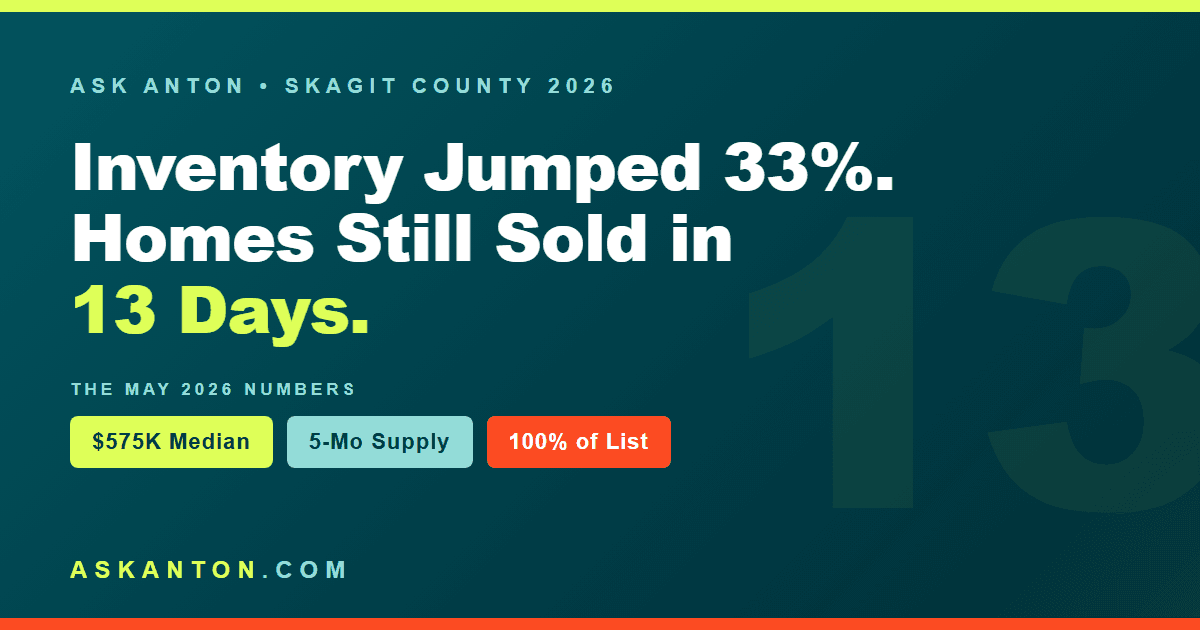
Skagit County has cooled from a seller's market into a genuinely balanced one. By the Northwest MLS, homes for sale reached 685 in May 2026, up about 33 percent year over year, and months of supply climbed to 5.0, inside the four to six month balanced range. That is the most choice buyers have had in years. But it is not a fire sale: the median home still sold in just 13 days at 100 percent of list price, so well priced homes still move fast. The deeper story is affordability. At the $575,000 median, the typical local household earns only about 59 percent of the income the median home requires, so demand leans on equity rich and out of area buyers. And this is really five markets in one county, from 445,000 dollar Burlington to 875,000 dollar Anacortes.
$575,000 Median sale price, up about 2% year over year | 685 Homes for sale, up about 33% year over year | 5.0 mo Months of supply, up from 3.6, now balanced | 13 days Median days on market; sold at 100% of list price |
01 · Prices
Prices have plateaued near their peak
The Northwest MLS median sale price was $575,000 in May 2026, up about 2 percent from a year earlier. Through the first five months of 2026 the monthly median bounced between about 531,000 and 575,000 dollars, so the county has effectively plateaued near its all time high after the steep run of 2020 through 2022. Price per square foot was about $345.
There is no single Skagit price, though, because Skagit is really five markets. Waterfront Anacortes on Fidalgo Island and the historic channel village of La Conner sit at the top, the county seat of Mount Vernon anchors the middle, and inland Sedro Woolley and the retail hub of Burlington offer the entry points.
Consumer portals such as Zillow and Redfin report different headline numbers because they use different windows and a small county sample, but the Northwest MLS county median is the ground truth: a typical single family home sits in the mid to high 500,000s, with the trend flat to gently softening off the peak.
02 · The Trend
Inventory has snapped back, and the market is balanced again
The biggest change in Skagit is supply. Homes for sale reached 685 in May 2026, up from 515 a year earlier, about 33 percent more inventory (NWMLS). New listings were up about 16 percent year to date while closed sales ran about 8 percent lower, so homes are accumulating. Months of supply has climbed to 5.0, squarely inside the balanced band.
Convention treats zero to three months as a seller's market, four to six as balanced, and six or more as a buyer's market, so Skagit has moved squarely into balanced territory for the first time since 2019. The counterweight, and the reason this is not a runaway buyer's market: the median home still sold in just 13 days at 100 percent of list price in May 2026. Translation: there is real room to negotiate on homes that have sat, and very little on the fresh, sharply priced listing everyone else also wants.
03 · The Long Game
Why Skagit prices cool but rarely crash
Step back from the monthly noise and the long run is unmistakable. The Northwest MLS median has roughly doubled over the past decade, and the federal FHFA home value index for Skagit County is up about 53 percent over 5 years and about 251 percent over 25 years (FHFA, 2025). Even the 2008 downturn was a modest dip that fully recovered within a few years.
The reason Skagit cools but rarely crashes is geography: the Cascades to the east, Puget Sound and protected farmland to the west, and a limited, expensive to build land base all cap new supply. Layer on steady in migration from higher cost King and Snohomish counties, where buyers trade a longer commute for dramatically more home per dollar, and you get a market with a structural floor under prices. The mid 2026 softening reads as a normalization off the 2021 to 2022 peak, not a structural decline.
04 · Affordability
The gap that defines the county
The most important structural fact in Skagit is that the typical local household cannot afford the typical local home on its own income.
Buying the $575,000 county median home needs roughly 150,000 dollars in income to stay inside a conservative 28 percent payment rule. The Skagit County median household income is 89,263 dollars (US Census, 2024). The median household earns only about 59 percent of what the median home requires.
That gap is why demand leans on dual income households, buyers arriving with equity from a King or Snohomish County sale, and relocating or remote workers earning a metro salary while paying Skagit prices. For local and first time buyers, the path usually runs through a lower price tier (Burlington and Sedro Woolley), a larger down payment, or a lender who can model what a rate buydown does to the monthly payment. The upside of today's more balanced, better supplied market is that this math finally gets a little easier.
05 · By City
Where to look, by budget and priority
Each Skagit city is a different trade between price, schools, safety and flood risk. The quick map.
| City | Median (mid 2026) | Character | Watch for |
|---|---|---|---|
| Burlington | about $445K | Retail hub, lowest entry point, first time buyers and commuters | High river flood exposure; retail area property crime |
| Sedro-Woolley | about $525K | Inland gateway, more affordable, fastest selling, safest of the larger towns | Schools below state; moderate upstream flood |
| Mount Vernon | about $580K | County seat, mid tier, workforce and families, wide internal range | River floodplain; school boundaries vary |
| La Conner | about $705K | Historic channel village, second homes and lifestyle buyers | Tiny, volatile market; tidal flood exposure |
| Anacortes | $740K to $875K | Fidalgo Island premium, waterfront and ferry, best schools and among the safest | Cooling fastest; coastal not river risk; premium pricing |
For a deep dive on the county seat, including neighborhood level detail and a first time buyer playbook, see the Mount Vernon (98273) buyer's guide.
06 · Flood Risk
The risk you cannot skip in Skagit
The Skagit River is the largest river by volume in Washington, and flooding is the defining environmental risk in the county. First Street data show about 25 percent of county properties, roughly 18,000 homes, at risk of severe flooding over the next 30 years.
In December 2025 the county ordered an evacuation of the entire 100 year floodplain, an estimated 75,000 people, as historic crests were forecast. The river ultimately crested near 30 feet, below the 2021 flood, so the realized event was moderate, but the threat is real and recurring. Read the forecast and the outcome separately, and underwrite the risk either way.
Buyer action: pull the FEMA flood map for the exact parcel, get a flood insurance quote during your contingency period (often 1,000 to 3,000 dollars a year in a Special Flood Hazard Area), and price it into your monthly. Exposure varies sharply by city: river valley Mount Vernon and Burlington carry the most, Anacortes faces coastal rather than river risk, and higher ground neighborhoods sit outside the main zone.
Two secondary risks: wildfire is low in the wet western lowlands but higher in the eastern, upriver forested zones near Concrete and the North Cascades; and like all of western Washington, the county sits in the Cascadia earthquake zone, with delta soils under Mount Vernon and Burlington prone to liquefaction, so any pre 1994 home warrants a look at foundation bolting.
07 · Schools
Quality varies more by city than buyers expect
School quality is the county's biggest hidden differentiator. Anacortes School District is the standout, the only Skagit district clearly above the Washington state average in both math, about 58 percent, and reading, about 64 percent, ranked 26th of 247 districts statewide (SchoolDigger, 2024). It is a genuine draw, and part of why Anacortes commands a premium.
The larger river valley districts trail the state. Mount Vernon and Sedro Woolley both test below the Washington average and sit in the bottom half of districts statewide, and Concrete is the weakest in the county. La Conner posts the highest graduation rate at about 90 percent on a tiny enrollment, and Conway is a strong small K through 8 option. Because outcomes vary by individual school and the property line sets the attendance boundary, families should research the specific boundary for any home rather than rely on the district average. Private options include Mount Vernon Christian and Immaculate Conception Regional. (School proficiency figures trace to the 2022 to 2023 state cycle and should be checked against the current OSPI report card.)
08 · Safety
Safe from people, watch the property crime
The county's safety profile is lopsided. Violent crime runs about 44 percent below the national average, but property crime runs about 57 percent above it, with larceny near double the national rate (FBI data, 2019 to 2024). That split is what drags the overall county grade down even though the area is comparatively safe from violence.
By city, Sedro Woolley is the safest of the larger towns with a strong multi year downward trend, and Anacortes ranks well nationally. Mount Vernon has the highest absolute counts as the largest city, and Burlington shows the highest per capita rate, though that is heavily a retail theft effect inflated by a small resident base against heavy daytime shopper traffic. Within Mount Vernon, the east side higher ground neighborhoods are both safer than the city average and outside the main flood zone.
09 · Jobs, Commute and Who Lives Here
The economy behind the housing demand
Skagit's economy is more diversified than its farm county image suggests. The largest employers are Skagit Regional Health and the aerospace composites maker Janicki Industries, followed by the school districts, Skagit Valley College, county government, Island Hospital, two oil refineries (HF Sinclair and Marathon), and food processors. Manufacturing is unusually strong for the county's size. Unemployment was 5.0 percent in May 2026, modestly above the state's 4.8 percent (Washington ESD, 2026).
The commute is the defining constraint and the defining opportunity. Mount Vernon to Seattle runs 75 to 90 minutes at peak, about 62 to 65 miles, so the county works best for remote and hybrid workers rather than daily King County commuters. Amtrak Cascades stops at Skagit Station and Skagit Transit runs County Connector buses to Everett and Bellingham, but only about 12 percent of local workers are fully remote, so proximity to Interstate 5 and the train carries real value. The county skews older (median age about 42, with roughly 22 percent of residents 65 or older) and the homeownership rate is 70 percent, both pointing to steady move up and downsizer demand alongside the imported Seattle metro buyer pool that has driven the last five years of growth.
10 · Where You Stand
The buyer and seller playbook for right now
If you are buying
- Use your leverage on the right homes. With inventory up about 33 percent and supply now balanced, target listings that have sat 30 plus days and ask for price, closing cost credits, or a seller paid rate buydown. Expect little movement on fresh, sharply priced homes that still sell in about two weeks.
- Pull the FEMA flood map for every parcel and get a flood quote in your contingency window. This is the number one due diligence item in the county.
- Match the city to your priorities. Burlington and Sedro Woolley for value, Anacortes for schools and safety at a premium, Mount Vernon for the widest selection. Research the exact school boundary if children are in the picture.
- Get fully underwritten so you can move fast on the well priced homes that still go quickly.
If you are selling
- Price to fresh closed comps, not last year. With more inventory and a balanced market, an aspirational price now accumulates days that signal a problem and then forces a cut that nets below market. Homes priced right still sold at 100 percent of list in about 13 days.
- Present at a professional level. Move in ready, staged, and well photographed homes are the ones still selling quickly. Pre inspect to control the repair narrative.
- Know your submarket. The premium Anacortes tier is correcting fastest, while lower priced inland homes are holding better. Set expectations to your city, not the county headline.
- Lean on the equity buyer. Out of area and move up buyers arriving with cash from a King or Snohomish sale remain the most active and least rate sensitive pool.
Questions Skagit County buyers and sellers are asking
Skagit County real estate FAQ
Is Skagit County a buyer's or seller's market in 2026?
It has moved into balanced territory. By the Northwest MLS, homes for sale reached 685 in May 2026, up about 33 percent year over year, and months of supply rose to 5.0, squarely inside the four to six month range that defines a balanced market (up from 3.6 a year earlier). That is real, measurable improvement in buyer choice. The catch is that pricing power has not collapsed: the median home still sold in just 13 days at 100 percent of list price in May 2026. So buyers have more options and more time, but they are not getting deep discounts on the well priced, move in ready homes that still move fast. Sellers who price to fresh comps are still doing fine.
What is the average home price in Skagit County?
The Northwest MLS median sale price was $575,000 in May 2026, up about 2 percent year over year. Across the first five months of 2026 the monthly median ranged from about 531,000 dollars to 575,000 dollars, so a fair working number for a typical county home is the mid 500,000s. Price per square foot was about $345 in May 2026. Prices vary widely by city, from a median near 445,000 dollars in Burlington to 740,000 to 875,000 dollars in waterfront Anacortes.
Which Skagit County city is most affordable, and which is most expensive?
Burlington is the most affordable at a median near 445,000 dollars, followed by Sedro-Woolley near 525,000 dollars, both below the county median (Redfin, 2026). Anacortes on Fidalgo Island is the most expensive at 740,000 to 875,000 dollars, with La Conner close behind near 705,000 dollars, both driven by waterfront and lifestyle demand. Mount Vernon, the county seat, sits in the middle near 580,000 dollars.
How much income do I need to buy a home in Skagit County?
More than the typical local household earns. Buying the $575,000 county median home with 20 percent down at about 6.5 percent, plus Skagit property taxes and insurance, requires roughly 150,000 dollars in annual income to stay inside a conservative 28 percent payment ceiling. The Skagit County median household income is about 89,263 dollars (US Census, 2024). That gap, around 61,000 dollars, means the median household earns only about 59 percent of what the median home requires, and it is the defining structural feature of this market.
Does Skagit County flood, and will I need flood insurance?
Flood risk is the most important thing to check here. The Skagit River is the largest river by volume in Washington, and First Street data show about 25 percent of county properties, roughly 18,000 homes, at risk of severe flooding over the next 30 years. In December 2025 the county ordered a 75,000 person evacuation of the entire 100 year floodplain, though the river ultimately crested near 30 feet, below the 2021 flood. Properties in a FEMA Special Flood Hazard Area with a federal mortgage must carry flood insurance, often 1,000 to 3,000 dollars a year. Exposure varies by city: river valley towns like Mount Vernon and Burlington carry the most, Anacortes faces coastal rather than river risk, and higher ground neighborhoods sit outside the main zone. Always pull the FEMA map for the specific parcel.
Which Skagit County schools are the best?
Anacortes School District is the clear standout and the only Skagit district above the Washington state average in both math, about 58 percent, and reading, about 64 percent, ranked 26th of 247 districts (SchoolDigger, 2024). Conway is a strong small K through 8 option. The larger river valley districts, including Mount Vernon and Sedro-Woolley, test below the state average, and Concrete is the weakest. Because outcomes vary by individual school and attendance boundary, families should research the specific boundary for any home. Private options include Mount Vernon Christian and Immaculate Conception Regional.
What is the commute from Skagit County to Seattle?
Plan for 75 to 90 minutes each way at peak from Mount Vernon, about 62 to 65 miles down Interstate 5 (WSDOT based estimate, 2026). That makes Skagit best for remote and hybrid workers who head south one to three days a week rather than five. Amtrak Cascades stops at Skagit Station in downtown Mount Vernon, and Skagit Transit runs County Connector buses to Everett and Bellingham. The average commute entirely within the county is only about 27 minutes (Census, 2024), so a Skagit based job is a very different life than a King County one.
Will Skagit County home values hold up?
The long run trend is strongly positive even though the market has cooled to balanced. The federal FHFA index shows Skagit County home values up about 53 percent over 5 years and about 251 percent over 25 years (FHFA, 2025), and the Northwest MLS median has roughly doubled in a decade. Geography is the reason values rarely crash here: the Cascades, Puget Sound, and protected farmland cap how much new supply can be built, and continued in migration from King and Snohomish counties supports demand. Even the 2008 downturn was a modest dip that fully recovered within a few years. The mid 2026 softening looks like a normalization off the 2021 to 2022 peak, not a structural decline.
Written by Anton Stetner, Real Estate Solutions Group (RESG), Washington license number 24133. County market figures (median price, inventory, months of supply, days on market, percent of list) are from the Northwest Multiple Listing Service county dataset through May 2026 and supersede third party estimates. Additional context is attributed inline to the FHFA House Price Index, the US Census Bureau and DataUSA (ACS 2024), the Washington Employment Security Department, SchoolDigger, Niche and OSPI, the FBI and CrimeGrade, First Street Foundation, FEMA, Redfin and Zillow (city level), with windows and sources labeled where they apply. Figures are deemed reliable but not guaranteed and are provided for informational purposes only. This is not financial, legal, or tax advice. Always verify flood zone, school boundary, taxes, and HOA status for the specific property.