PSE Wants Your Electric Bill Up 17.75%. Who's Actually Paying for the Grid?
What Puget Sound Energy asked households to pay, how its rates compare with local public utilities, and who could pay for the grid upgrades that serve data centers.
Choose Play to load YouTube after Functional consent or permission for this video. YouTube may receive your IP address, browser information and playback activity and may use cookies or similar storage. Google’s Privacy Policy · Cookie information.
Run the numbers on your property
Buying a home, evaluating a rental or planning a build? Start with the city and the decision you’re weighing. The digital assistant can help you work out what to check.
You’re chatting with our digital assistant. Responses can make mistakes. Chat sessions are recorded. Verify important information before acting. About using Ask Anton By sending a message, you agree to our Terms of Use, including arbitration and use of your submissions in content, and acknowledge our Privacy Policy.
Chapters
Chapter links open the published video on YouTube at the selected time.
Figures and case status are as of November 19, 2026. The deck is shown in its original order. Updates to the Tacoma rates and PSE comment period appear beside the relevant slides.
What PSE is asking households to pay
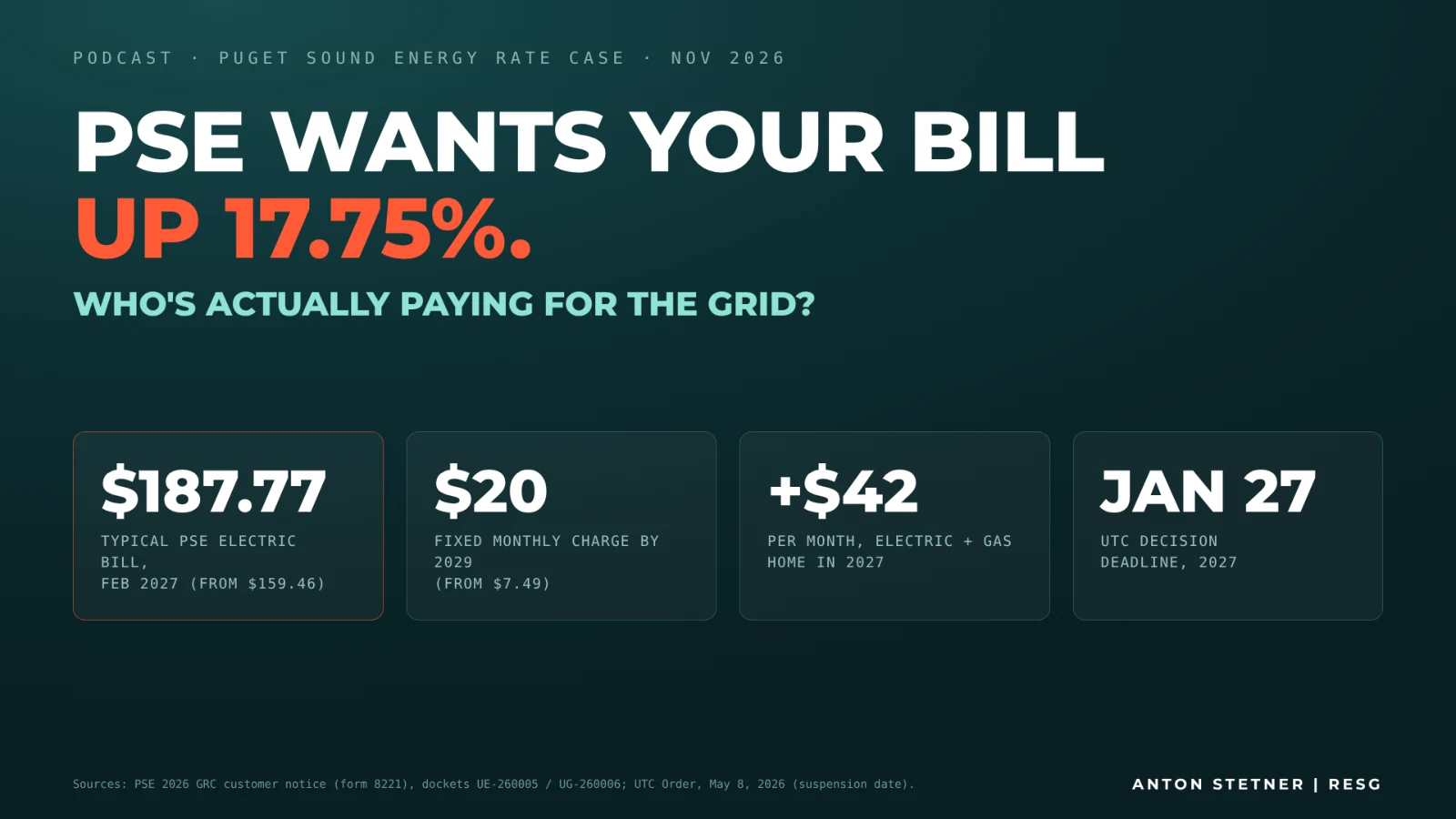
Puget Sound Energy filed a three-year electric and natural gas rate plan on February 27, 2026. The headline 17.75% is the increase in PSE’s filing-time example for a household using 800 kWh per month. Its residential tariff schedule shows an average 16.75% increase for 2027, and the systemwide electric revenue request is about 15.2%. Each figure measures a different thing.
PSE’s monthly bill examples, as filed
Usage stays constant
At filing
Feb. 2027
Feb. 2028*
Feb. 2029*
Electric bill at 800 kWh
$159.46
$187.77
$194.35
$210.04
Electric basic charge, included above
$7.49
$12.50
$15.00
$20.00
Gas bill at 64 therms
$105.37
$119.00
$122.78
$127.33
Combined monthly bill
$264.83
$306.77
$317.13
$337.37
Combined annual increase from filing baseline
—
$503.28
$627.60
$870.48
* PSE describes 2028 and 2029 as illustrative estimates. Annual differences multiply the monthly difference by 12.
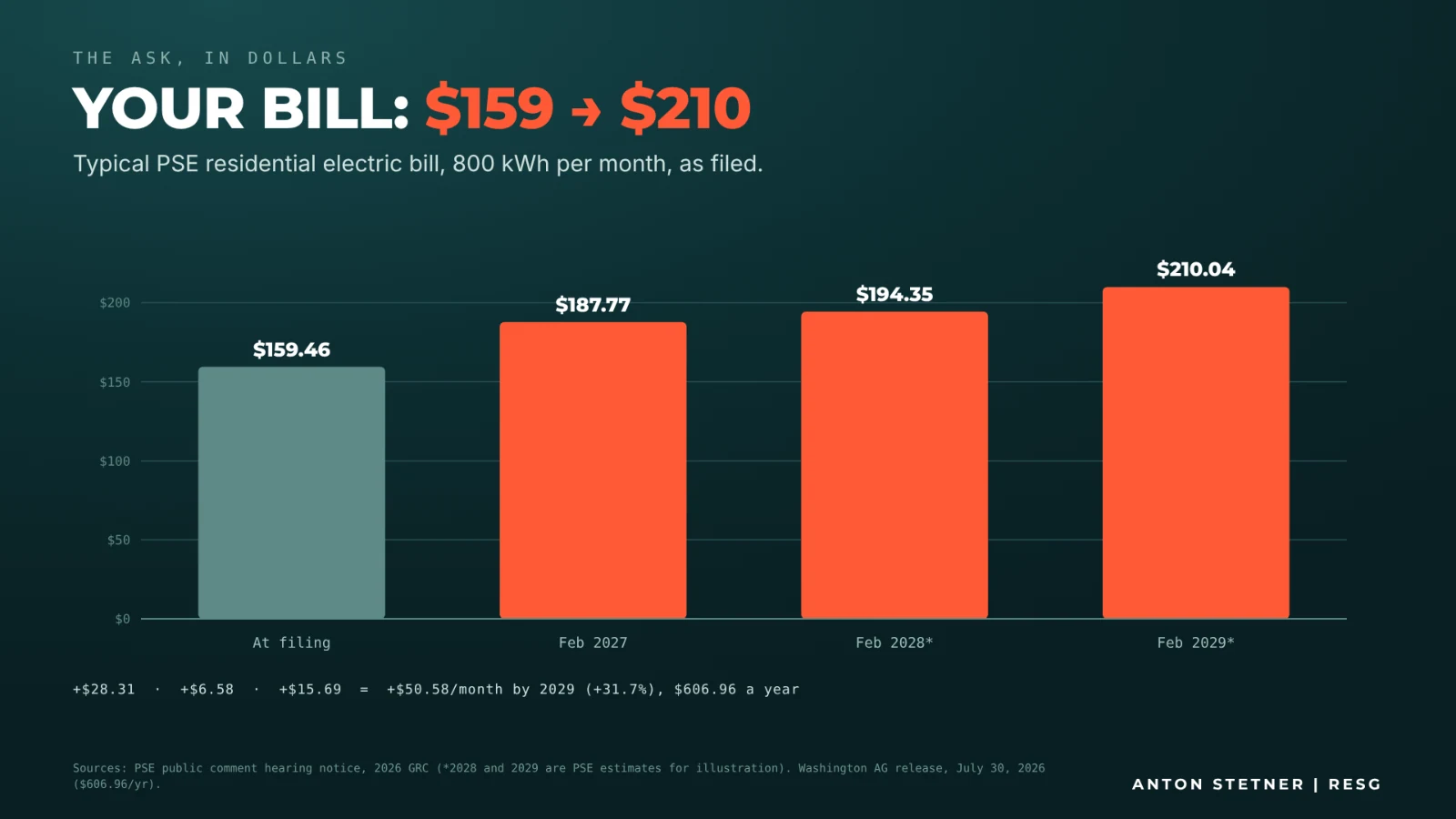
The filing example moves from $159.46 to $187.77 per month in 2027. The Washington Utilities and Transportation Commission (UTC) plans a January 27, 2027 decision. The figures are PSE’s requested amounts.
PSE’s example adds $28.31 in 2027, $6.58 in 2028, and $15.69 in 2029. At the end of the plan the example is $50.58 more per month than at filing. PSE labels the last two years illustrative.
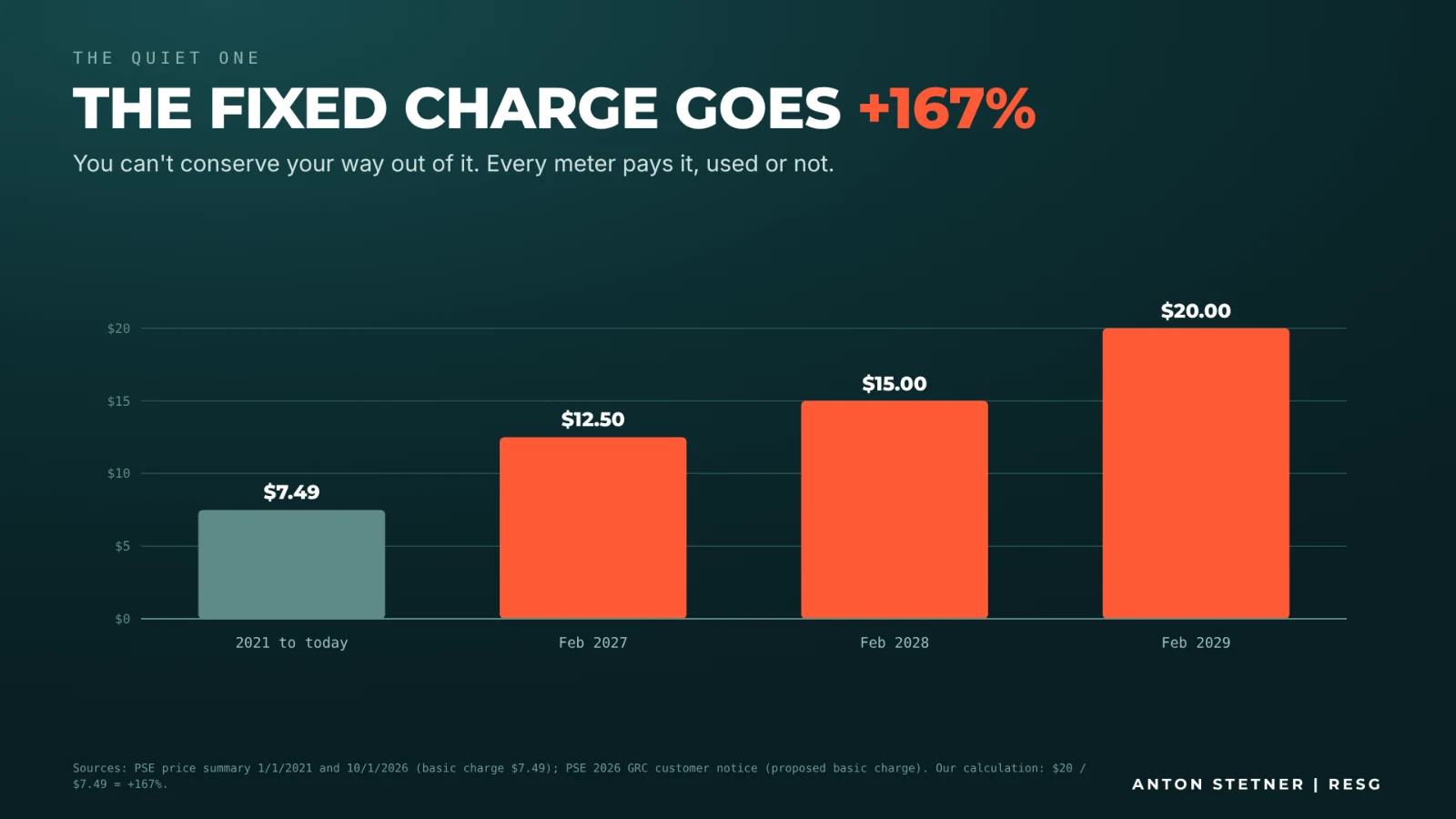
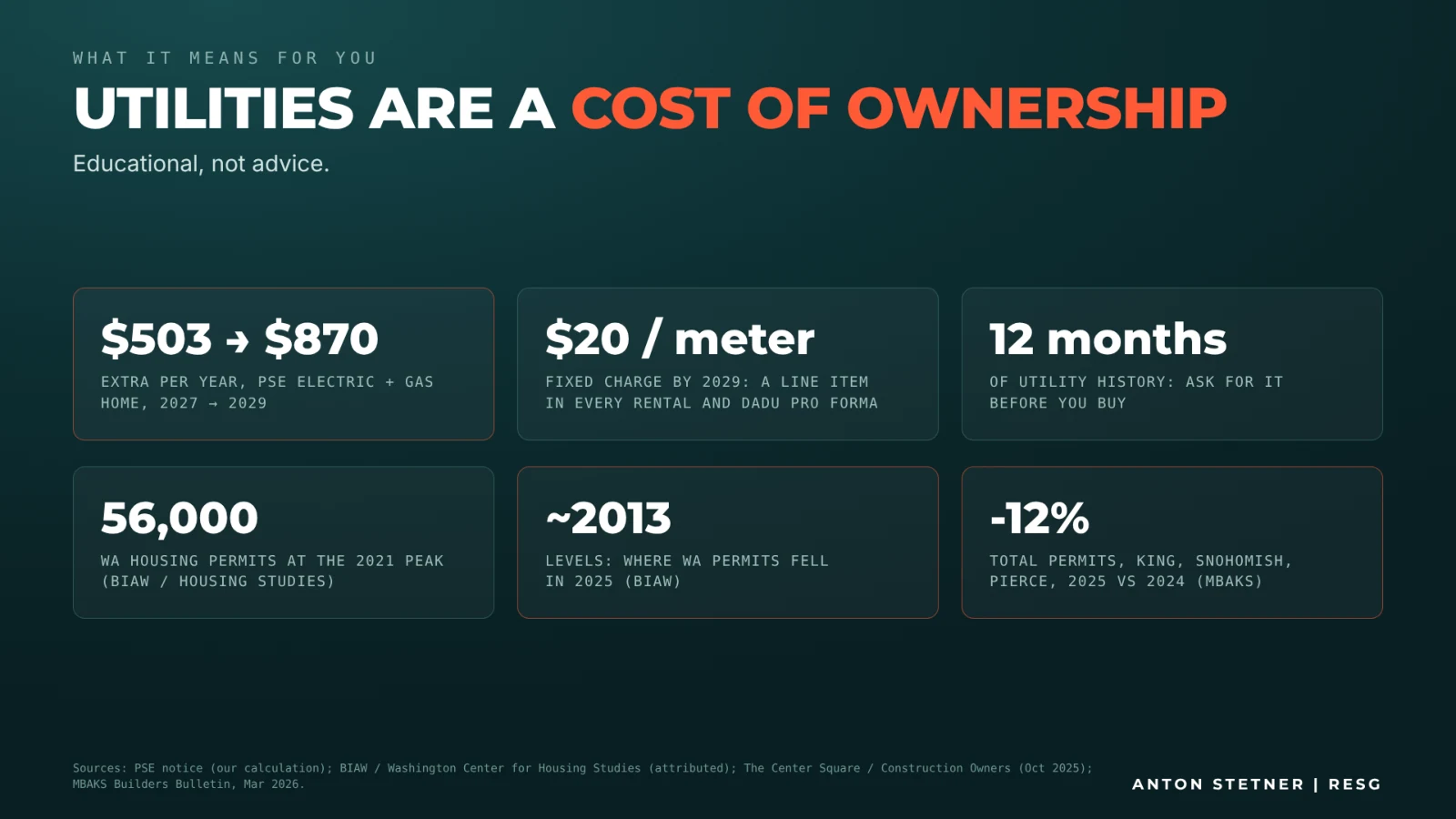
The electric basic charge would move from $7.49 to $12.50, $15.00, then $20.00. It is already included in the example totals. Lower usage can reduce energy charges while the basic charge still applies.
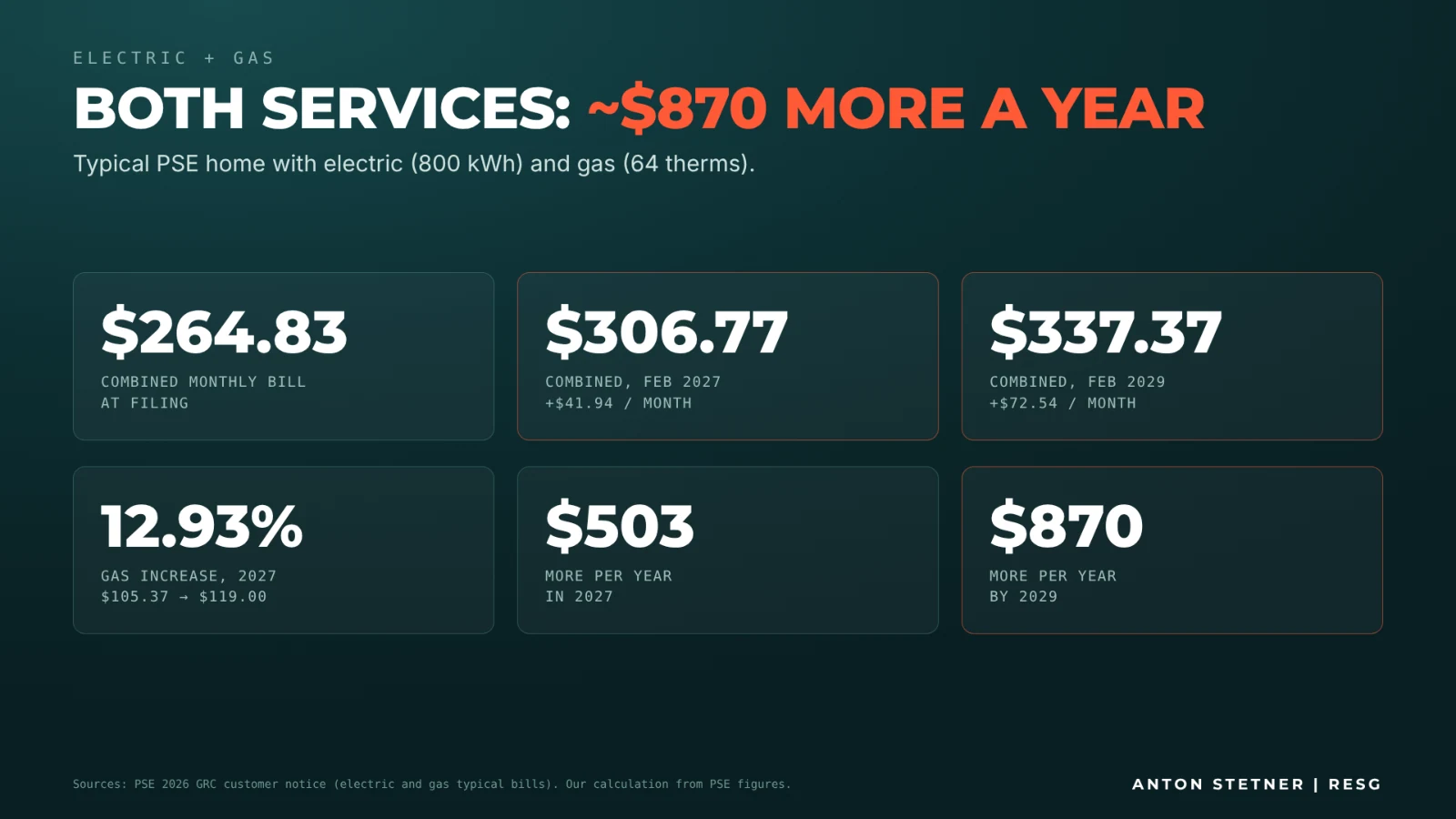
At 800 kWh and 64 therms monthly, the filing examples total $264.83 at baseline, $306.77 in 2027, and $337.37 in 2029. Holding those usage assumptions constant, that works out to about $503 and $870 more per year, respectively.
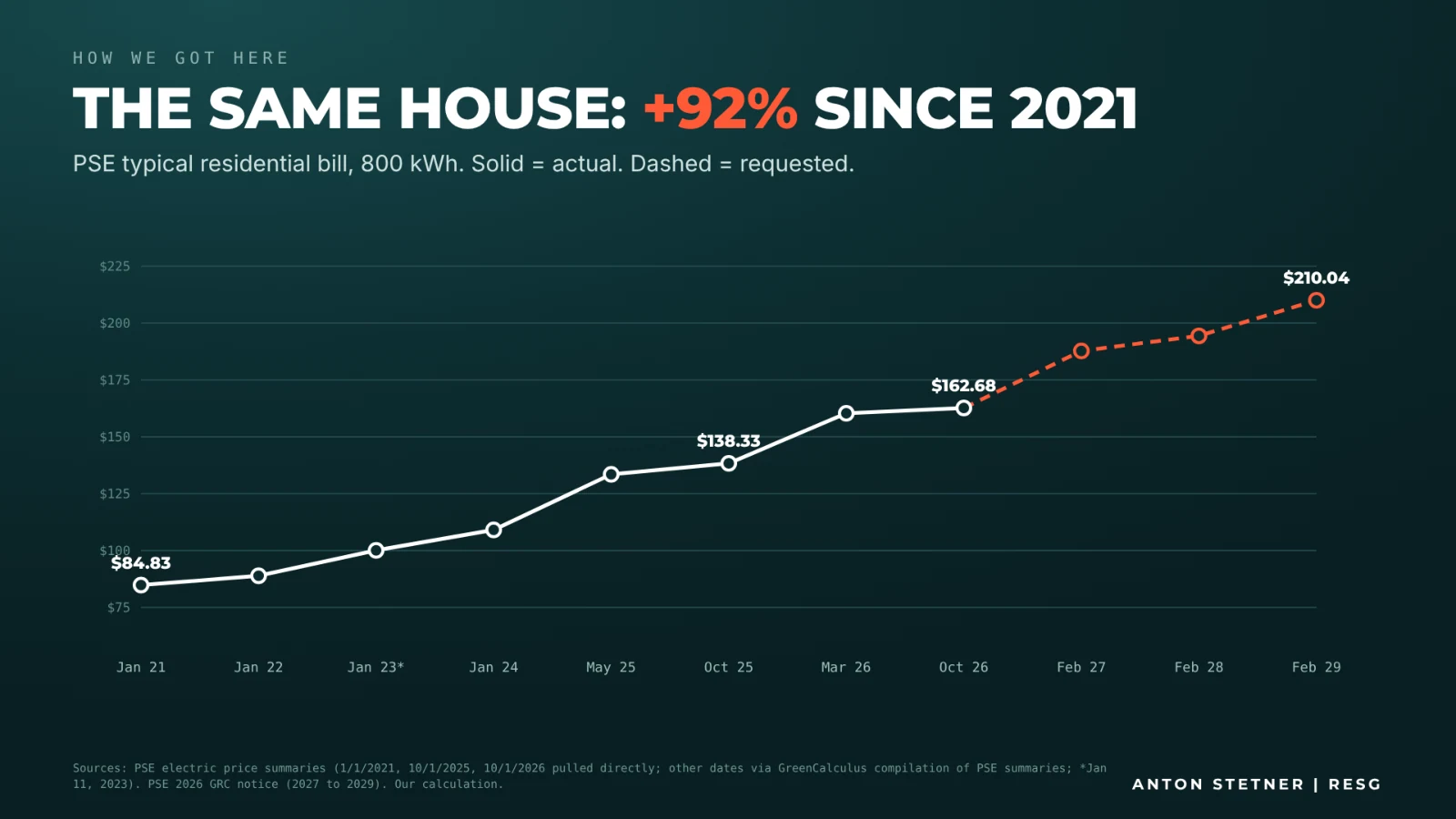
PSE’s published price summaries put the same 800 kWh electric example at $84.83 in January 2021, $138.33 in October 2025, and $162.68 in October 2026 before city tax. That latest tariff example is a different baseline from the $159.46 shown in the rate-case notice.
Slide 5 of 37
The same usage cost about 92% more
Dividing the October 2026 bill by the January 2021 bill gives an increase of 91.8%. The proposed $210.04 example for 2029 is about 2.48 times the January 2021 amount.
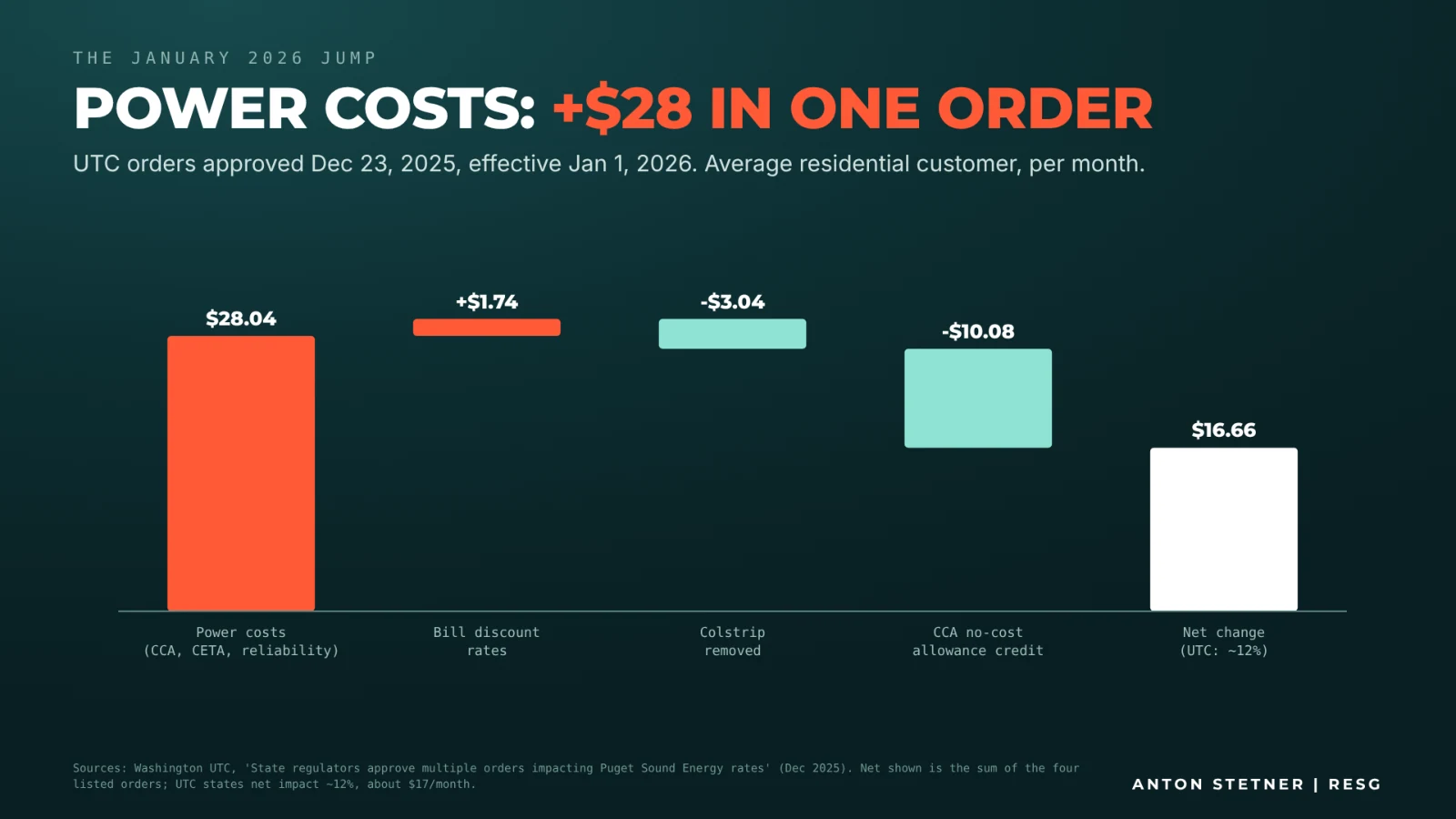
A power-cost order added about $28.04 per month for the UTC’s example customer. Other orders added about $1.74 for the discount program and subtracted about $3.04 for Colstrip and $10.08 for the allowance credit. The combined change was about $16.66.
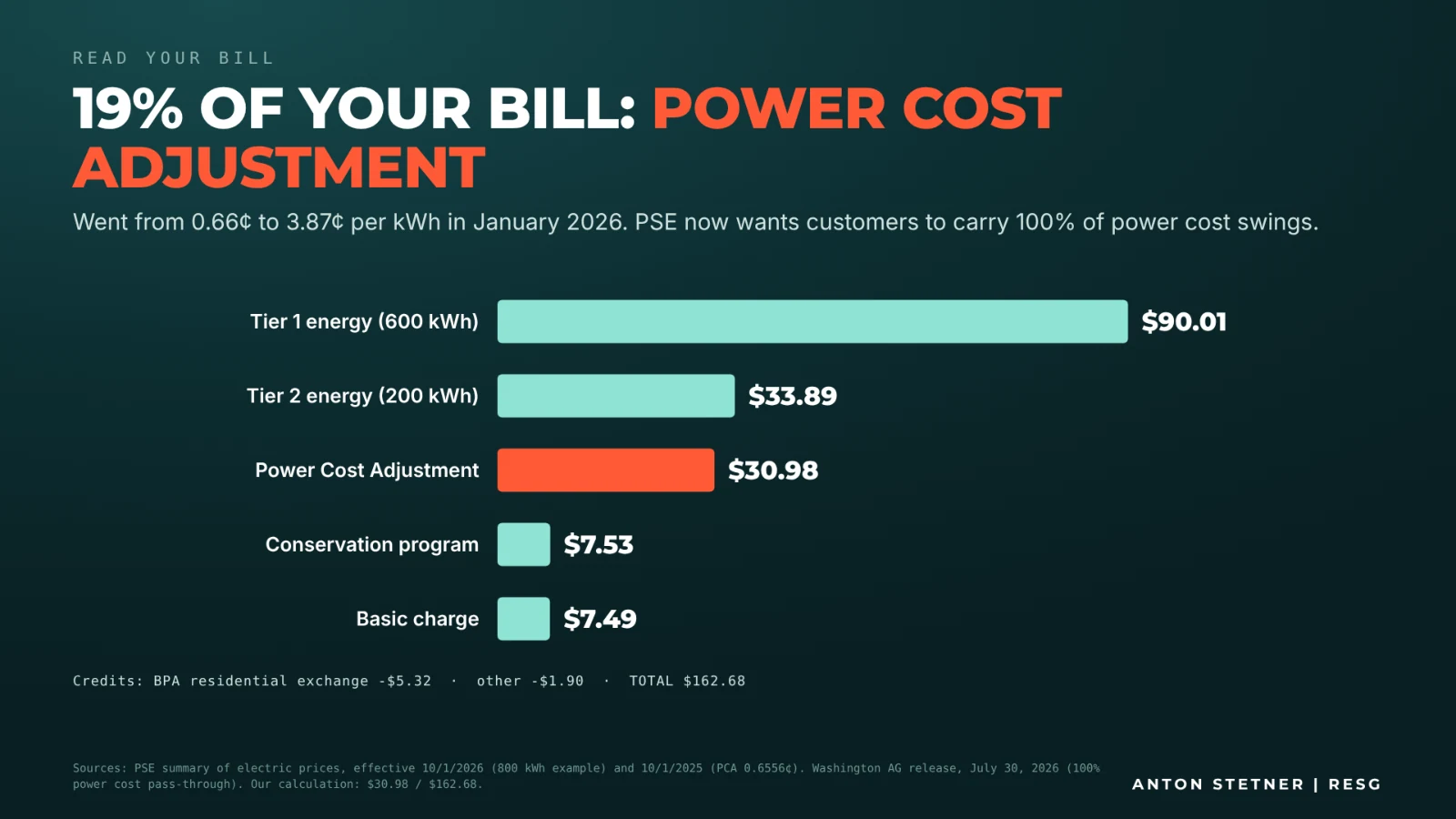
At 800 kWh, about 3.872¢ per kWh in Schedule 95 charges works out to $30.98, or 19% of the October 2026 bill example. Public Counsel argues PSE’s new proposal would shift more power-cost risk to customers.
The Clean Energy Transformation Act sets electricity supply standards. The Climate Commitment Act caps covered emissions and uses an allowance market. The episode asks how those policies affect bills and what the state can show for its auction spending.
Slide 8 of 37
Carbon allowances and prices at the pump
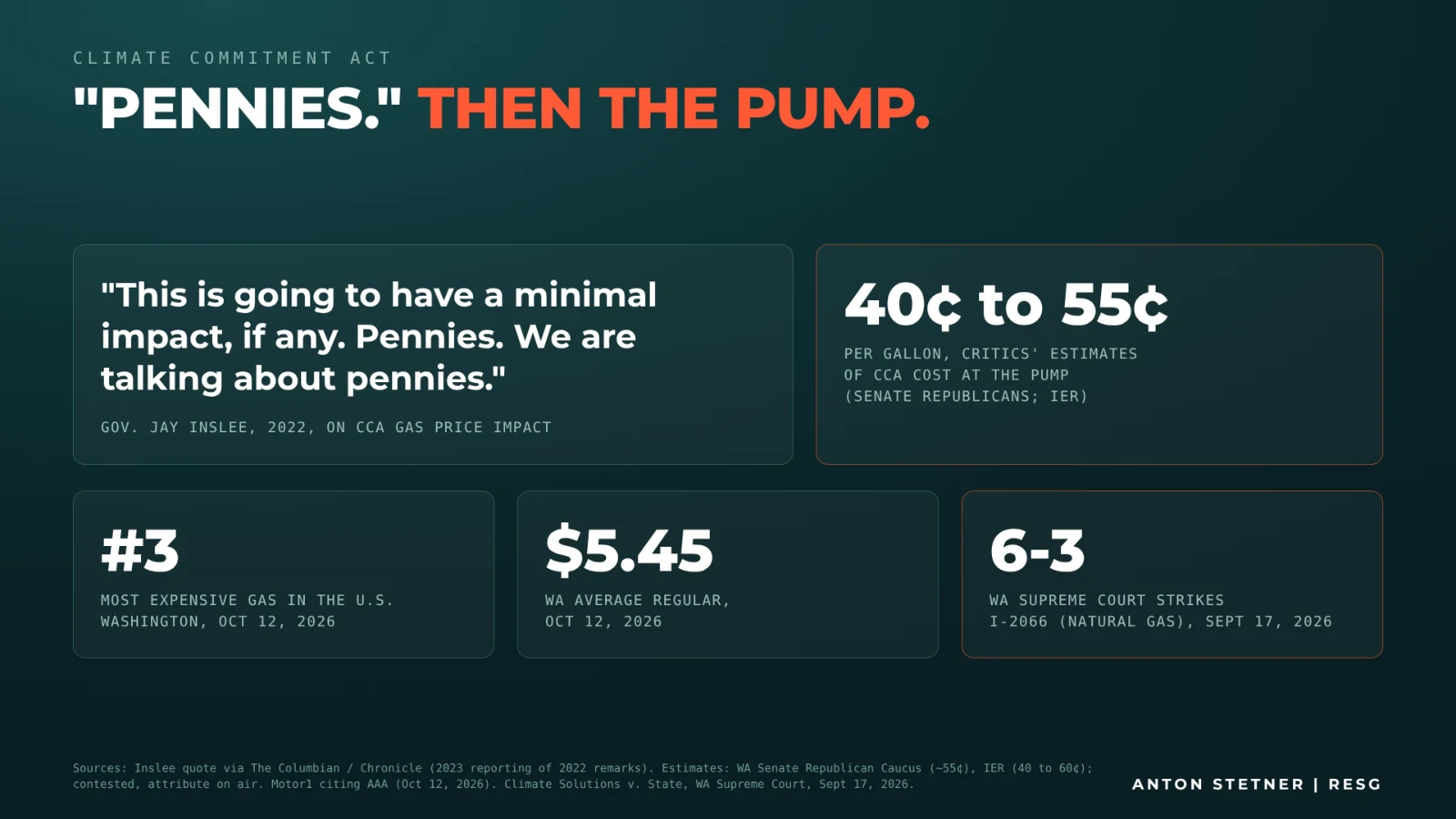
Former Governor Jay Inslee predicted a minimal impact. Critics estimated roughly 40¢ to 55¢ per gallon, depending on allowance costs and how much sellers pass through. The $5.45 on the slide is Washington’s average regular gasoline price on October 12, 2026, as reported by Motor1 from AAA data. Utility bills can also include credits tied to no-cost allowances.
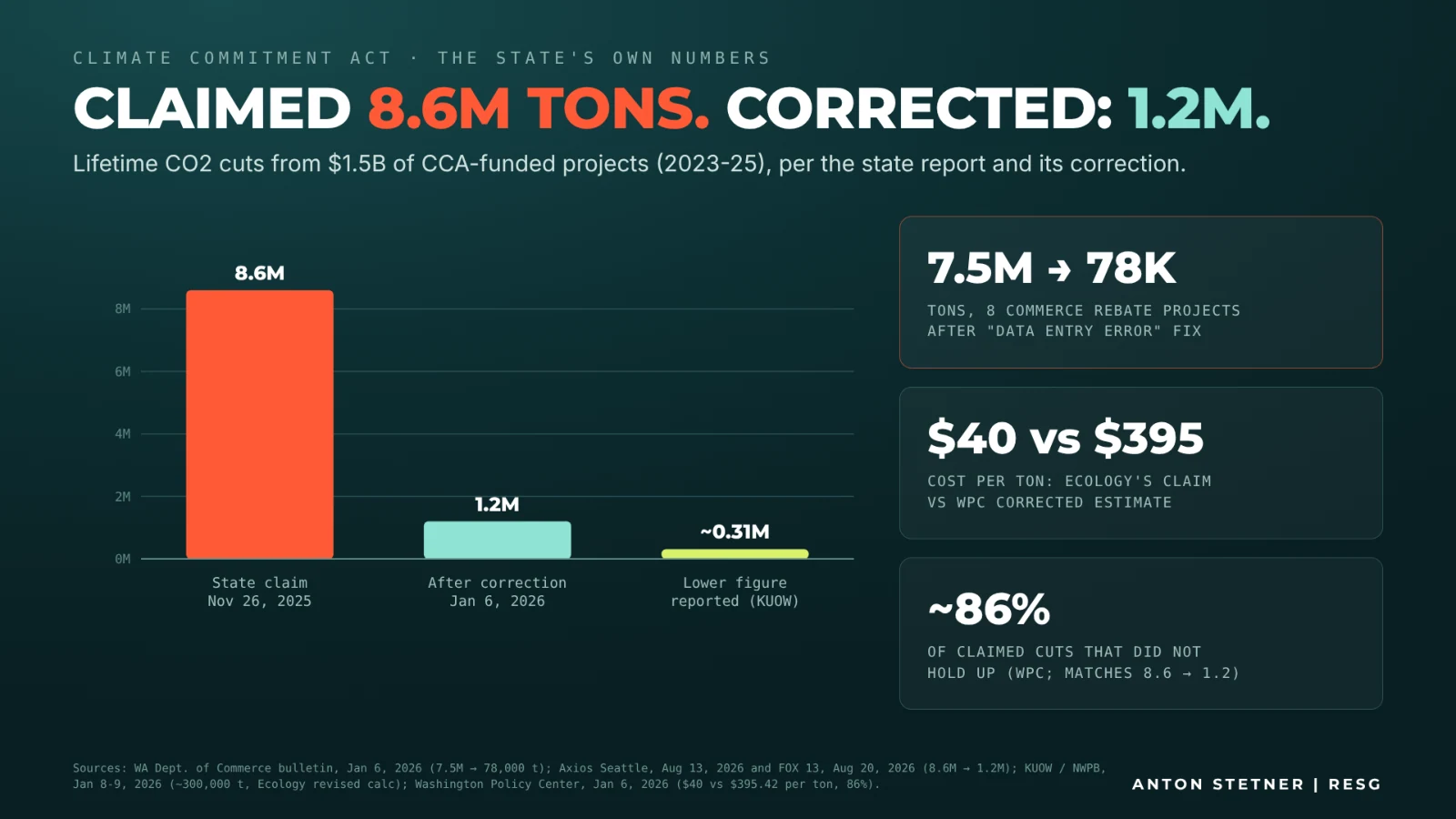
The original report projected roughly 8.6 million metric tons of lifetime reductions. Ecology’s March 2026 update reported approximately 1.2 million expected lifetime tons, about 86% below the original estimate. The roughly 308,000 tons on the slide covers Commerce’s projects only. The 26% in Ecology’s update refers to dollars spent on projects expected to reduce emissions, with other investments serving purposes such as resilience or assistance.
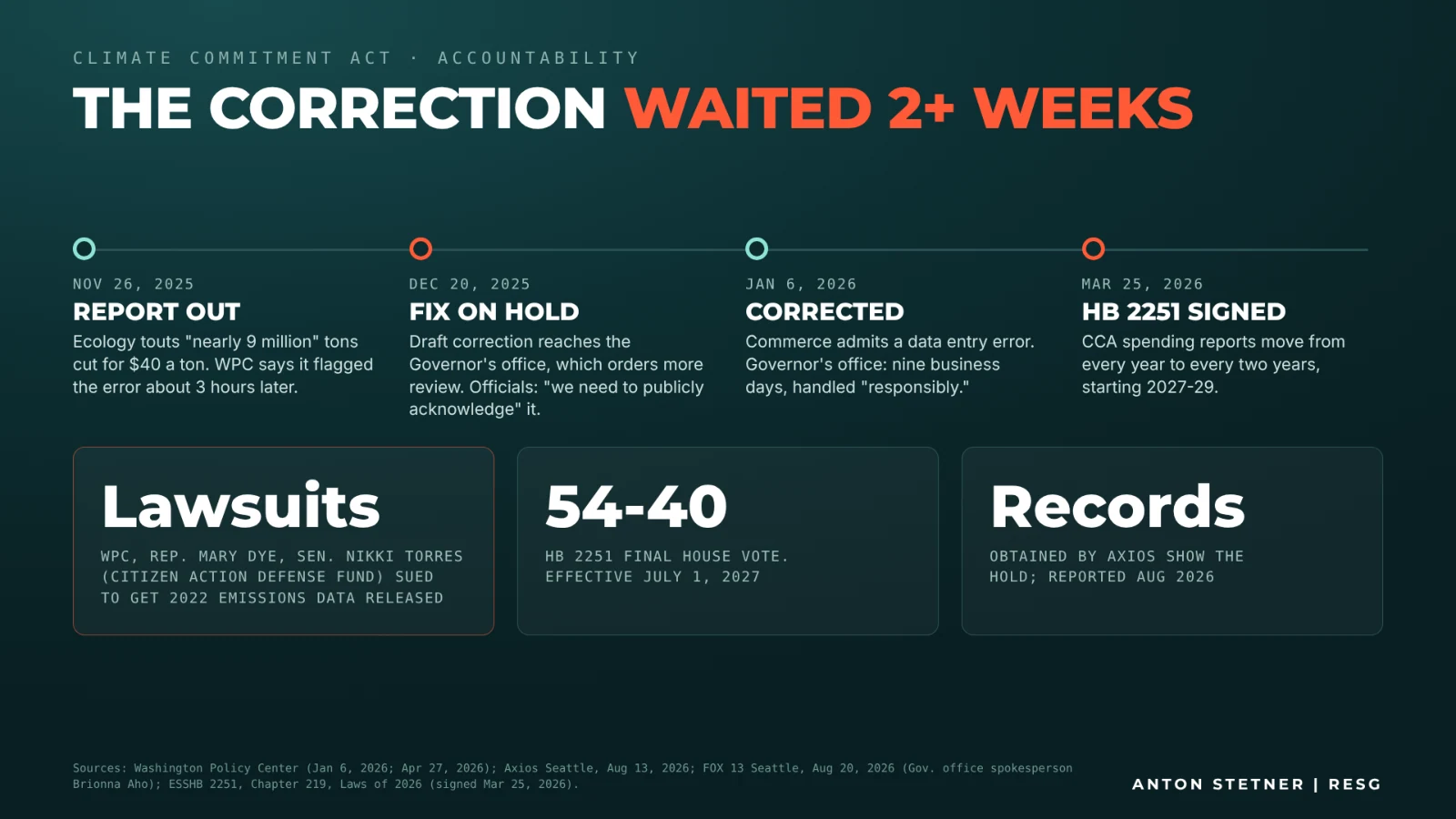
Public records reported by Axios and Washington Policy Center describe a gap between Ecology’s December request to issue a correction and its release January 6. House Bill 2251 subsequently became Chapter 219, Laws of 2026, restructuring CCA accounts. Read the enacted text for the final reporting requirements and Washington Policy Center for its critique of the bill and records delays.
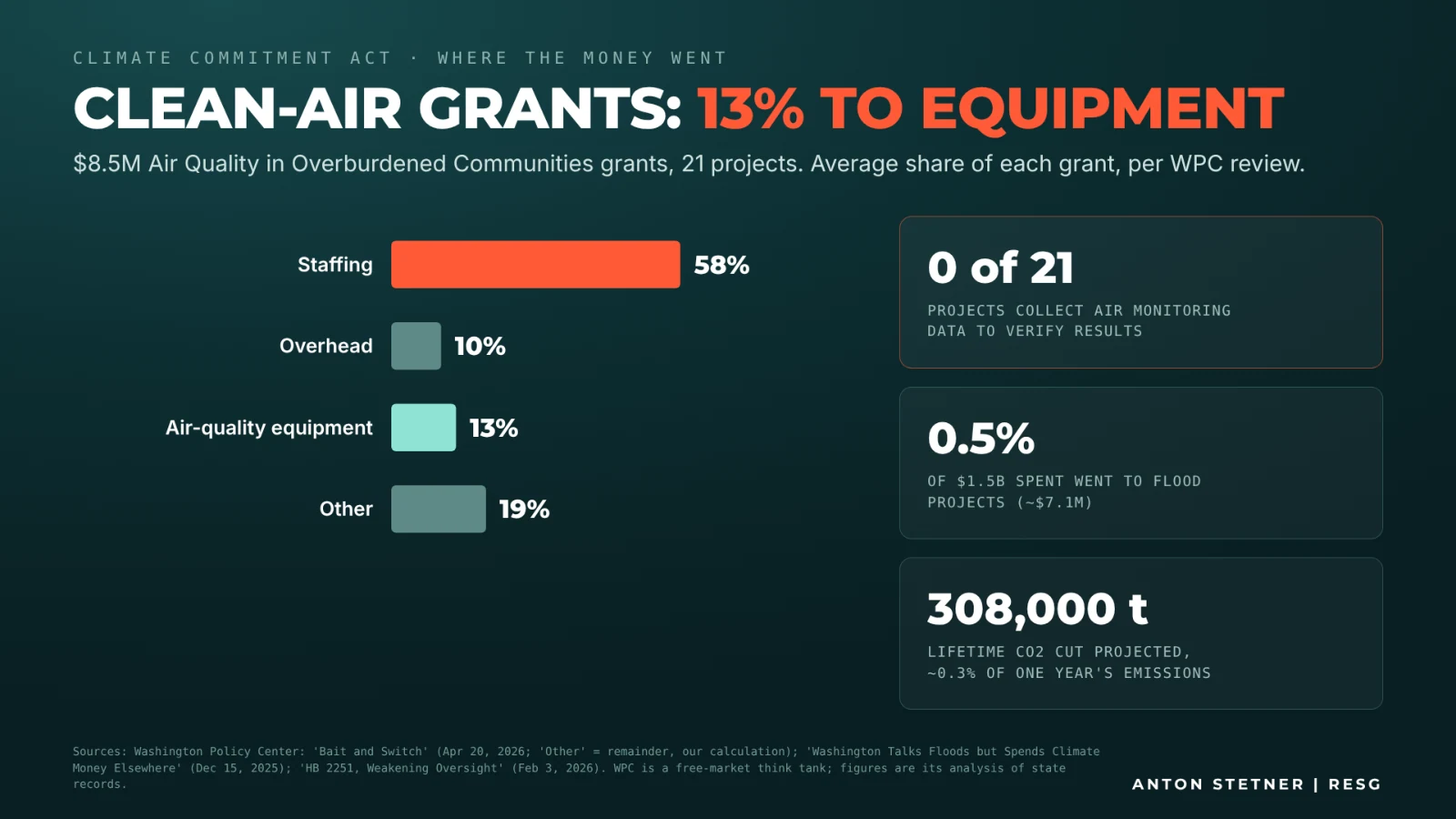
Washington Policy Center reviewed 21 grants totaling $8.5 million. It reported an average of 13% per grant for air-quality equipment and said the reviewed projects lacked air-monitoring data to verify results. The slide also cites the center’s flood-spending analysis, which uses a broader set of CCA investments.
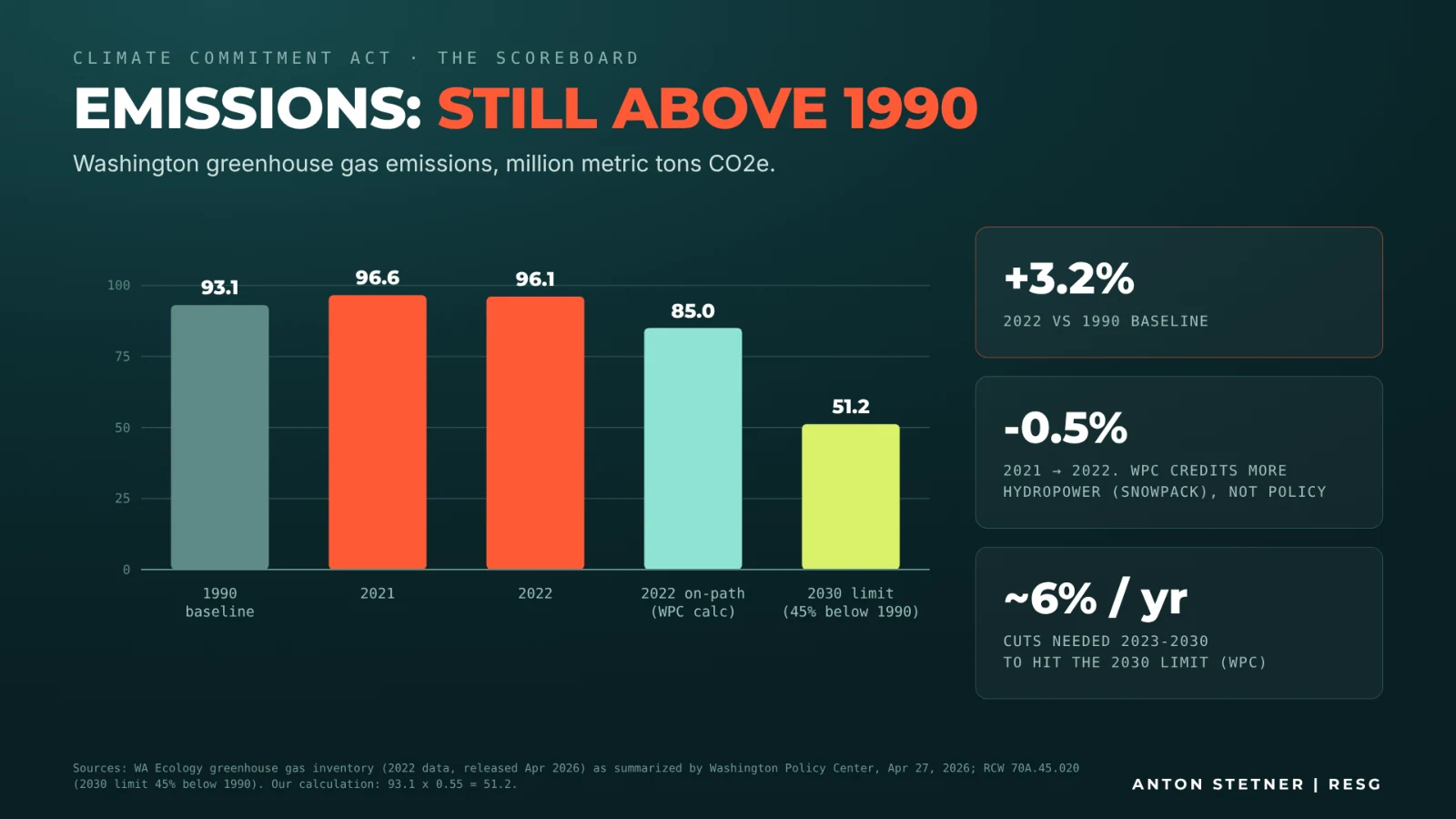
The deck compares statewide emissions of 96.1 million metric tons in 2022 with a 93.1 million-ton 1990 baseline and a 51.2 million-ton 2030 target. This statewide inventory uses a different denominator from the investment report’s estimates of project-level lifetime reductions.
Puget Sound Energy is the regulated operating utility. Its ultimate parent, Puget Holdings, is owned by a consortium of infrastructure and pension investors. The utility and its holding company report different earnings.
Slide 13 of 37
The ownership group
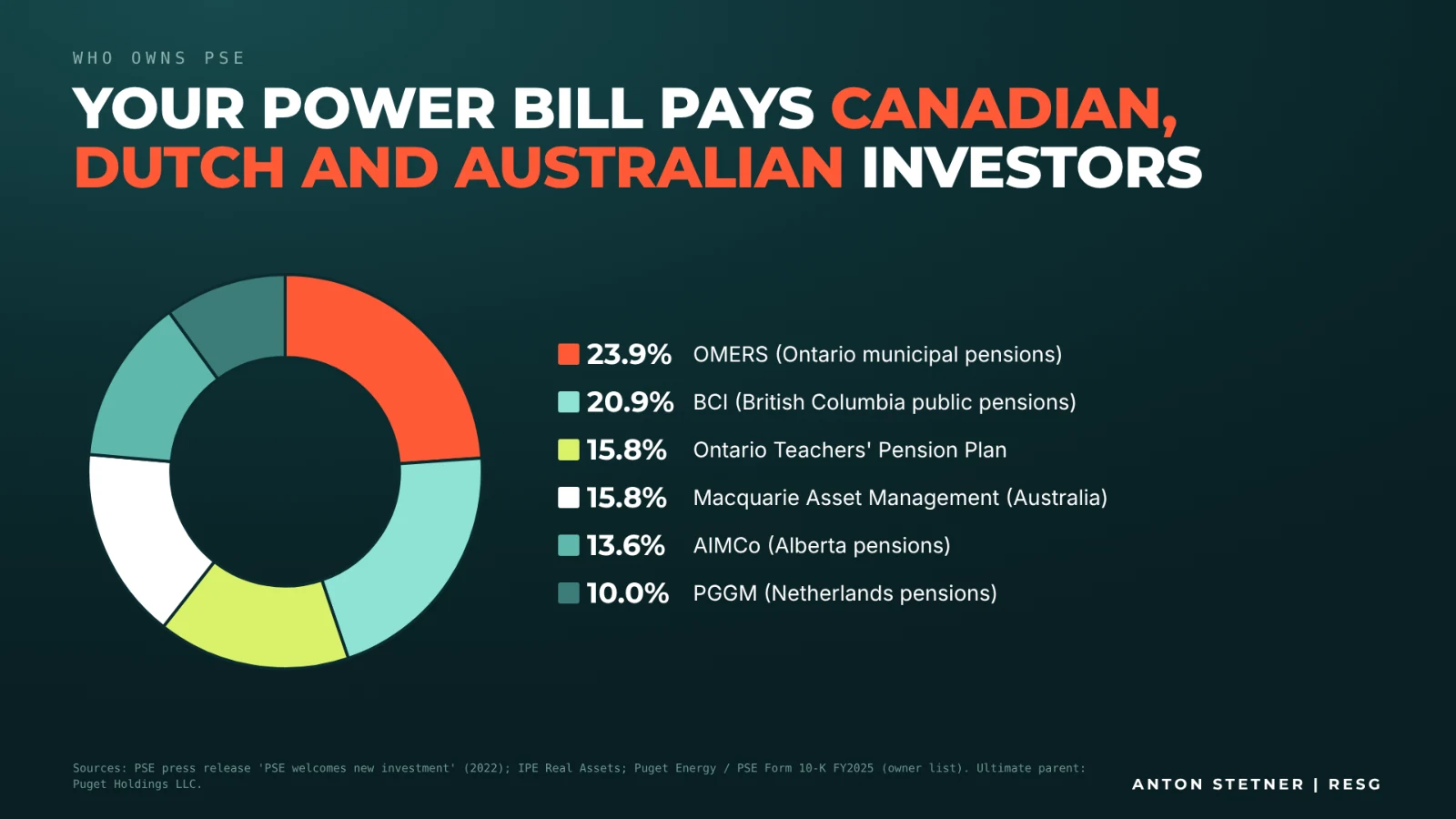
Reported stakes at Puget Holdings are OMERS 23.9%, BCI 20.9%, Ontario Teachers’ 15.8%, Macquarie 15.8%, AIMCo 13.6%, and PGGM 10.0%. PSE’s annual filing identifies the same ownership group.
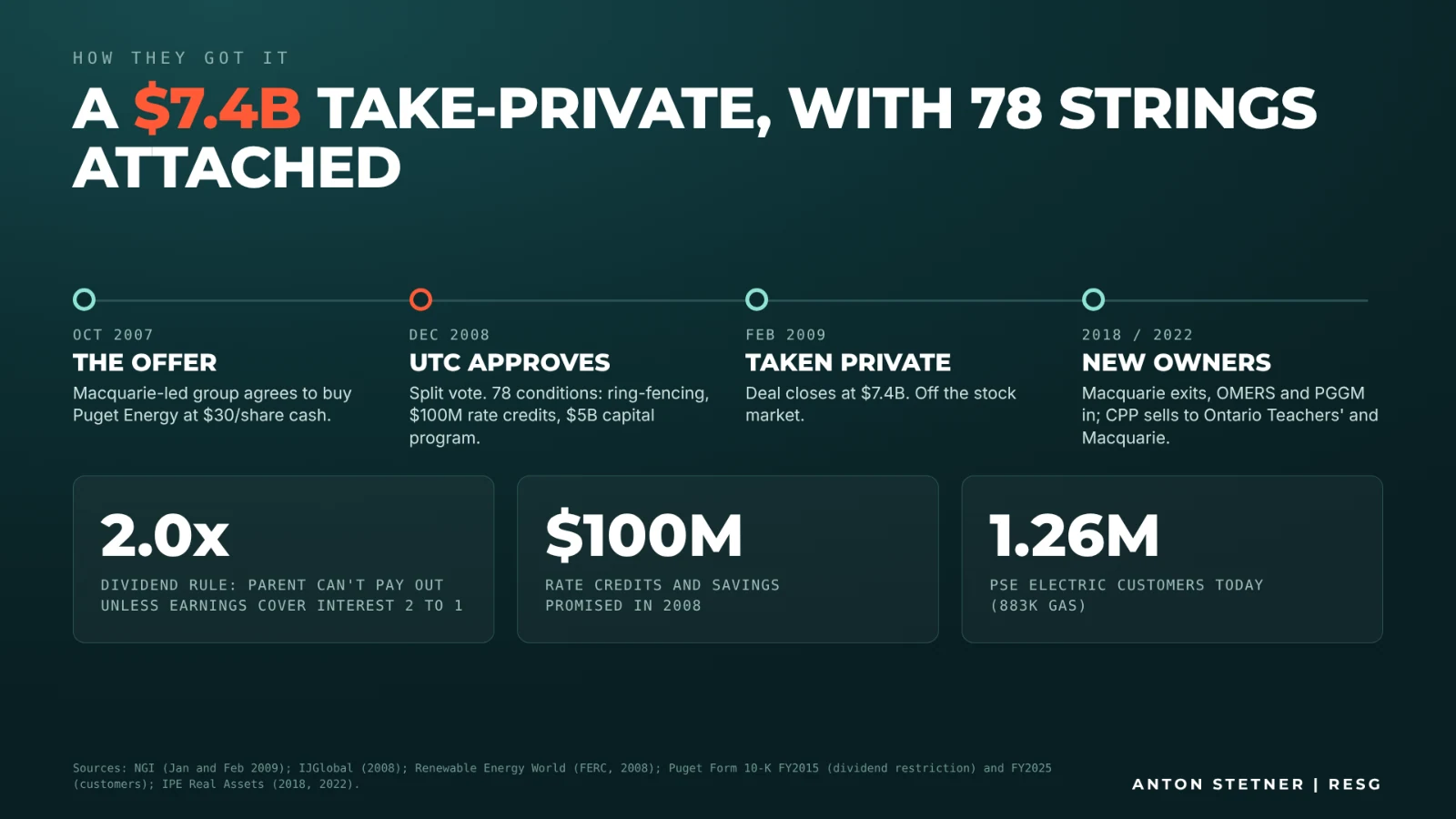
The 2009 transaction followed state approval with 78 conditions and commitments, including financial protections for the utility and $100 million in rate credits and other savings. A filing describes a two-times interest coverage test for certain distributions.
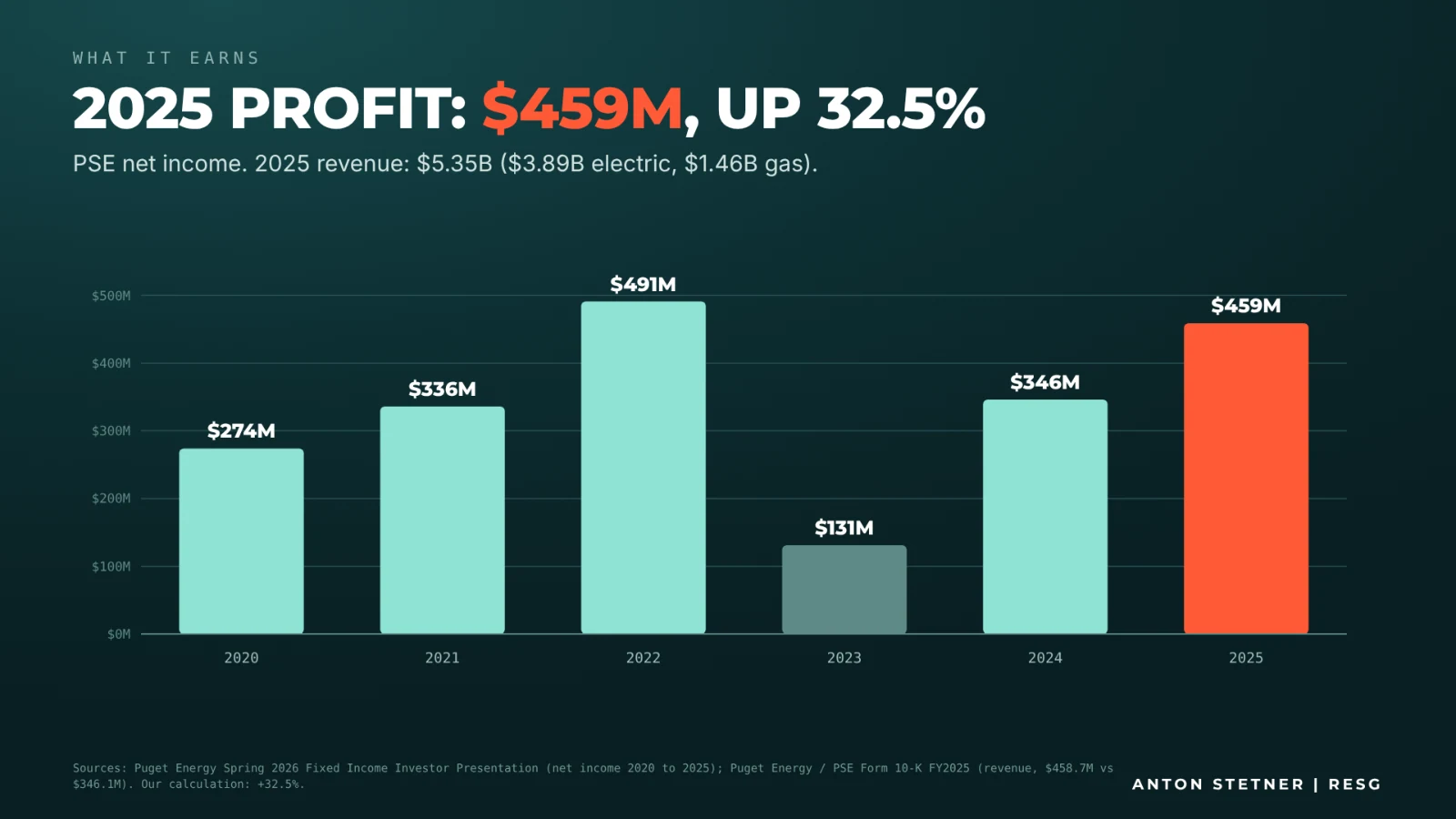
Net income was $274M in 2020, $336M in 2021, $491M in 2022, $131M in 2023, $346.1M in 2024, and $458.7M in 2025. The 2025 figure was up 32.5% on approximately $5.35 billion in operating revenue.
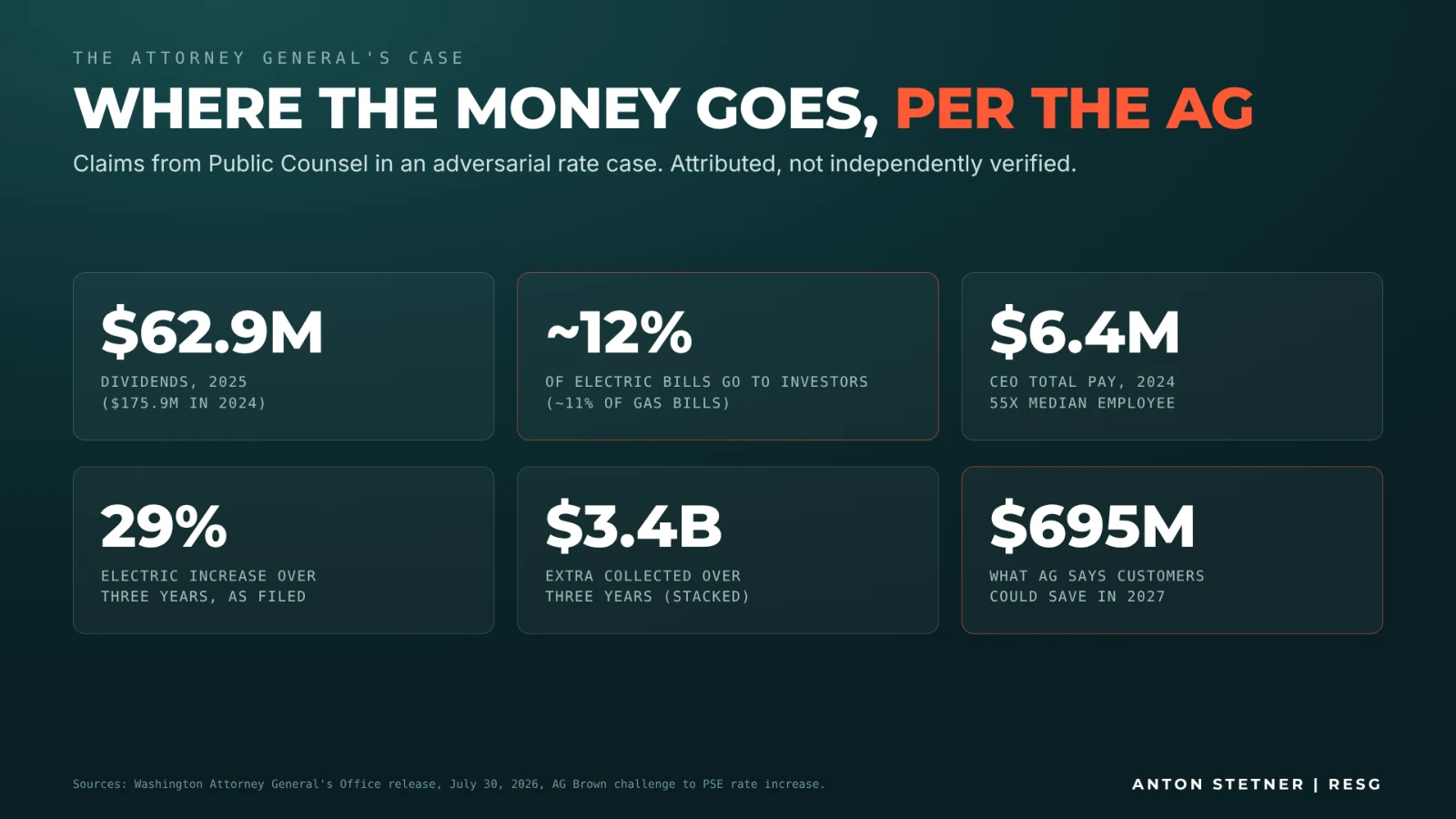
Public Counsel cites $62.9 million in 2025 dividends and estimates that roughly 12% of an electric bill goes to investors under its analysis. Its roughly $3.4 billion three-year estimate counts each rate step in every year it applies. These are Public Counsel’s positions in a contested proceeding.
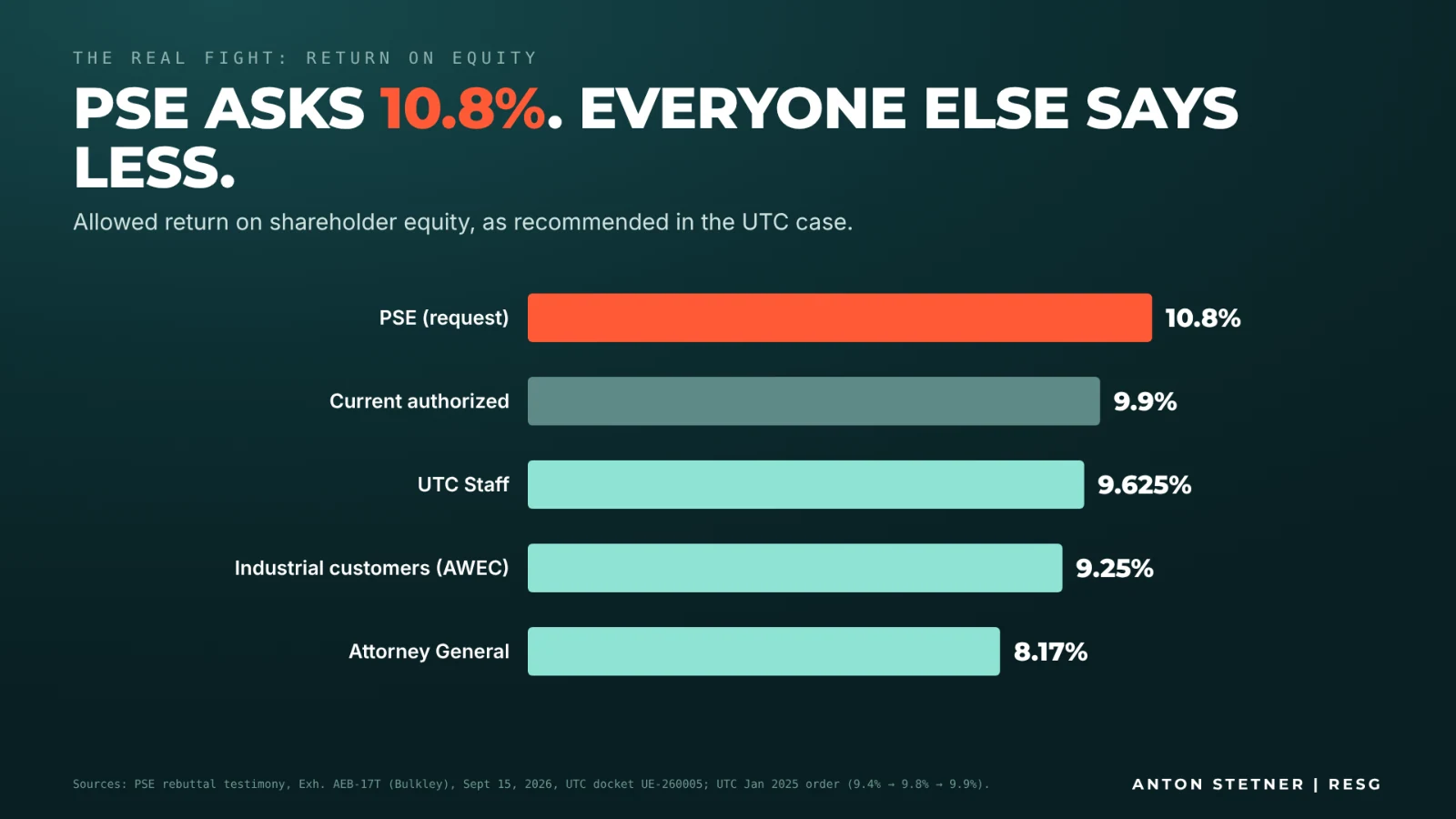
PSE cites power supply, reliability, wildfire resilience and a large capital plan as reasons to raise rates. Public Counsel, UTC staff and industrial customers each recommend lower allowed returns than PSE proposes. The commission weighs costs, service and the return needed to attract capital.
Slide 17 of 37
PSE asks for 10.8% return on equity
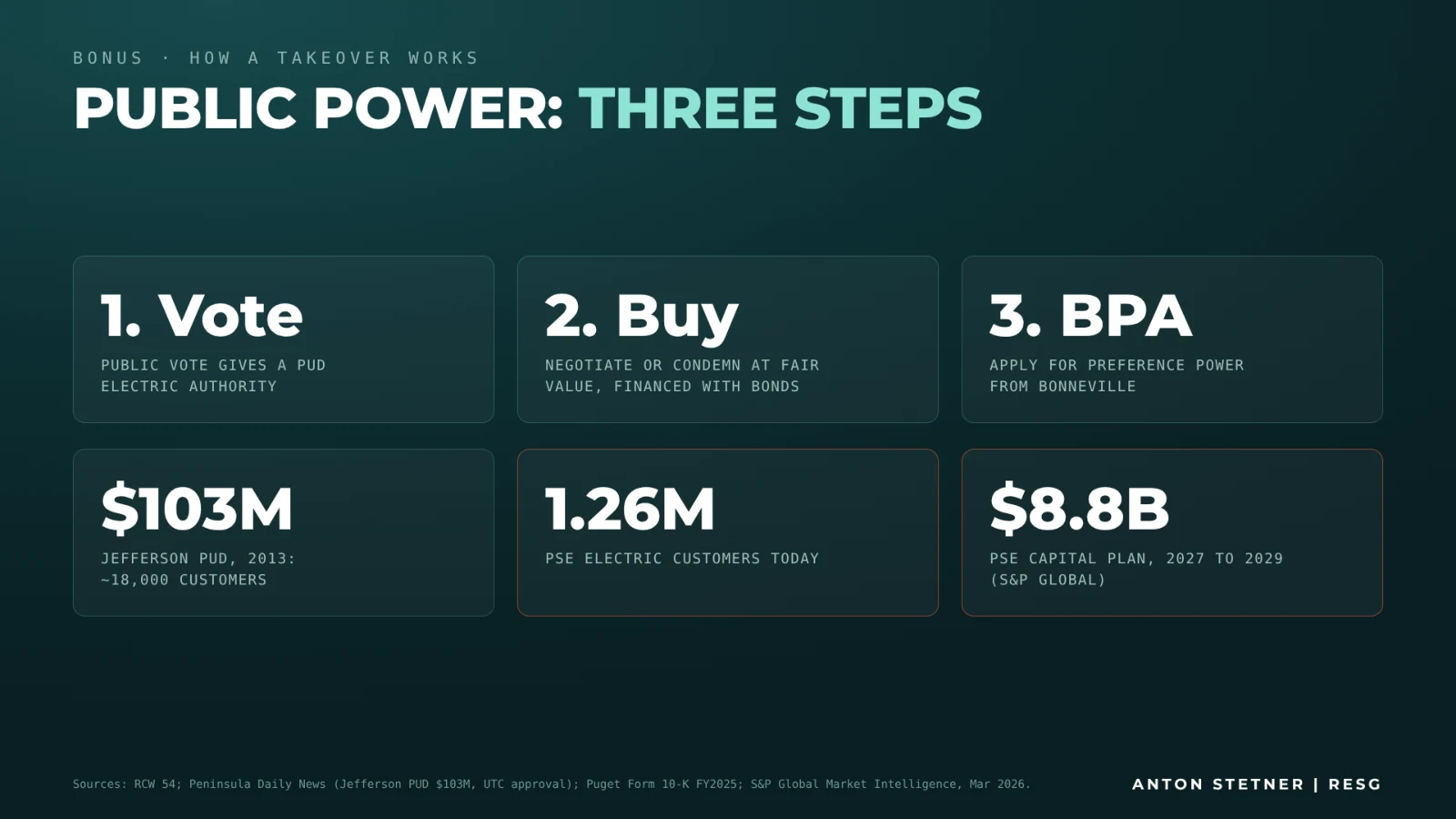
PSE proposed 10.8%, against a currently authorized 9.9%. UTC staff recommended 9.625%, industrial customers through AWEC 9.25%, and Public Counsel 8.17%. PSE’s proposed three-year capital plan is about $8.8 billion.
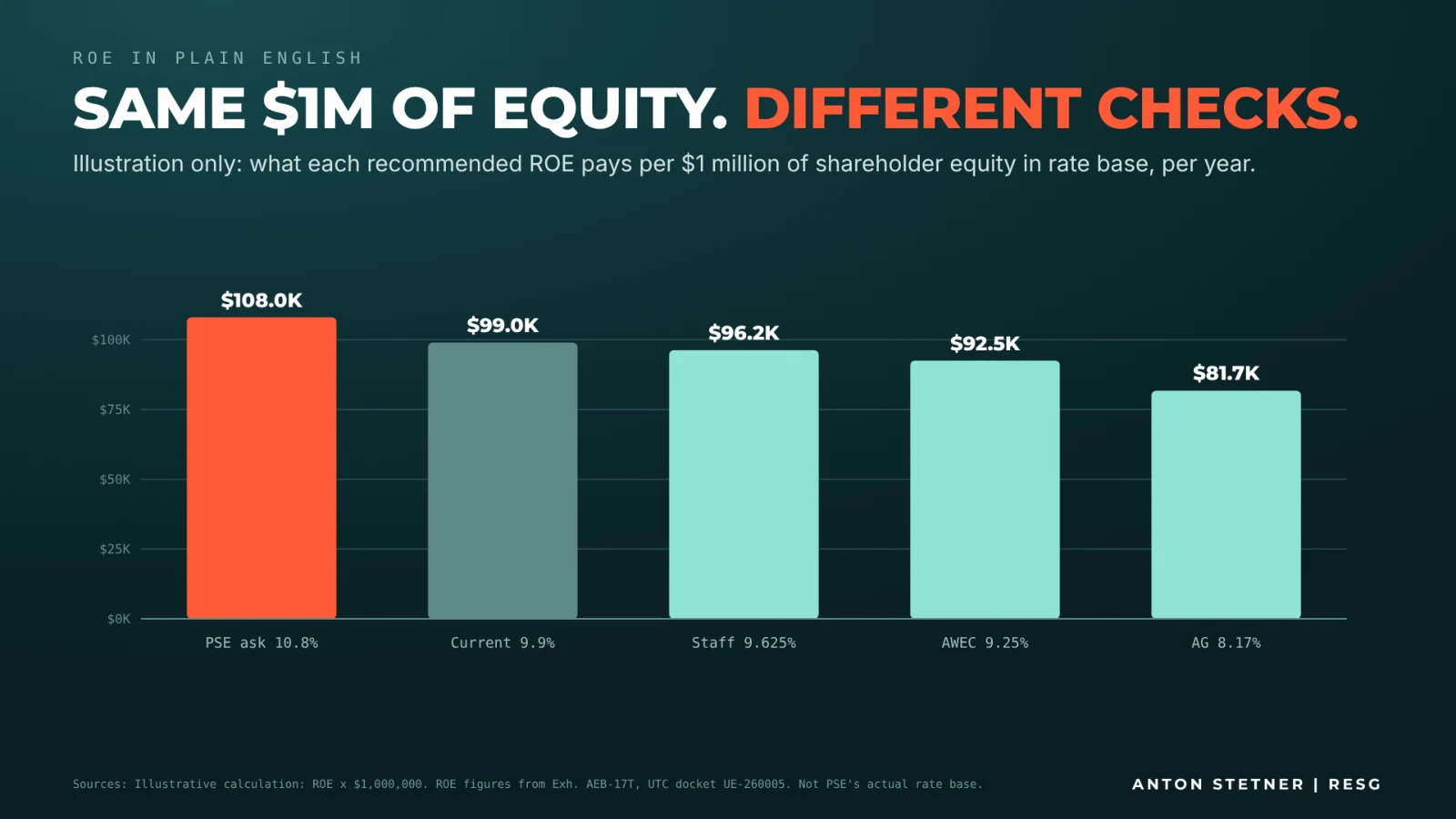
$1 million of regulated shareholder equity at 10.8% implies $108,000 in annual allowed return in this simple example. At 8.17% it implies $81,700. Actual earnings depend on costs, sales and how regulators treat the investment.
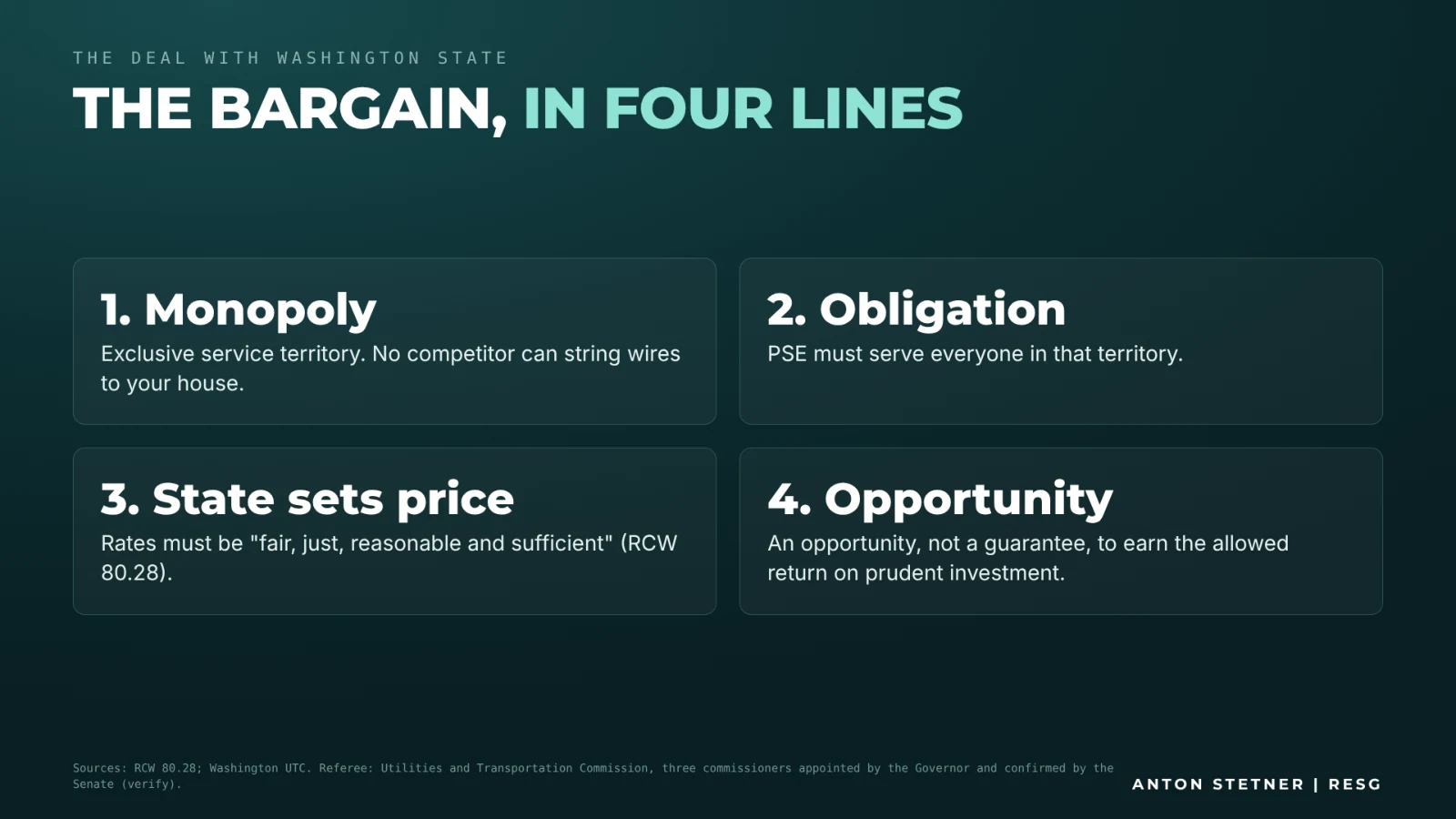
PSE serves an assigned territory under public regulation. The UTC sets rates for the investor-owned utility under Washington law. An allowed return is a ratemaking input applied to shareholder equity in the regulated asset base.
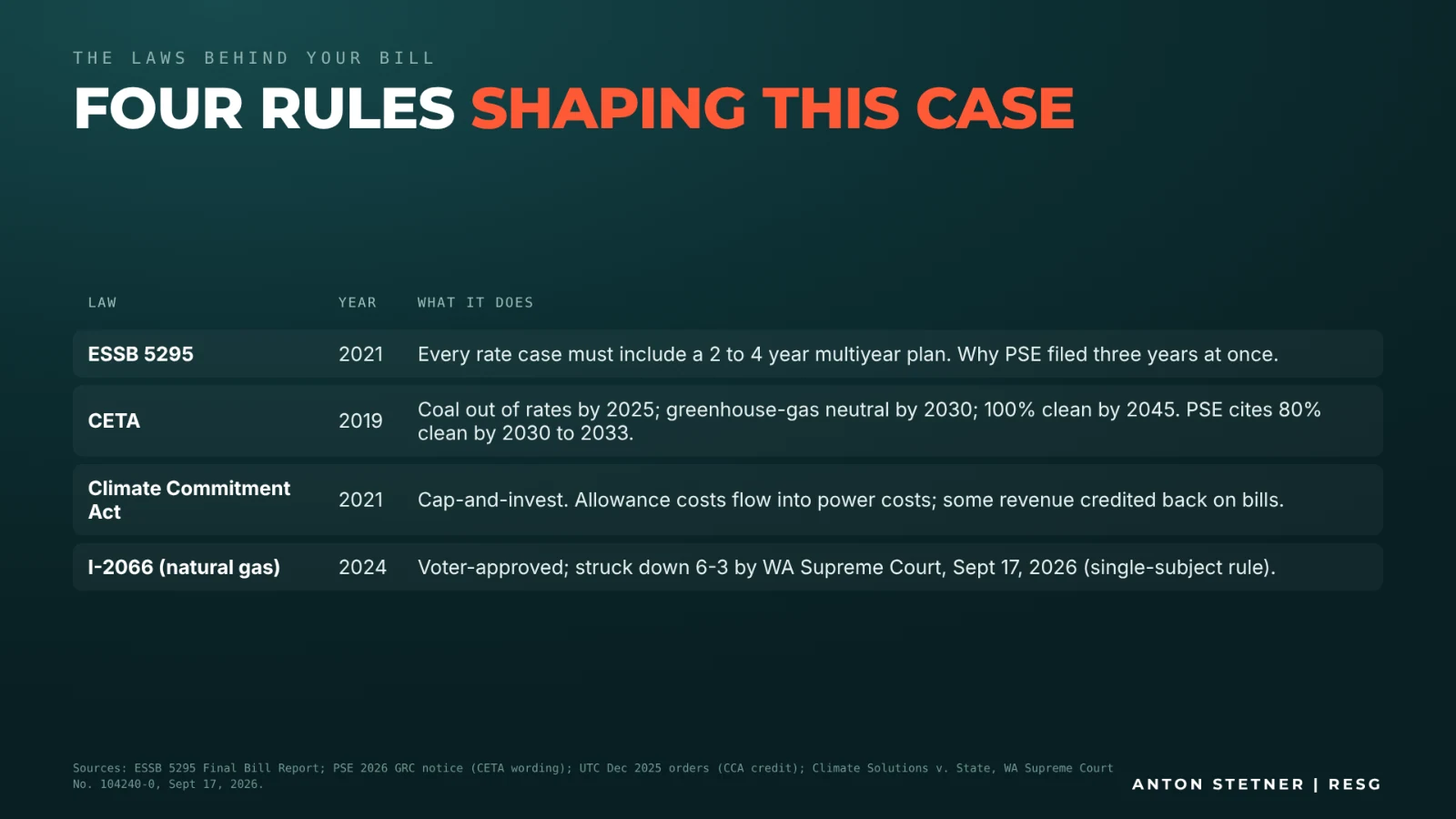
ESSB 5295 requires multiyear rate plans. CETA sets clean-electricity milestones, and the CCA creates the cap-and-invest program. The Washington Supreme Court struck down voter-approved I-2066 under the state constitution’s single-subject rule in September 2026.
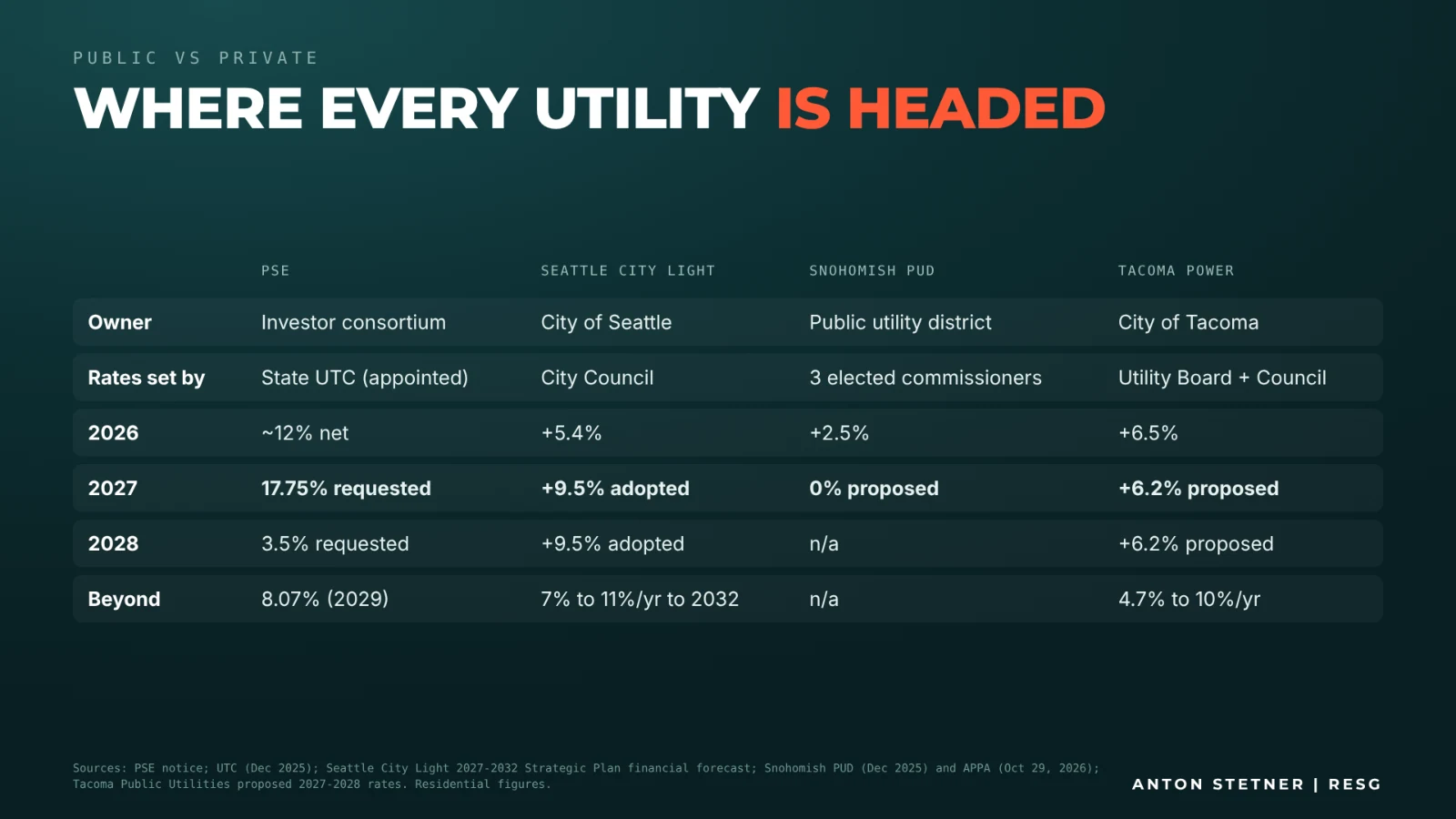
Regional utilities face some of the same costs, including wholesale power, poles, transformers and growing demand. Each has its own customer mix, supply contracts, governance and rate structure. The percentages below retain each utility’s published basis.
The state UTC regulates PSE. Seattle’s City Council establishes City Light rates, Snohomish PUD has elected commissioners, and Tacoma’s Public Utility Board and City Council approve Tacoma Power rates.
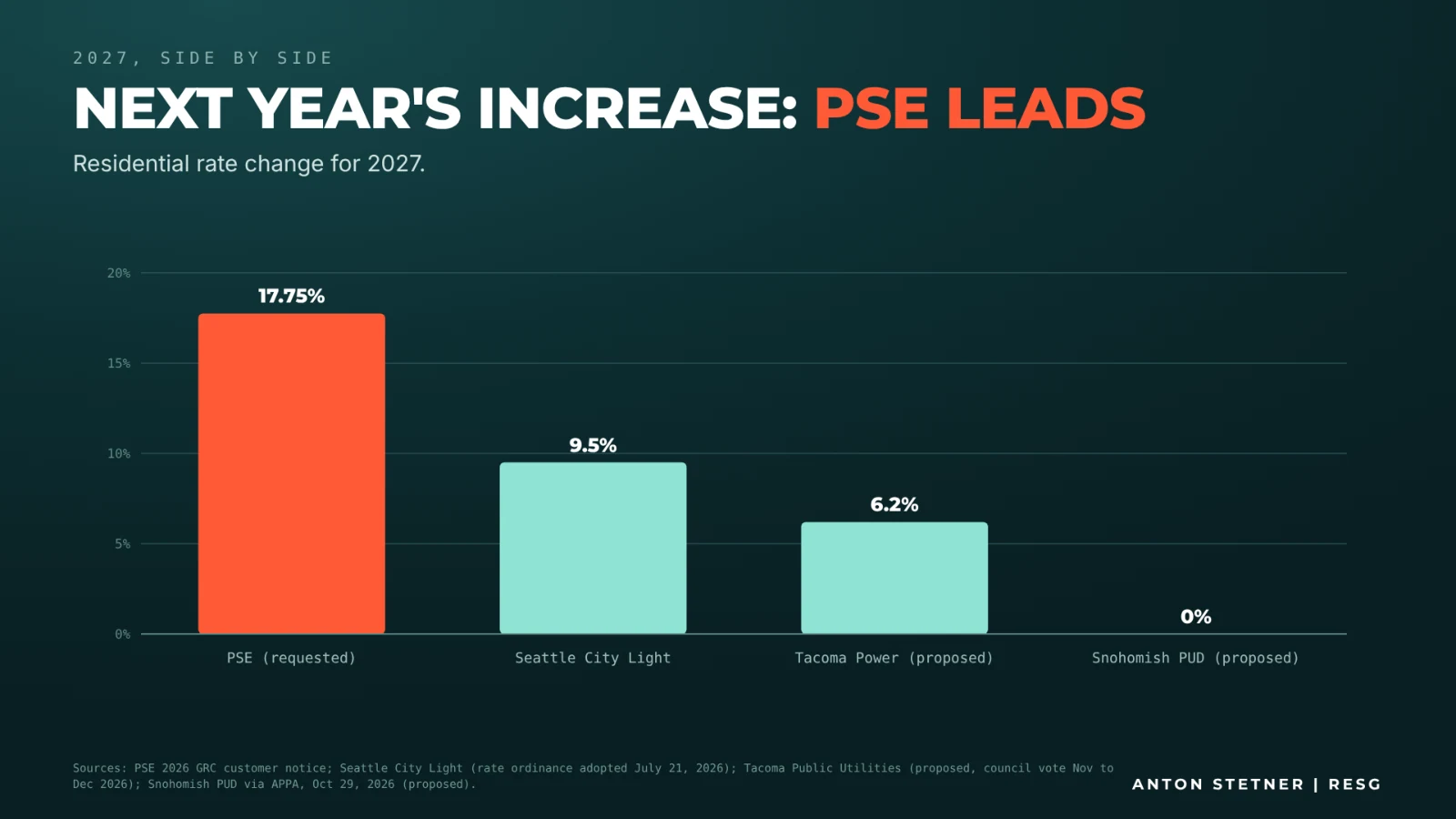
The original Tacoma figures in the deck were proposals. Tacoma’s November 17 adopted budget shows a 6.3% residential increase in each year. Snohomish PUD’s 0% overall proposal was still awaiting a December 1 decision as of the episode.
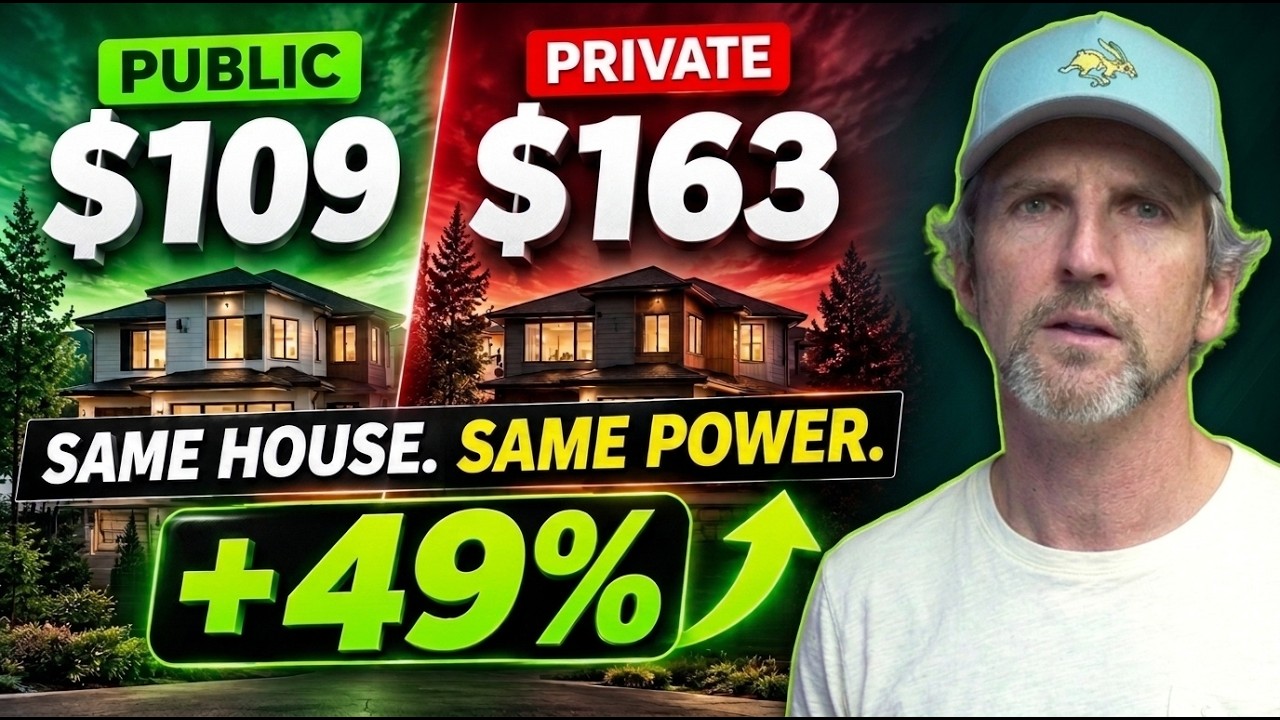
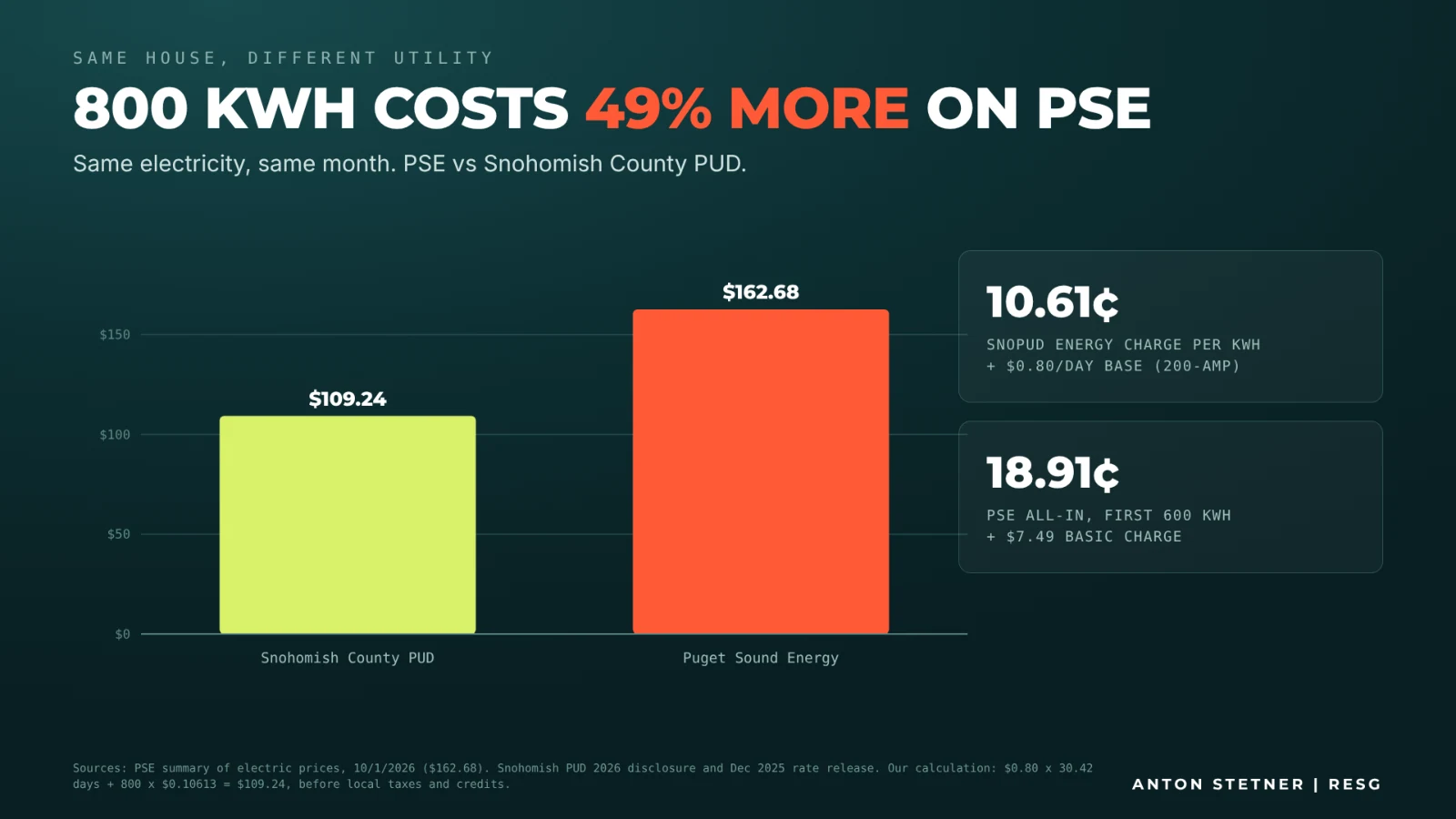
PSE’s October price summary gives $162.68. For a medium Snohomish PUD service, $0.80 per day over 30.42 days plus 800 kWh at $0.10613 comes to about $109.24 before local adjustments. PSE is about 49% higher on those assumptions.
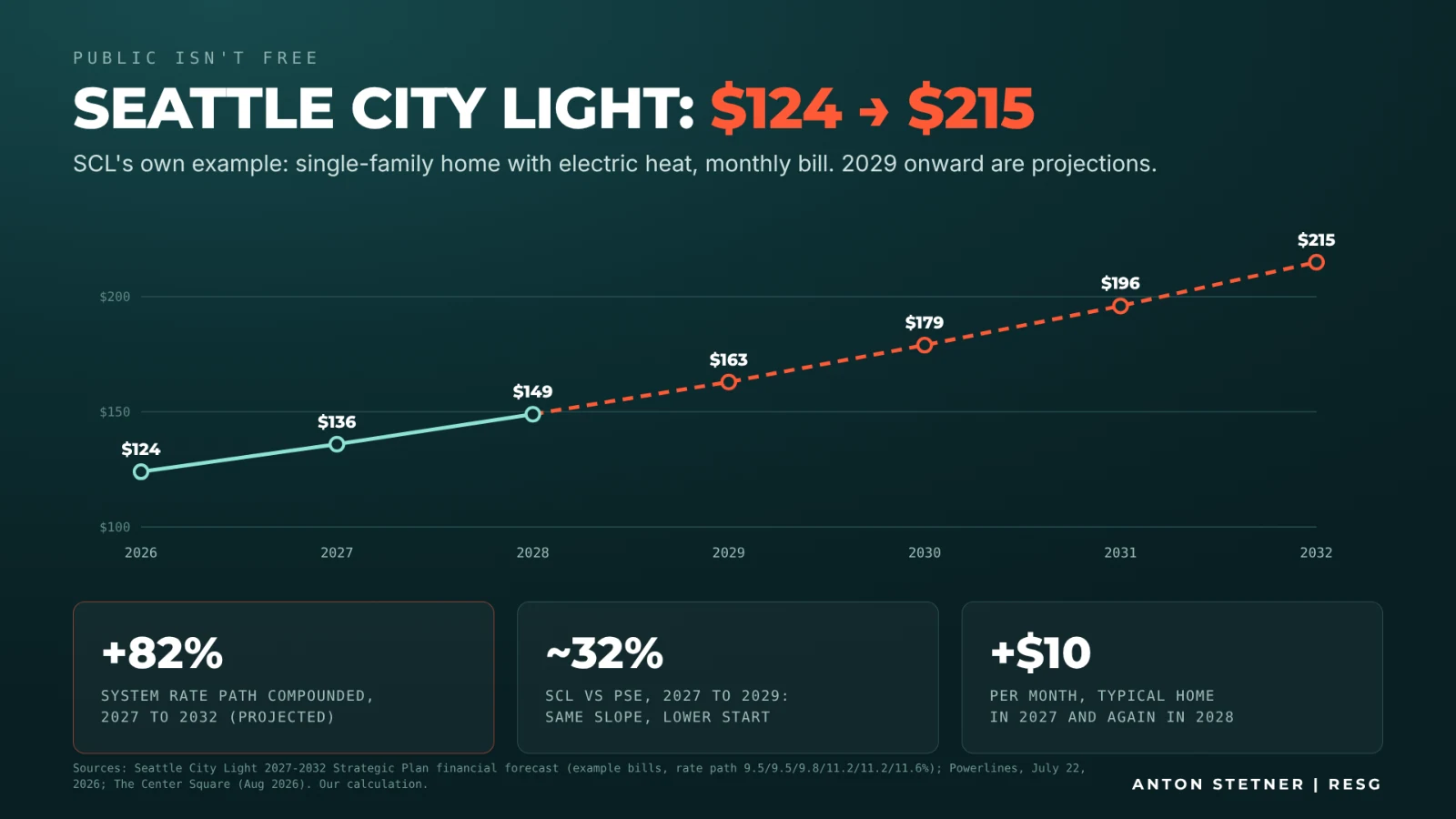
Seattle adopted 9.5% increases for 2027 and 2028. Its strategic plan illustrates a single-family electric-heat bill growing from $124 to about $215 by 2032, including forecast years. The roughly 82% figure is the compounded system rate path through 2032.
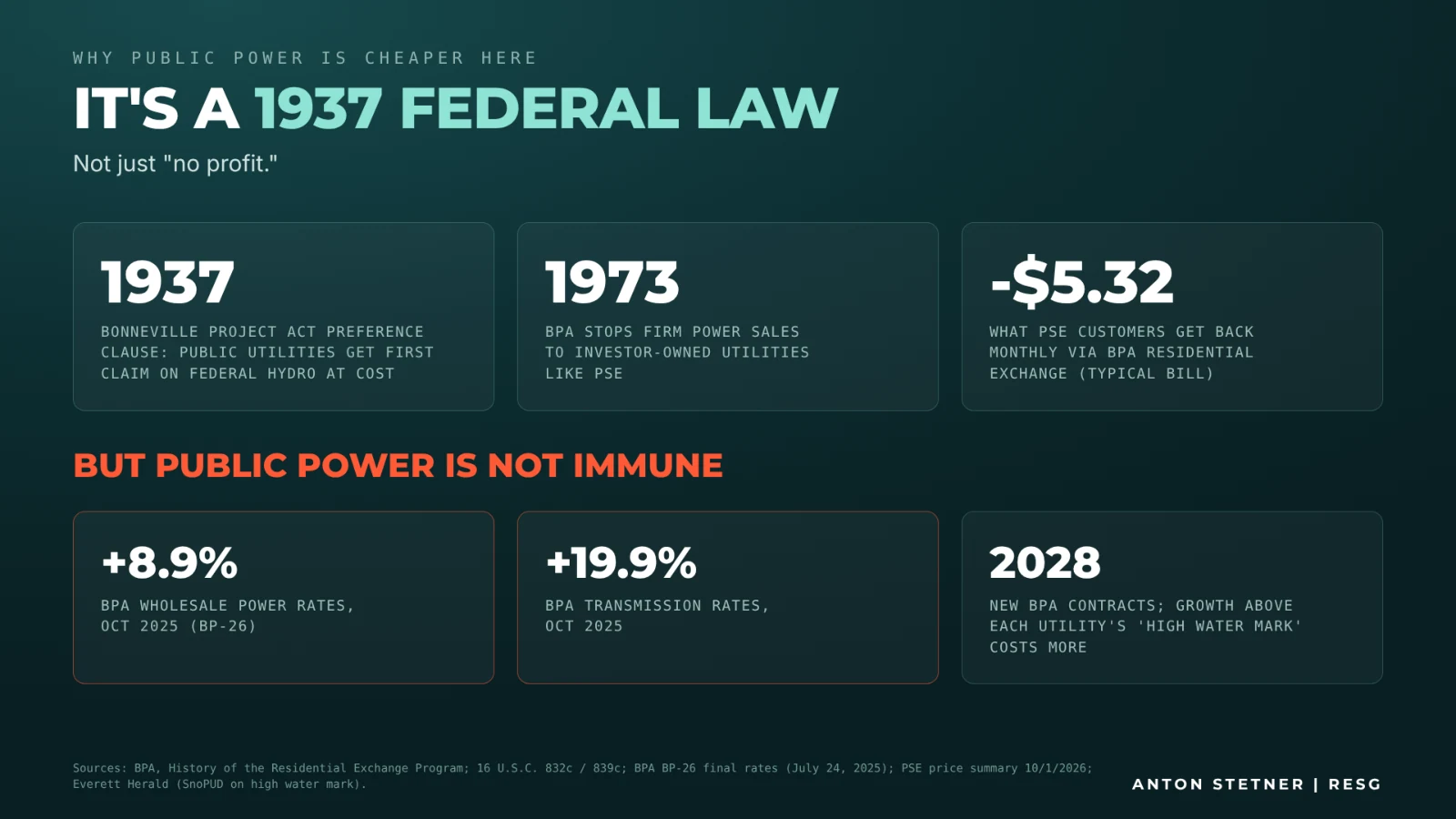
Public utilities and cooperatives get preference access to federal power. The Residential Exchange Program passes a benefit to eligible households and small farms served by investor-owned utilities. Under BP-26, BPA’s priority-firm Tier 1 power and transmission rates also rose.
A data center can pay for dedicated facilities, commit to minimum purchases, or pay a special tariff. How a specific project’s costs reach other customers depends on its utility’s tariff, contract terms and allocation of shared upgrades.
Slide 26 of 37
Electricity prices in the national CPI
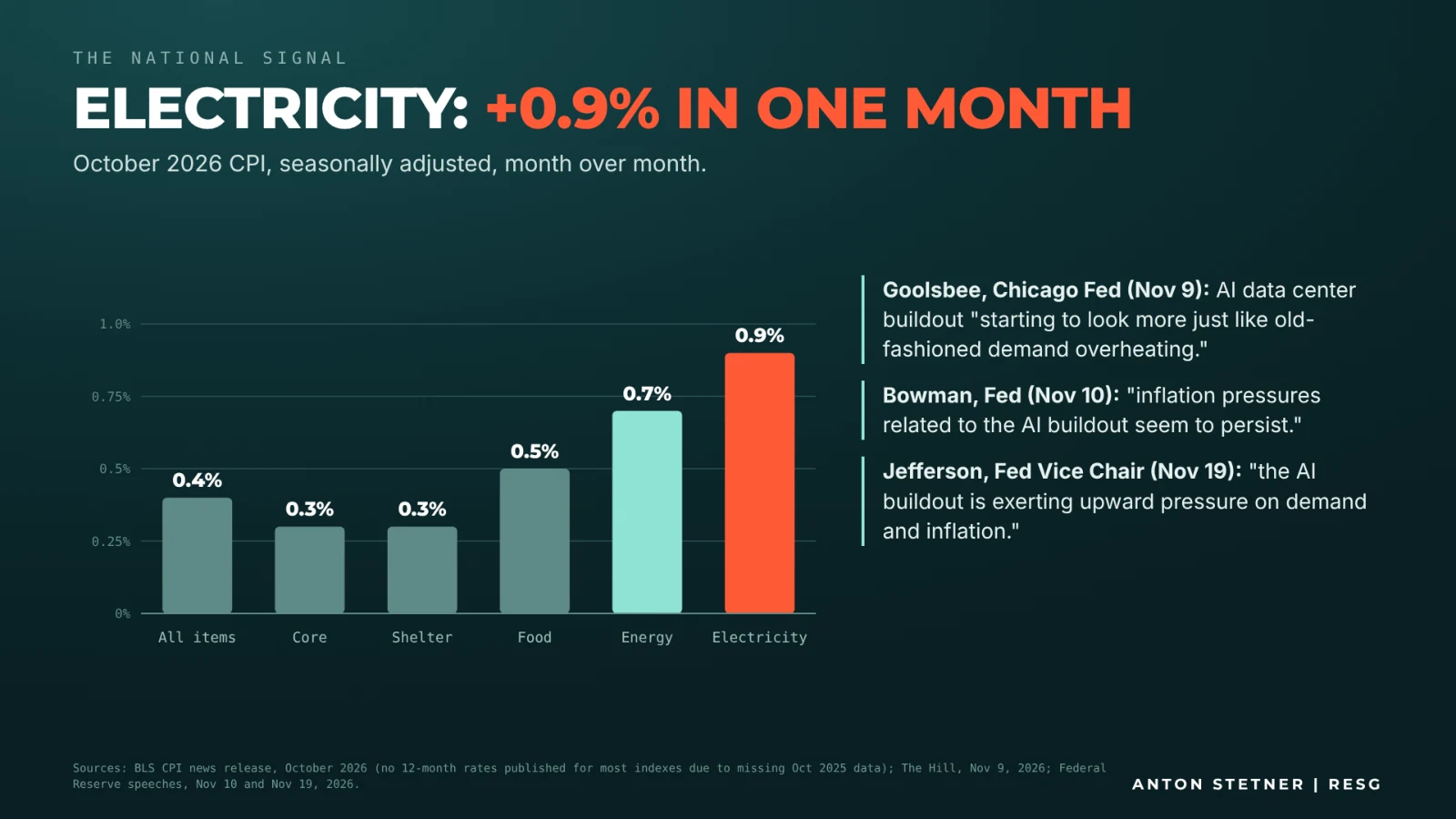
October 2026 electricity prices rose 0.9% month over month on a seasonally adjusted basis, compared with 0.4% for all items. Federal Reserve officials discussed AI buildout as a source of demand pressure. The national index does not measure the effect of any particular Washington project.
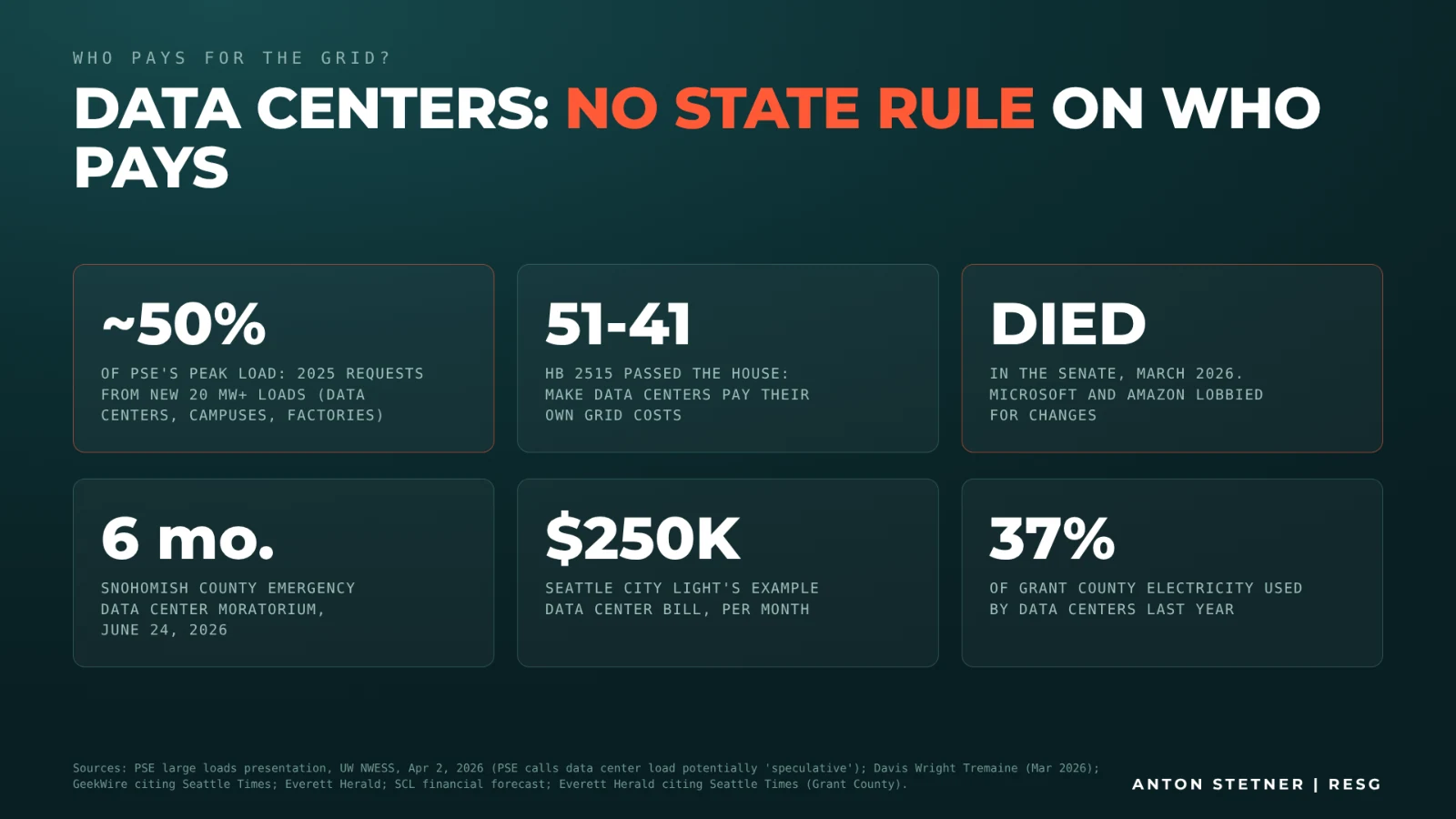
PSE said 2025 requests for loads over 20 MW summed to nearly half its winter peak. That pool included data centers, tech campuses, manufacturing and multifamily projects, with some requests speculative. HB 2515 would have required protective tariffs for qualifying customers. It passed the House 51–41 and stalled in the Senate. Separately, PSE identifies reliability, generation, power costs and clean energy among the drivers of its rate request.
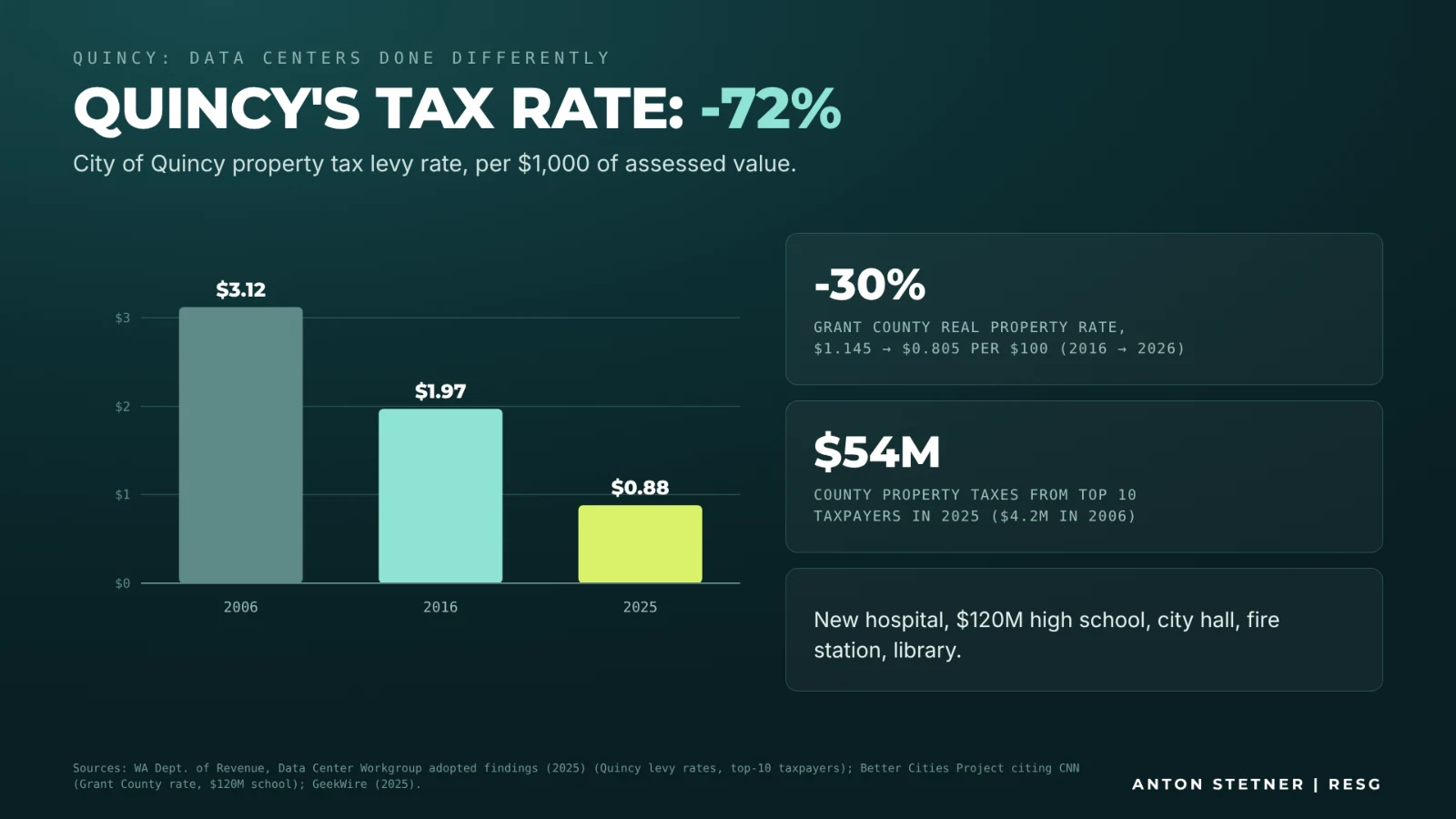
Washington’s Data Center Workgroup reported that the City of Quincy levy rate fell from $3.12 per $1,000 of assessed value in 2006 to about $0.88 in 2025. The levy rate is distinct from individual property tax bills. Grant PUD’s rate structure raises a separate question about capacity costs.
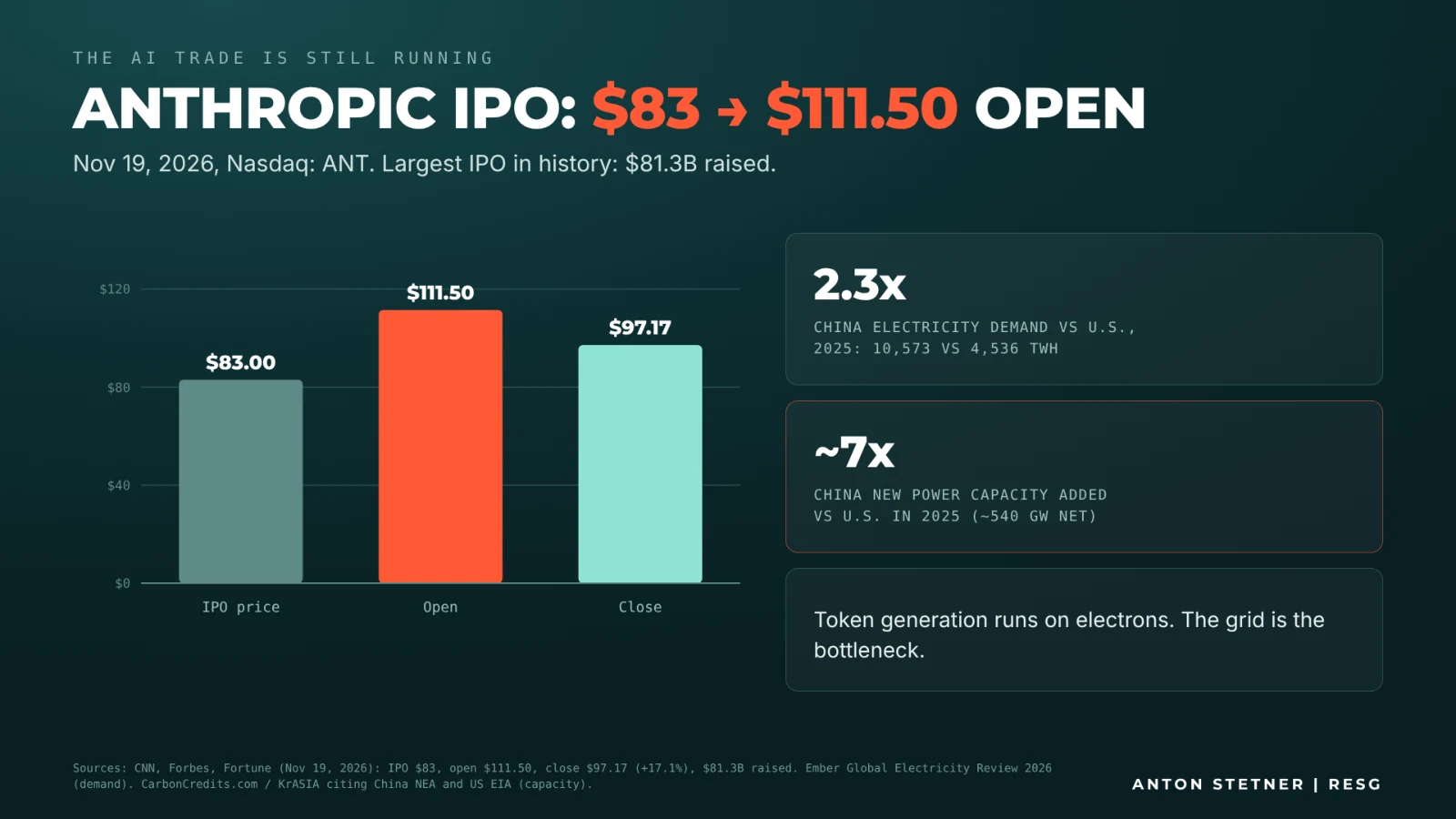
Anthropic priced shares at $83 and opened on Nasdaq at $111.50 on November 19. The episode uses the IPO and international electricity data to discuss the scale of AI investment and the power needed to serve it.
The episode also connects utility bills to debates over public spending, infrastructure costs and housing supply. These slides provide context for that discussion.
Slide 30 of 37
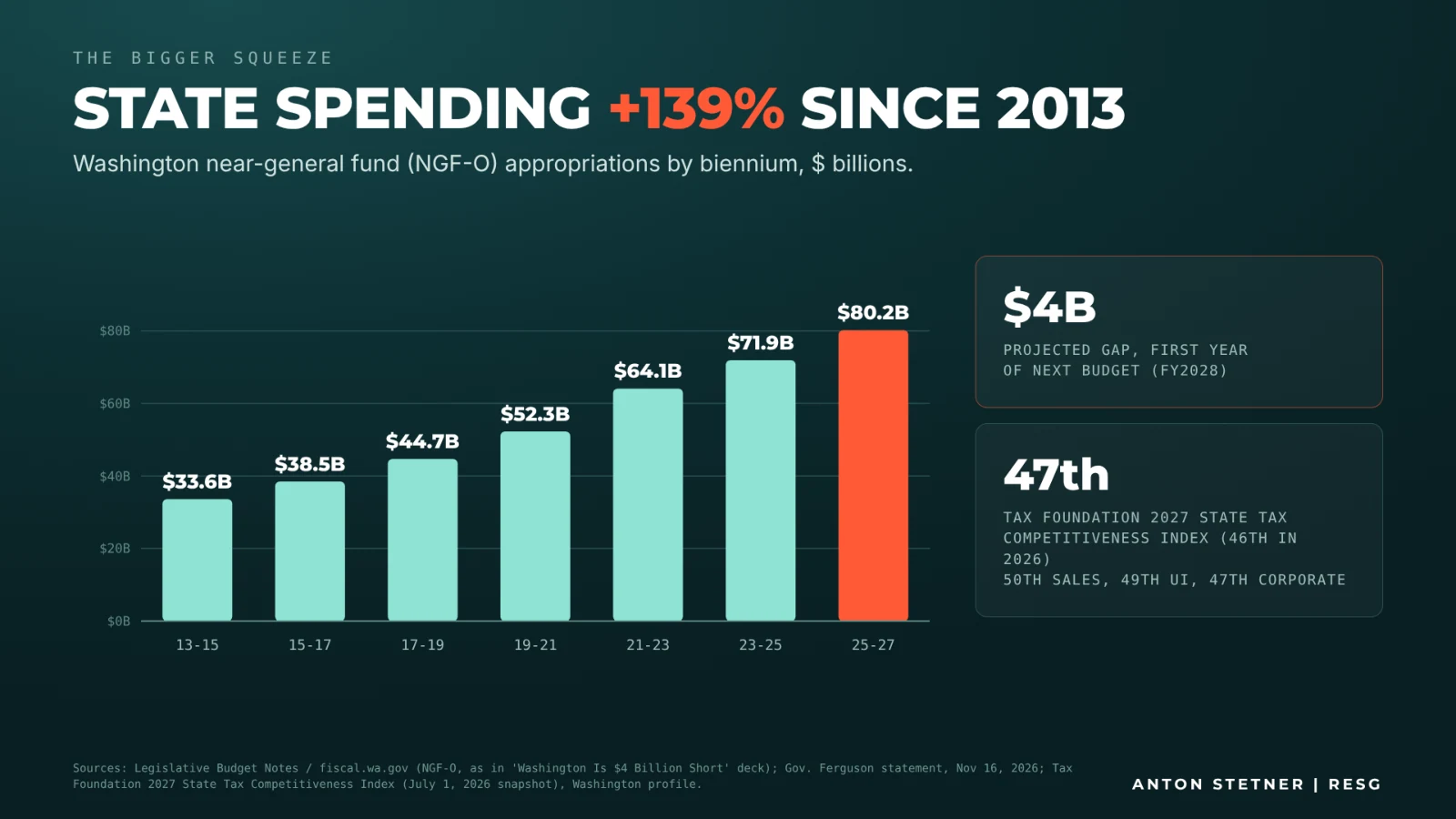
Washington’s budget and spending growth
The deck uses nominal near-general fund appropriations, rising from about $33.6 billion in 2013–15 to about $80.2 billion in 2025–27. The $4 billion figure refers to a projected fiscal 2028 gap. The Tax Foundation ranks Washington 47th in its 2027 State Tax Competitiveness Index.
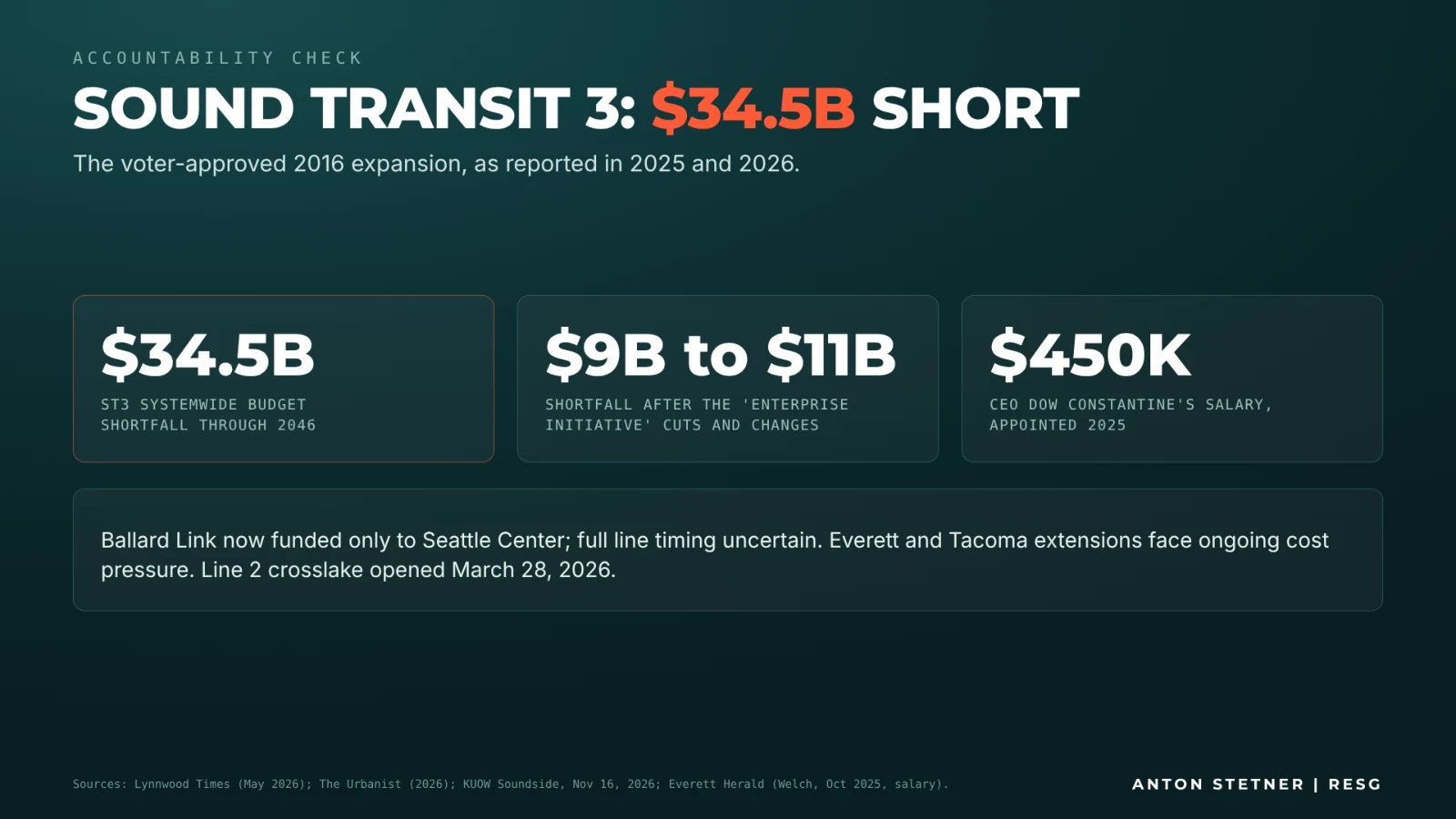
Sound Transit’s Enterprise Initiative reviewed a roughly $34.5 billion long-term funding gap against the original program. Later project changes and revenue assumptions affect the remaining gap and delivery dates. Consult the agency’s current plan for individual extensions.
Find the electric and gas providers for the specific address and request 12 months of bills when available. For rentals, verify which meters the owner pays and model higher utility costs. For an ADU or development, check service capacity, trenching or undergrounding requirements, connection costs and the utility’s lead time.
Slide 32 of 37
Budget for utilities as a cost of ownership
The $503 and $870 figures come from keeping usage at 800 kWh and 64 therms each month and annualizing the difference from PSE’s filing baseline. For a property with different usage, estimate with its own rates and meter configuration.
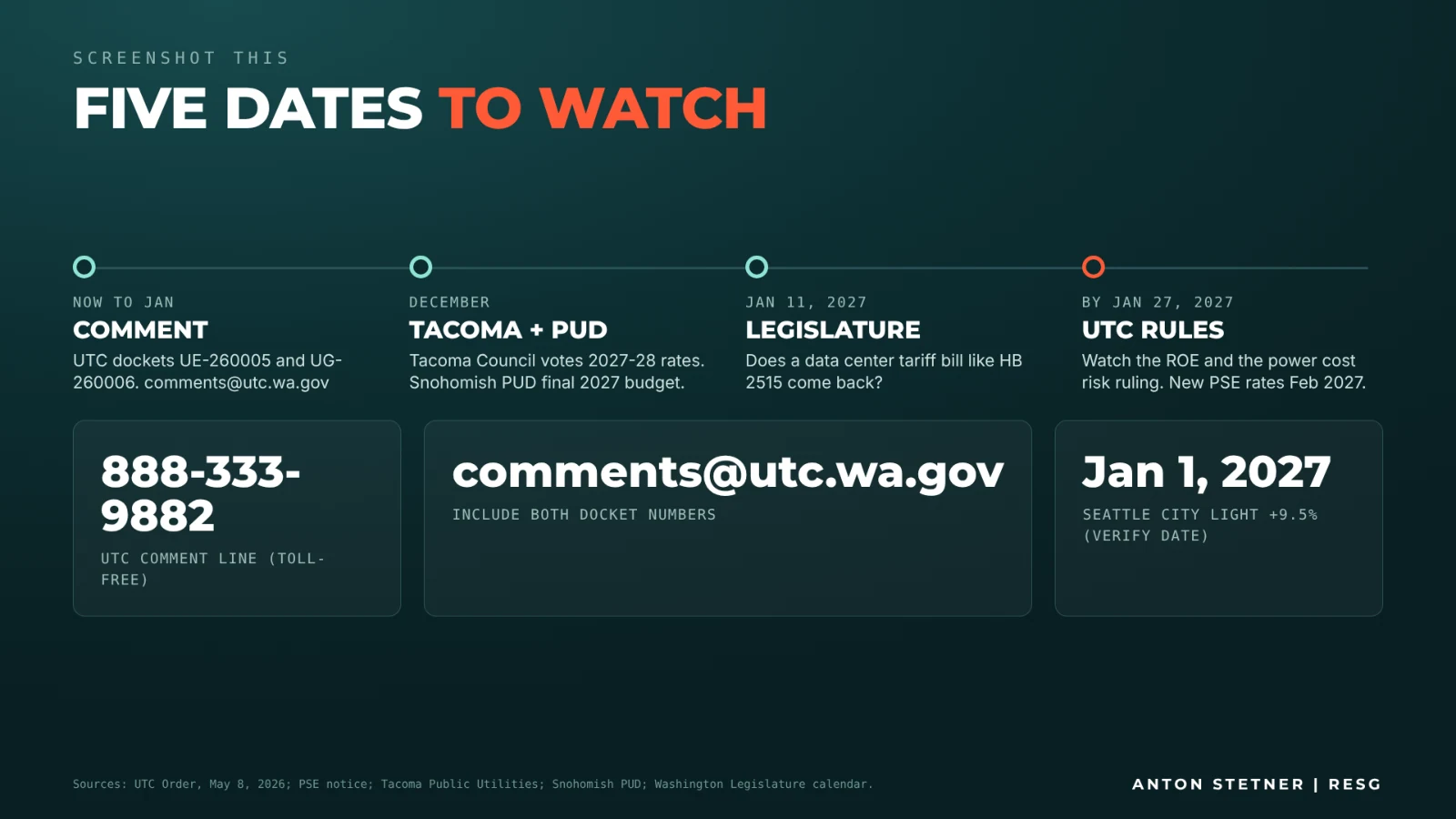
The UTC says public comment in this case closed November 12. Its corrected November 18 bench request sets a November 30 response deadline for case participants. The commission lists January 27, 2027 for its decision and February 1 for any approved rate changes. Tacoma adopted its budget November 17, and Snohomish PUD listed December 1 for a possible budget and rate decision.
What would a household pay? What return will the state authorize? What protections should apply when a large new customer needs more capacity? The filings, utility schedules and legislation answer different parts of that picture.
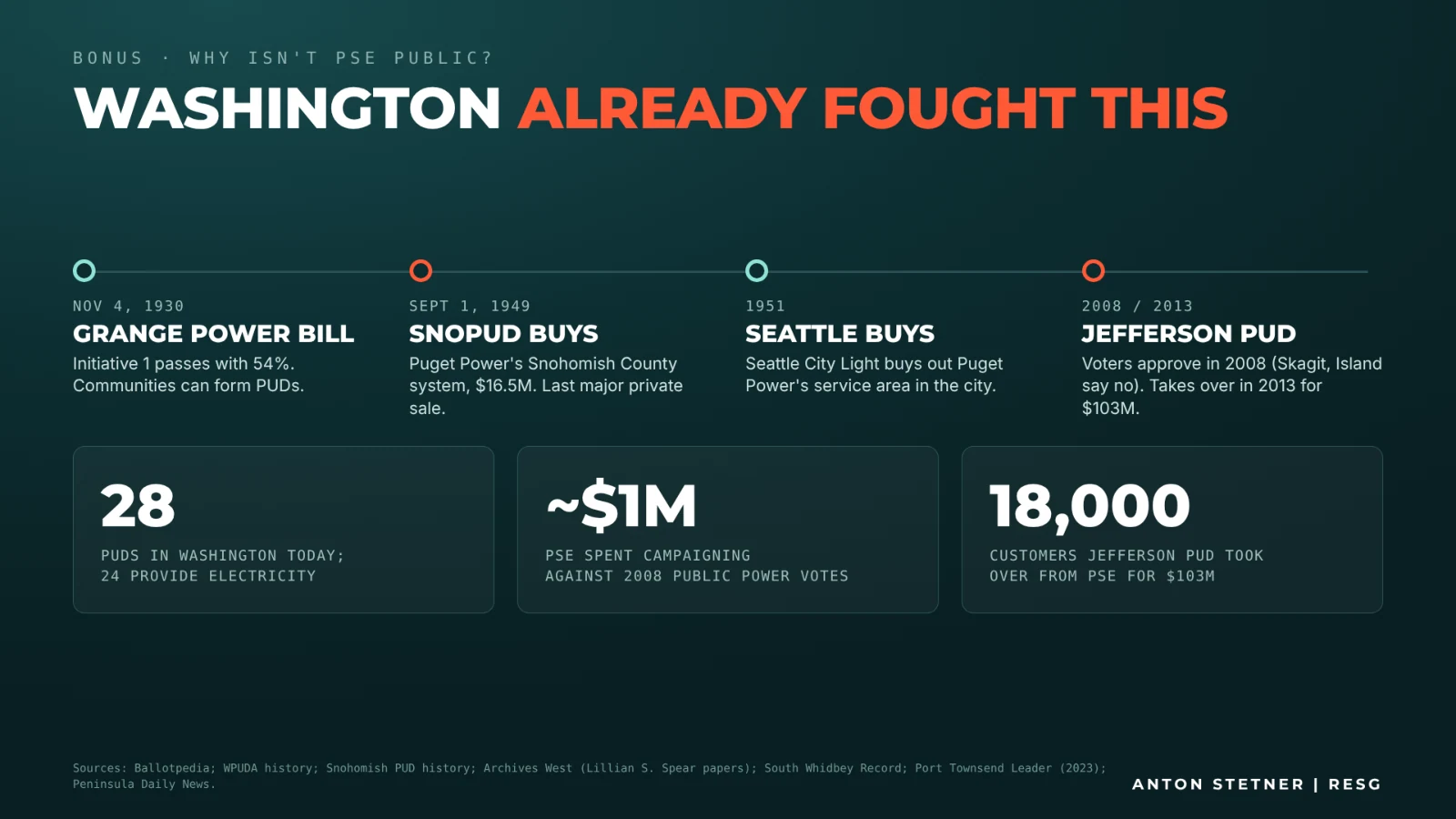
The deck includes historical material on how Washington communities formed public utilities and acquired privately owned systems.
Slide 35 of 37
Washington communities voted on public power
Washington voters authorized public utility districts in 1930. Snohomish PUD acquired Puget Power’s local system in 1949. Jefferson voters authorized electric service in 2008 and the district took over the system in 2013.
A local district needs authority to provide service, financing to acquire and operate the system, and a wholesale power supply. In East Jefferson, the acquisition covered approximately 18,000 customers for $103 million.
As of November 19, 2026, the UTC case was pending. The commission lists January 27, 2027 for a decision, with any approved rate changes taking effect February 1.
PSE’s 17.75% is the change in its 800 kWh monthly bill example. The 16.75% is the proposed average for the residential service schedule, while about 15.2% is the overall electric revenue increase requested for 2027.
At the filing’s usage assumptions, the two services together would increase by $41.94 a month in 2027 and $72.54 a month by 2029. Annualized, that is about $503 and $870, respectively. Individual bills depend on usage, charges and credits.
The allowed return sets how much return is included in the rate calculation for regulated shareholder equity. Actual earnings depend on sales, investment, costs and other regulatory decisions.
Data centers are part of the region’s projected demand growth. The filing emphasizes a mix of reliability, generation, power costs and clean energy investments, and the cited large-load figures include several industries and speculative requests.
Why can a public utility charge less for the same power usage?
Public utilities have different costs, financing and supply contracts. In the Northwest, preference access to federal hydropower can help lower supply costs. Differences in fixed charges, power supply and taxes can also affect the comparison.
The UTC says the PSE public comment period closed November 12, 2026. Use the commission’s case docket to follow filings, orders and any later instructions.
The Plaud transcript covers the original 63-minute recording from Elias’s welcome to Anton’s sign-off. For times in the 55:55 YouTube edit, use the video chapters above. The automated text may contain errors. The episode notes cite and clarify figures discussed on air.
Opening and the 17.75% request
Elias Welcome to the Anton Stetner podcast, episode one hundred and ninety-nine.
Studio Wow!
Elias Congratulations, that's amazing. So today's topic is PSE wants your electric bill up seventeen point seven five percent. Who's actually paying for that? Grade. That's almost twenty percent.
Anton It's ridiculous.
Elias If you're a Puget.
Anton Sound Energy customer, aka PSE, your power company just asked to raise your bill by seventeen point seven five percent in one shot. And then guess what? In twenty eight, they're going to do it again. And then in twenty nine, they want to do it again. And those aren't my numbers. These are not Anton's numbers. They're printed on PSE's own customers' notices. And here's what makes it interesting. For those of you that don't know, PSE is owned by pension funds from Canada and the Netherlands, plus an Australian investment firm. Your neighbor in Everett or Tacoma buys power from a utility company that's owned by the public. Same region, same rivers, same power.
Anton Very different bills, and yet both of them are going up. So today, we're going to break down exactly what PSE asked for, how much PSE earns, the deal it has with Washington State, what Seattle City Light, Snohomish County PUD, and Tacoma Power are doing, and the data center questions that no one has quite answered yet, and who is going to pay for the grid. I'm Anton Stetner. We run real estate small businesses here in Washington. We sell real estate, we invest in it. I love data. I love talking about the economy, policy, what's happening here in Washington State. So if you own here, if you rent here, if you invest or operate a small business here in Washington State, hit that subscribe button. Follow us along because we're going to talk about the data. We're not going to spin it. We're going to let you decide.
Anton What's happening, and I think you're going to decide that. Oh my, bills are getting too expensive.
Elias So the ask. We want to figure out the dollar to this.
Anton What is PSE actually asking for? What are the dollars? Let's start with their receipts. PSE filed a three-year rate plan on February twenty-seventh, and here's what it means for the normal house. Today, your electrical bill is one hundred fifty-nine dollars and forty-six cents for the typical eight hundred kilowatt home. In February of twenty twenty-seven, that'll be one hundred eighty-seven dollars and seventy-seven cents. In twenty-eight, it's going to be one hundred ninety-four dollars and thirty-five cents. And twenty-nine is going to be two hundred and ten dollars and four cents. That means today, the fixed charge is seven dollars and forty-nine cents.
Anton But the fixed charge is going to be twelve dollars and fifty cents in 2027, on top of the twenty-eight dollar increase, and the fixed charge is going to be twenty fifteen dollars and twenty-eight and twenty dollars in 2029. As always, because we're going to go through a lot of numbers in this episode, we're going to put a link in the comments for you to be able to see all this data and see where we got it. Follow along on the journey and see where it's coming from, because sometimes when we share a lot of this data, people like, 'Hey, I didn't quite see that.' It'll be right there in the pinned comments for you. Gas, aka sixty four therms, went from a hundred and five dollars and thirty seven cents to a hundred and nineteen dollars in twenty twenty seven, or basically approximately a thirteen percent increase.
Anton And then it's going to go to $127 by 2029. So both services, if you look at gas and electric, account for almost $42 a month more in 2027, which is about $503 a year. Isn't the average consumer already feeling pinched enough right now?
Elias That's exactly what I was going to say. I'm like this whole thing that we've been talking about consistently is how people are feeling pinched, and now it's like oh wow
Anton Another attack on affordability here in Washington State.
Elias It's like they don't want us to live here.
Anton Taxington. And you know Washington State and Lions and Tigers and Bears.
Anton When you look at it by twenty twenty nine, it's going to be another eight hundred and seventy dollars a year. That's almost a thousand dollars a year. And so I just want to ask where is that going to come in your budget? Where is that going to affect you and your family? And as usual, we're going to get into how does this affect home prices? What should we be paying attention to? What's it mean for AI? This fixed charge is the quiet one though from PSE. It's been seven dollars and forty nine cents, and that has been the number since twenty twenty one.
Anton And PSE wants to increase that to twenty dollars. That is a one hundred and sixty-seven percent increase on the part of the bill. There's no way to conserve your way out of it. This fixed charge is just something they straight tack onto the bill. It's not built into the rate. It is a fixed charge. It's a fixed part of your bill. So they're asking to be able to increase it. Now the regulators, the utilities, and the transportation commission has to rule by January twenty-seventh of twenty twenty-seven. They almost never give a utility everything it asks for. So the real question is, what is this fight really about?
Elias I saw Benji. I was like, is seventeen point seven five percent the number of people who will actually pay, or is that the opening bid?
Anton That is a great question. And so, before we get into that fight, you need to see what's already happened with PSE bills because this request lands on top of the bill that has almost already doubled.
Elias Jeez.
Anton Let me know if you're feeling the pinch from everything in the comments.
Anton How did we get here? PSE publishes a price summary every time the rate changes. They have to do this. I pulled them, and here's the same eight hundred kilowatt hour house over five years. In January of twenty one, it would have cost eighty four dollars and eighty three cents. By October of twenty five, it was one hundred thirty eight dollars and thirty three cents. By March of twenty six, it's up to one hundred sixty thirty five. By October, which is just last month, it's now up to one hundred sixty two dollars and sixty eight cents.
Anton And the request for twenty nine is basically an average of two hundred and ten dollars and four cents per month for that eight hundred kilowatt hour house. So if you look at that from January of twenty one to today, that's up almost ninety two percent. If PSE gets everything it asked for in twenty nine, it's about two and a half times, two point five x, more than the twenty one bill.
Anton I'm like, come on, ladies and gentlemen, we're already being pinched from all angles, and then they vote through an income tax on everyone. They're talking about raising property taxes. Governor Ferguson just came out this last week and said, hey, we have a four billion dollar shortfall. But it's not my fault. I inherit it. You inherit it from fricking Inslee that you fricking worked for by your fricking party. Insert whatever explicitive you want there. Then he goes, "Oh, it's Trump's fault."
Anton This is sheer overspending and lack of accountability. The Washington State Attorney General's Office said when they released their statement. PSE electricity rates have nearly doubled between twenty and twenty five, and our summaries agree. We talked about this already. I don't want to belabor this, but I want to go through just a couple of the numbers in the January twenty six jump. PSE's cost adjustment line went from sixty six cents per kilowatt hour.
Anton 0.66 cents per kilowatt hour to 3.87 cents on today's typical bill. That's 30.98 cents, about 19% of the bill. Power costs. The talking points: why they're doing this. The power cost line is the most important number in this episode. Remember it when we come back to section three. Wholesale power has been expensive and volatile, and we've had droughts here. A lot of the power in Washington State comes from hydroelectric, and because of the droughts that we've been having, there hasn't been as much water passing through the turbines, and the utility companies have to pass those expenses on, and then add the cherry to the top.
Anton We've got two state laws that are just absolutely crushing us here. CETA, which is the Clean Energy Transformation Act, requires utilities to move to clean power on a legal timeline. So they're forcing us over to specifically only using clean power. Getting away from anything that is not considered green. Environmentally friendly power, and you are paying for that. That's number one. Number two, the Climate Commitment Act forced what's called a cap and invest. So if you're a business, if you emit carbon, you have to go buy these carbon credits, and these carbon credits happen as an auction. And they said, 'Don't worry,' when they introduced the Climate Commitment Act.
Clean energy, carbon allowances, and accountability
Anton It will only add pennies to your bill. Does anyone else remember Inslee saying that? But what has it done? It's added massive expense to our bills, to our gas. Just look at how much we have the third highest gas prices here in the United States. So we buy these credits, these carbon credits, in the auction that was only supposed to cost pennies. But any auction starts to get gamed, so people are making money off the auction, and then they're supposed to turn around and invest the money. What percentage do you think is actually going into making a difference with the climate? Do you think it's a majority or a small amount? What would you think?
Elias I hate to say this, but knowing our state and knowing the way that things are going, I honestly am going to go for a small amount, like a small amount is really going towards helping.
Anton A super small amount. So depending on how you measure it, as little as three percent, like a max of maybe ten, is actually going into helping the climate. This ideology is hurting us on an economic reality. But I want to ask everyone, wait a second, aren't we being attacked from all angles right now?
Elias Feels like it.
Anton We've got AI attacking the tech industry and attacking our jobs. We've got our legislation, legislature attacking small business, attacking tech, attacking entrepreneurs with the constant tax and spend and the increases in tax. You have to ask yourself right now: Why is San Francisco booming and Seattle is not? And then, lastly, this. Ideology is now confronting economic realities. See, part of the reason PSE is getting so expensive is because it's trying to comply with CETA and the Climate Commitment Act. It is being forced to go to more expensive power options for this ideology that's maybe helping. Let's just say it's ten percent. So that means if a hundred dollars go in.
Anton Ninety dollars gets blown on weird programs that are not impacting anything, and ten dollars goes to actually help our climate.
Elias Question: How does that work? I've been really thinking about it, and just how is this? How do you know how to ask? But get past this, because you mentioned, with all the things we've talked about, there's only so little that goes to the actual thing they're fighting for. For the community, for the state. Why is that? How is that okay?
Anton I believe it's not okay, and I think our listeners and our subscribers also believe it's not okay. Hit the hype button if you agree. Drop it in the comments. Second, what happens in Washington State, and you see this with Mayor Katie Wilson. We are running ideological experiments that have no bearing in economic realities. They go why are businesses moving out of Seattle because you chase them out with many things. Let's just name one of them, the jumpstart tax that taxes corporations based on their headcount. So then they moved over to Bellevue. So Bellevue is outperforming Seattle.
Anton But San Francisco is also massively outperforming Seattle right now.
Anton Everyone says I'd like to save the climate. I would like to save the climate. I think this is a great idea. I have kids. I want grandkids. I want great, great grandkids. I love trees. I'm doing a development project right now where we're planting. We actually already planted them. I planted fifteen hundred trees on it. Why did I plant so many trees? Because I wanted to get close to a wetland, and I'm talking twelve feet inside of a buffer over a two hundred foot strip, so I could do that. What I suggested is let me plant a bunch of trees. So I'm all for the climate and helping the climate, but I'm also for seeing the money go to what it's supposed to go to. What happens is we create these programs, and then we have no accountability.
Anton For producing a result, and then the waste, fraud, and abuse just runs rampant, and nobody comes back through to check and to say, 'Is this program giving me the result I wanted? Are these dollars being spent appropriately, and is it getting the result?' Go look at Sound Transit. My partner Tony called me yesterday. He said, 'Hey, I was over looking at the Broadway project in Everett.' We're going to build a triplex, literally almost right on the sound wall coming off of I-5. Sound Transit has contacted me multiple times because guess where my property is? In that line. It's right in the line of where they're going to build it in the future. So I said to them, 'You can buy it now today if you want it at today's market value. Otherwise, I'm going to build a triplex here, and it's going to cost you a bajillion dollars.'
Anton That's a fake term, but I would love a bajillion for it. And Tony asked, "Well, did you see that they're running all the tests and they're testing the ground and they've been doing that down the road?" I said, "I hadn't seen that." So they're doing this stuff, but has Sound Transit hit any budget? No. Have they hit any timeline? No. And then I think his name is Constantine Dow Constantine. He failed at this. He failed at that, and so the people he put in power gave him a job and then overpaid him to fail again. Go Washington State.
Anton Sound Transit. I love the idea of mass transit. But it's a great example of Washington's continuous inability to get something done at scale and get it done correctly. My fear is we're going to end up like California. California's got the high-speed rail to nowhere. Of course, we have Sound Transit that's functioning, but ridership will never pay for it. It's never going to get to where they say it's going. And honestly, I think with things like, and people are going to yell at me in the comments for this one, but things like self-driving Teslas.
Anton And then VTOLs, those vertical takeoff and landing. I think in the next ten years, you're literally going to have air taxis, autonomous taxis, and you're not going to hop on a rail when you could just hop in your own private little box and ride there. It's a past idea, just like the Climate Commitment Act. It's a good idea.
Elias Twenty years ago
Anton Twenty. Not even twenty years ago, it's a good idea. But I want to see ninety percent of it go to the climate. If this is what we're doing, if we're not, cut the waste, fraud, and abuse. Ladies and gentlemen, the ADD got the best of me. Pulling back. I want you to look at your PSE bill. I want you to find a line on it that's called the power cost adjustment. Let's comment what yours are. Let's see what's happening. And so next, we want to talk about who gets paid when your utility bill goes up. We're going to go into who owns PSE, and oh my goodness, this next part is going to make you vomit because I'm going to show you how much money they're actually making.
Anton PSE isn't on the U.S. Stock market. You can't buy shares. Ladies and gentlemen, ask yourself a question. Who owns it? Who's making money off of my utility bill? Omer's, the Ontario Municipal Workers Pension owns twenty three point nine percent. BCI, the British Columbia Pension Fund owns twenty point nine. The Ontario Teachers Pension Plan, fifteen point eight. I don't even know how to say this next one. Mac.
Anton Macquarie, Macquarie Asset Management in Australia owns fifteen point eight, Alberta Pensions thirteen point six, and PGGM, which is a Dutch pension fund, owns ten percent. So when people say that PSE is private, here's the honest version: it's investor owned, and the investors are mostly public pension funds. These are teachers. These are city workers, other public sector and healthcare workers, but they're in Canada and the Netherlands, and they collect a return on your utility bill here in the Puget Sound. How did we end up here? How did they get it?
Elias Very good question. I wasn't asked that.
Anton From 2007 to 2009, the Asset Management Group out of Australia bought Puget Sound Energy for 7.4 billion, 30 dollars a share, and they took it private. So there were opportunities for people in the great financial crisis when everything was upside down. It wasn't just real estate. It actually makes me think of Monopoly.
Anton You own the utility. Everyone's someone lands on the utility, they gotta pay you. The problem is they're not paying you or me; they're paying Canadians and the Dutch and the Australians. The UTC approved it with seventy-eight conditions, ring fencing to protect the utility from the owners, other bets, a hundred million in rate credits, commitments to five billion capital program. One condition still matters: the
Anton Parent can't pay dividends unless earnings cover interest at least two to one. In other words, they can't pay dividends if they're not making good money.
Elias Well
Anton How much money do you think the PSE earns?
Elias I think they earn quite a bit of money.
Anton Yes.
Elias Talking to the ten, I don't know millions, a couple million. Ten to fifteen million.
Anton In twenty, PSE's net income was two hundred and seventy four million. In twenty one, it was three hundred and thirty six million. In twenty two, four hundred ninety one million. Twenty three, a hundred and thirty one million. Twenty four, three hundred and forty six million. Twenty twenty five, four hundred and fifty-nine million dollars, almost half a billion. Twenty twenty-five revenue, five point three five billion. Three point eight nine billion was from electric. One point four six billion was from gas. Net income was up thirty-two and a half percent from twenty-four, according to their K ten filing.
Anton I'm gonna throw this data into the comments so you can see it. I will also put up some drafts, charts and graphs so that you can visually see where they're making their money, how they're making it, all of that stuff for you, the listeners and the subscribers. One thing that notice inside the data and the analytics is that a lot of you hang out with us and watch and you don't subscribe. For us to push this information about Washington State, we need comments. We need subscriptions. We need hypes, and we need likes. That helps us to push this message further, so people actually understand what's happening, because I don't think Washingtonians understand, and the government will continue to make it more unaffordable if we don't push back against these things.
Elias One quick question.
Anton Please.
Elias Do you know why? I'm kind of looking at the numbers here. Why was twenty twenty three one thirty one versus everything else just being way higher?
Anton That is a great question. I did not dig into that. Here would be my guess. I will guess that they made improvements when they bought equipment, so it's called capital expenditures. They probably bought things for the future, wire lines, transmission, maybe land, whatever it may be, in order to be able to supply this.
Elias I see.
Anton Guess what? That's one of the reasons they're asking for a raise so they can spend more money. Now we have to do this. I want to point this out. I gotta flip this over and steelman this argument for just a second. The grid in the United States sucks. Our power grid has not fundamentally been massively expanded since like the fifties and the sixties and the seventies. And we slow down the growth of the grid. If we want to electrify everything, and I just bought my wife an electric car. The car payment is what she was spending in gas. It makes total sense, and it is so smooth. I can't get over how smooth it is.
Anton You let off the gas, it doesn't slow. It gently slows down. It gently takes off. This is like driving a lazy boy. If you press on the accelerator, though, it just takes off like a rocket ship. We can't have everyone with an electric car. We can't have all of these appliances inside of our houses and expect the electrical grid. Ooh, and we can't have AI.
Anton Expect the electrical grid here in the United States to keep up. Economic dominance in the future is going to be based on token generation, and token generation is based on electrons. China currently has the ability and is bringing it online, almost three times the amount of electron generation that we do, a.k.a. electricity. We have to catch up, so we're going to have to make improvements. I just personally don't like PSE, so I'm attacking them. I like my PUD. Let's go. Come on, Snohomish County.
Anton And hold on. I'll get into this next part. So the attorney general says the dividends were sixty-two point nine million in twenty-five, and a hundred and seventy-five point nine million in twenty-four. About twelve percent of PSE subscribers' electrical bills go straight to the investors. Does that feel fair?
Anton No. Do you think it's higher or lower for the public utilities? I would say it's lower. Exactly. So we're gonna go. We're gonna nerd out for a second. Let's do it. Go on the investor journey with me. One of the things that investors are always looking at, like if we buy a piece of real estate, we're looking at what's called return on equity. That is a measure of how a utility company operates. It's called return on equity. In other words, if I put in a million dollars, that is the equity. What's the return on that?
Anton Now that's assuming you paid for the asset in cash. If it was a two million dollar asset, there would still be a million dollars in there. If you had a million dollars in debt, does this make sense? It's just on the equity, not the value. A utilities profit actually works because almost no one takes the time to explain it. The state doesn't set PSCs profit in dollars; it sets a rate of return for the money.
Anton That the shareholders have invested in the plants, in the poles, in the wires, in the infrastructure, and that's called the ROE or the return on equity. PSE is asking for ten point eight percent. They're currently authorized nine point nine. The UTC staff, so that's the government. Bureaucratic body that regulates our power companies wants it to be nine point six two five. Internal customers, or excuse me, industrial customers are only paying nine point two five, and the attorney general wants it to be eight point one seven. Every other party that filed a ROE recommend.
Anton Came in below the Puget Sound Energy's ask, and the spread, like I just said, is 10.8 to 8.17. Everything in there is just pure profit. That is the profit. That's you can think of it as like the margin. It's actually better in the margin. It's what they're making on the money. That's the yield. And if you've ever raised money for a deal or you look at your investment properties. You know how this works. Every investor wants a return that matches the risk. And so the question is, how risky is a monopoly with basically a guaranteed return and the right to ask for rate increases?
Elias It's not risky at all.
Anton Here's my, ladies and gentlemen. I think we should just go raise the money, go buy these people out, and we could do it for eight percent.
Elias Man, that's crazy.
Anton I would love to run that.
Anton We could meet what the attorney general wants, make it an eight percent return on equity, and then all of a sudden everybody saved money.
Elias Yes.
Anton Oh my goodness.
Anton So PSE. Once again, we're going to flip it over. As I'm giving you the data, the facts, I always like to try to give you both sides. I try to give you multiple viewpoints. Puget Sound Energy has to raise about 8.8 billion of capital in three years, according to S&P Global. And then, money costs more than it did in 2020 because interest rates have gone up. We're feeling that in slow real estate transactions right now.
Anton The high cost of debt capital has caused real estate to slow, which is allowing our buyers to get some smoking deals.
Elias So our question is for you: If you were a pension fund, is ten point eight percent on a monopoly up?
Anton Oh no, that's a great question. It's a good way to think about it. Is ten point eight percent? Good enough for monopoly. I think the eight percent is good enough. Arguably, it could probably even be less than that because it's basically guaranteed. The risk here is extremely low. Hit that like button, hit that subscribe button. If you guys didn't understand how much profit PSE is making, they have a contract. What exactly did Washington State agree to?
Anton And who's on the other side of the table fighting for you?
Elias So now, what's the deal that they've done with Washington State?
Anton PSE, the deal that they've done with Washington State. Every investor-owned utility in the United States runs on the same basic bargain, and here's what it is. PSE gets a monopoly; they get an exclusive territory. No competition can string wires to homes or businesses in that area. PSE must serve everyone in that territory, and the state sets the price by law. Rates must be fair, reasonable, and sufficient. PSE gets the opportunity, not a guarantee, to earn its allowed return on a prudent investment.
Anton That's the wording, but they have monopoly. If you are a PSE customer, can you unplug from them and get your power from somewhere else? So I get it's not a guaranteed return, but it's close to nothing in my book. The referee is the UTC. Three commissioners appointed by the governor, confirmed by the Senate. Another body of bureaucrats that you didn't vote for that massively affect your life. What I think a lot of people miss, and we and they don't understand, is that there are so many unelected bureaucrats, locally in Washington State and nationally, but we're talking about Washington State right now, that control multiple aspects of how you make money, how you're taxed.
Anton What you can do and what you can't do, and none of us had a say in choosing who they are. They were picked by the people in power. That pisses me off, and there's multiple of them. It's not just these ones. It's the Puget Sound Regional Council, the PSRC, who won't expand the buildable land inventory, who is making housing more unaffordable because we've basically put single-family homes on the endangered species list. It's whoever's in charge of fricking sound transit, because everyone who's in the district has to pay more property taxes and tabs. No one got a vote on that. That just got force-fed to everyone.
Elias What I wonder is these people—they live in Washington, so it's like when you understand that you're doing this to yourself, in a sense.
Anton It is such a good question, Elias.
Anton How greedy are people for power?
Elias Since the beginning of time.
Anton Since the beginning of time, I think the greed for power and control outweighs the minor problems that they build for themselves. Now also remember, the politicians don't play in the same pensions and taxes as us. They voted in for us, but it's not necessarily their problem, both locally and nationally. I'm calling you out, people.
Anton So the UTC is supposed to represent us. The staff argues in the public interest. Public counsel inside the AG's office represents residential and small business customers. Industrial customers have their own group, which is the A W E C, and the builders are weighing in via the B I A W, which ran a campaign, for example, to allow you to have natural gas, and the initiative passed, but the people in power decided they wanted to keep their power and keep their ideology. So the Supreme Court said.
Anton This violates the single subject rule, and kicked that one out. That's my fear on the income tax that's going to get challenged at the Supreme Court level. I believe, and I'm not an attorney, and it's not legal advice, but I believe the income tax is unconstitutional in Washington State because it says in our state constitution we have to tax uniformly. Now we're going to go fight that, and that's going to end up in the Supreme Court. The question is, will the Supreme Court say this is a single subject, or will they use that rule again to throw it out. The laws that apply in this case that we need to pay attention to in 2021, ESSB 5295. Every rate case must include a multi-year plan for two to four years. This is why you saw PSE come out and show you where it was going. Great law. Why did it take us so long to pass that one?
Anton Have got a B in my bonnet, CETA and the Climate Commitment Act. Utilities must hit clean energy targets on schedule. PSE cites eighty percent renewable or non-emitting energy by twenty thirty to twenty thirty three. I don't know if that's possible. And then they've got to keep investing in the cap and invest through the Climate Commitment Act. But once again, the money's not going where it's supposed to. So these multi-year plans give utilities certainty. Unfortunately, what they're doing is they're locking the customers in to known increases in the future. Did it surprise you that PSE is? And I'm asking the audience: is a private model that's meant to look kind of like a public utility, and how much money they're making? And I want to compare.
Anton PSE to the private or our public ones next, and we'll compare them to the big ones.
Elias The public utilities, prices, and where they're going.
Anton If you pay attention to the public utilities that are just outside of PSE's territory, most of the Seattle Metro buys power from a public utility. The big three are Seattle City Light, Snohomish County PUD, and Tacoma Power. Who sets the rates? The state for PSE, Seattle City Light is the Seattle City Council. Snohomish County PUD is three elected commissioners, and Tacoma Power is the utility board plus the council. How much are they increasing? Now this is where the rubber meets the road, and it's very clear that the private one is.
Anton Is costing its consumers more. PSE up twelve percent. Seattle City Light five point four. Snohomish County PUD two and a half. Tacoma Power up six point five. Now I'm talking about the residential on that. For 2027, PSE has requested a seventeen point seven five percent increase. Seattle City Light has adopted a 9.5% increase. Snohomish County PUD has zero proposed. Tacoma Power 6.2, 2028 PSE three and a half requested. Seattle City Light nine and a half adopted. Not available for Snohomish County PUD. Tacoma is up 6.25 as a proposed. Beyond that, PSE wants another eight percent.
Anton In 2029, Seattle City Light says they're going to have to take 7 to 11 percent for projected through 2032. No comment from Snohomish County PUD, and Tacoma Power is 4.7 to 10. Snohomish County PUD, and I live in Snohomish County, that's why I keep rooting for them. They're the low cost outlier. 2026 residential charges 10.6 cents per kilowatt hour. Plus a daily base charge, so that means a medium, two hundred amp home is about eighty cents a day, the cheapest around. That same, eight hundred kilowatt hour house is about a hundred nine dollars a month. If we go back to what we were using earlier, versus it's one hundred sixty two with PSE. That's forty nine percent more for the same electricity.
Anton I live in Snohomish County. I work here. Of course, we work throughout the whole metro. But these are just things that we have to pay attention to. I'm going to drop in a bunch of what they're proposing, why they're proposing, and what increases they are, for Seattle City Light, Tacoma Power, Puget, Snohomish County PUD.
Anton But one of the reasons they have to increase their rates is that wages have been going up. Unemployment insurance has been going up, as has L and I insurance. So the workers for these places are making more and more money, and they provide very high paying jobs. P.S. In my personal opinion, it's actually a little bit too high, based on the return that we are getting.
Anton But they do have to increase their power transmission, so they've got to put money into plants. They've got to put money into poles. They've got to put money into the transmission lines. And the BPA raised its own rates, and that's the Bonneville Power Administration. Power is up basically eight point nine percent, and the transmission is up almost twenty percent.
Anton I just want to move over to data centers. So we all know that data centers are power-hungry beasts. One thing that I find funny right now about the data center rhetoric is people act like data centers are a new thing. Data centers power grocery stores. They power the whole freaking internet. They power the banking system, so yes, we could get rid of data centers and we could go back to counting things with a, what is that called, an abacus, where you slide it back and forth. You just slide the little things back and forth to count. Don't even use a calculator. Now I get it that AI is more power hungry than some of these other.
Anton But to act like data centers haven't been around for decades is naive, and that's a motion that people are responding to. Did you see Anthropic's IPO this morning? Anthropic was going to come out at eighty-three dollars a share. It said it was like ten x oversubscribed. Immediately it pops and then rips up to like a hundred and fifteen. Dean, our transaction coordinator, her and I talk stocks. Almost every day, about what we're buying, what we're doing, things like that. It's cool to watch her grow as an investor. And she goes, 'Did you play Anthropic this morning?' I said, 'No. I don't get in on the first day. I wait for it to rip up, then I wait for it to pull back down, and then if it settles somewhere, then I'm going to do it. Because if you look at IPOs over history, a lot of times they pop up and then they fall. However, none of this is financial advice.
Anton Anthropic had one of the fastest growth rates in history. They are sitting on hundreds of billions of dollars in cash now that they just raised. That means, depending on how you look at it, they have two to three years of full runway sitting in front of them right now. I do believe their growth rate is going to slow down. But I don't believe AI is going away. When you look at this, even with the Jensen kerfuffle, we had a whole episode about Jensen impacting us here locally. The AI trade is still moving fast; it's still powering the economy, and it's something we've got to really keep watching because that's what's keeping our economy alive. So we've got to keep watching Anthropic.
Anton We got to keep watching Nvidia. We got to watch SpaceX. We got to watch Google and Microsoft and Meta. Where is all the spending going? What's Amazon doing? How many tech workers are they hiring or laying off? Where is the capex going? And is the economy slowing down? Because that's going to determine what happens to our economy here locally, and then of course to our real estate market. The problem with data centers is they require so much power. So much power.
Elias So now the next is, why isn't PSE public? Everything else is public.
Elias Oh wow. Let's do it. Data centers. Who is the one paying for the grid?
Anton You. Me. Everyone.
Elias Taxpayers.
Anton The majority of the grid is not currently being paid for by the data centers, so we got a national signal. CPI electricity went up point nine percent in one month, seasonally adjusted. That's more than double the headline CPI. And so what's happening is now we've got people from the Federal Reserve, like Austin Golesby on November ninth, he was talking about the AI data center buildout starting to look more like an old-fashioned demand overheating. Michelle Bowman, inflation pressures related to the AI buildout seem persistent. Vice Chairman.
Anton Philip Jefferson, the AI buildout is exerting upward pressure on demand. So what's happening is we have inflation from the Iran War, because that's hitting oil. We have inflation from AI. We have inflation from tariffs, and all of this is adding up, putting us in a situation of higher for longer rates, more expensive, while the average consumer is feeling pinched. And the economy is hanging on by the AI trade.
Anton Locally, we talked about PSE. There, PSE in twenty twenty five will have requests for twenty megawatts. That's almost fifty percent of PSE's current peak load for data centers, tech campuses, manufacturing and multifamily. PSE called this speculative, and a lot of this did not move forward. But basically, data centers and these other businesses in the Seattle area serviced by PSE said they want half of your total load to go into this. Of course, that's not happening. Then all of these moratoriums popped up.
Anton There was a bill that was sitting there in the legislature. It was House Bill twenty five fifteen. It would have required utilities to set special tariffs so data centers pay their own way. It died in the Senate. It did not get through. Guess who lobbied for the changes? Microsoft and Amazon. In another episode, we talked about Skagit County. We talked about Snohomish County. We talked about other areas that put moratoriums on data centers. One of the things I want you to understand is the moratoriums that were put in—they are simply a timed ban; they are not preventing them permanently. What it's doing, though, is allowing a lot of these municipalities to get their act together to figure out what is happening. We also did that episode about Quincy. Got my Quincy Jackrabbits hat on. I actually wore this on purpose.
Anton So just so I could give Quincy a shout out, that's my dad's hometown. Data centers used thirty-seven percent of the county's electricity last year, and the Grant County PUD proposed separate higher rates for data centers. There's good and bad to that. There is a massive expansion of these high-voltage lines happening, going across all these property owners. I didn't like that. There's a whole episode about that one. But locally in the Quincy area, their property taxes are down almost thirty percent, and they got a new school, a new hospital, and new roads. So I think there are ways to balance this. We need the balance of progress and economic prosperity.
Anton And I think they should be put in some of the rural areas, not necessarily downtown Seattle, where they ask for 20 megawatts. And we should accommodate this because, obviously, one, we need the tax revenue. Washington State cannot satisfy their spending problem. The live that we did this week, we talked all about that for an hour. The budget in 2013 was 30 billion, and now it's 80 billion.
Anton That's ridiculous. It's massively outpaced population and massively outpaced inflation. We took one-time spending programs that should have been one-time during COVID, and we made them permanent, even though part of the government, the budget committee said, 'Don't do this. This is dumb.' We did it anyway. We need to clip a bunch of the cords.
Anton I think we should have a fast lane for data centers. I think you should just make an enormous pay-to-play. If you've tried to build anything here in Washington State, you permitted anything, it's a knuckling fightmare. Flip those words around. You'll get what I'm saying. And you'll realize that it takes you two to three years to do a big project, and there's so much red tape. If someone wanted to build a data center in a rural location near cheap power that's not going to massively affect someone, let's figure out how to tax them. Let's figure out how to get them to stand up their power. Let's make them pay to play.
Anton Give them a fast lane where they can get a permit in ninety days, but just make it expensive. They'd pay it in two seconds. And then make sure we're getting some type of consistent tax revenue and something that contributes to the grid. What I don't like that they did in Quincy is the Grant County PUD is fronting all of the cost for those data centers. It's an enormous cost too. I think they should have just taken the money from the data centers. And then just paid it, but the problem is, the way the law is written, it has to be, the utility has to do it when it's for the public good. So I think we just need to redefine some of this. But one, we know there's a lot of revenue. There's a lot of construction revenue. There's a lot of economic revenue, and there's potential sales tax revenue there. We should be collecting that. Texas is the one who is definitely getting the most of it.
Anton But everyone is so anti AI right now. I think the AI trade is going to slow down. Also, I think because of conspiracy theory. I'm putting my tinfoil hat on. The hit job on Jensen. There I said it. I'm not sure who did the hit job, but somebody did the hit job. Now I'm not forgiving his infidelity and his poor behavior, but that hit job is causing the Bank of AI to slow down because Nvidia was financing everyone, and that hit job is most likely going to cause the U.S. Economy to slow down, which is probably going to benefit us in real estate because when the economy slows down, rates go down. But I don't want to slow down so much that we go into a major recession. If a data center wanted to plug in here in Snohomish County or in King County, what would you say? What are your thoughts?
Anton Do you think it's worth the tax revenue? Do you think it's worth the money? And what do you think the average consumer is thinking? P. S. Comment on what you're thinking, and then Elias, what are you thinking?
Elias I think initially there's always a lot of hesitation because, as humans, we don't like change. Anything that may be the best thing in the world, if it's new and different, we don't want it. But the funny thing is that change is always the only constant in life.
Anton Yeah.
Elias The only way I really think I don't know exactly where it would go. It's funny, Snohomish County isn't indexed in Snohomish County.
Anton PSE.
Elias But I mean, I guess it would have to be the companies like you mentioned. I do love how Quincy was a great example, where it helped the person, the citizen that lived there. And I think it'd have to be something like that.
Anton It'd have to be in an area where it could help the community.
Anton Makes sense. Ladies and gentlemen, let us know your thoughts and comments. So let's bring it a little bit home. I want to talk about this idea of what this means for our buyers, for investors, for us here locally. See, because utilities are part of the cost of owning real estate. When you buy a multifamily building, that's what affects your cap rate or your return. It's also what affects. Even just the first-time homebuyer, see the first-time homebuyer is barely getting in to the house, and if the utilities are really expensive, that may prevent them from getting in there. It's an extra forty-two dollars a month on electric plus gas PSE. That's five hundred and three dollars a year. By twenty twenty-nine, it's eight hundred and seven. This is real money in people's monthly budget, and it's the same direction as insurance, as property taxes.
Anton As HOA dues, so I think you need to really know the utilities before you buy. If you're an investor and you're buying that commercial building, or that small business owner buying that commercial building, hit us up at rsg.com. Love to help you. But you've got to take those utilities and then underwrite them based on their future growth, because that's going to be affecting your cash flow. You can't look at it as just simply a fixed charge that's sitting there. If you're a builder, a developer, or a house hacker, and you're thinking about putting in an ADU, you're thinking about doing a development project. You need to go look at the power specifically. There are battles right now, and my friend Pat McCord of Land Pro is spearheading one of these things. Basically, when you've got frontage improvements like on the side like this, if you have to drive.
Anton The power all underground instead of overhead. All of a sudden, that can start costing hundreds of thousands, in some cases almost a million dollars. And the problem is the utility companies are so far behind that you can't get them to make the decisions and move forward quick enough. So you're basically being stranded by power right now. And Pat's working with all of these local groups, with the utility companies, with the builders' associations, with the builders, the developers, the investors, with the national home builders, trying to get this solved because unfortunately it's preventing projects when projects are already down. See, ladies and gentlemen, we're at like below pre-COVID eras for permits and land development applications. We can't just add the utility problems on top of it.
Anton Also, what that means is because the applications are so low, hear me when I say this: there is a point in the future where all of a sudden that lack of new inventory coming will force prices and rents up. My guess is 2028. Right now, maybe late 2027. And then, if you're that house hacker or you want mom to come live with you, you got to run the budget. For the ADU, for the dadu, you got to think about how much it is going to cost to build it, and then what's going to be the monthly charges, and does that make financial sense? If you want to discuss any of your projects with us, please reach out. We've been having a lot of discussions with a lot of builders and developers lately because a lot of people have started things, and they're upside down.
Anton Or they've decided to pause them, and they're trying to figure out when. And we'd love to run the numbers with you and figure out exactly what you need to do with your investments and your projects. So we've got a scoreboard. There's things I really want you to pay attention to. Now through January PSE through the UTC through the commission is open to public comment. And remember, they're trying to get over ten percent, and the AG wants them to only have eight. And I'd love to run that monopoly, so you could just sign me in on the ballot to run the monopoly. I'd do it for eight, ladies and gentlemen. And we got to pay attention because Tacoma City Council's final vote for the twenty-seven to twenty-eight power rates is also in December. Snohomish County PUD is going to finalize their budget in December.
Anton In January, the legislature will reconvene, and we got to watch to see what's happening with this idea of tariffs against data centers. I think something like this is a good idea, but it also needs to be economically competitive. If AI is the future, we want to get part of the economic future. Our prosperity in Washington State is because we embraced tech, and we told startups, 'Come build a business here.' We don't have income taxes. We're a great place to start a business. According to the Tax Foundation, we are 47th out of 50 in the nation for tax competitiveness. That means we're losing our competitive edge. In January, the UTC is going to make the decision, and then we're going to watch to figure out what the return on equity number is going to be.
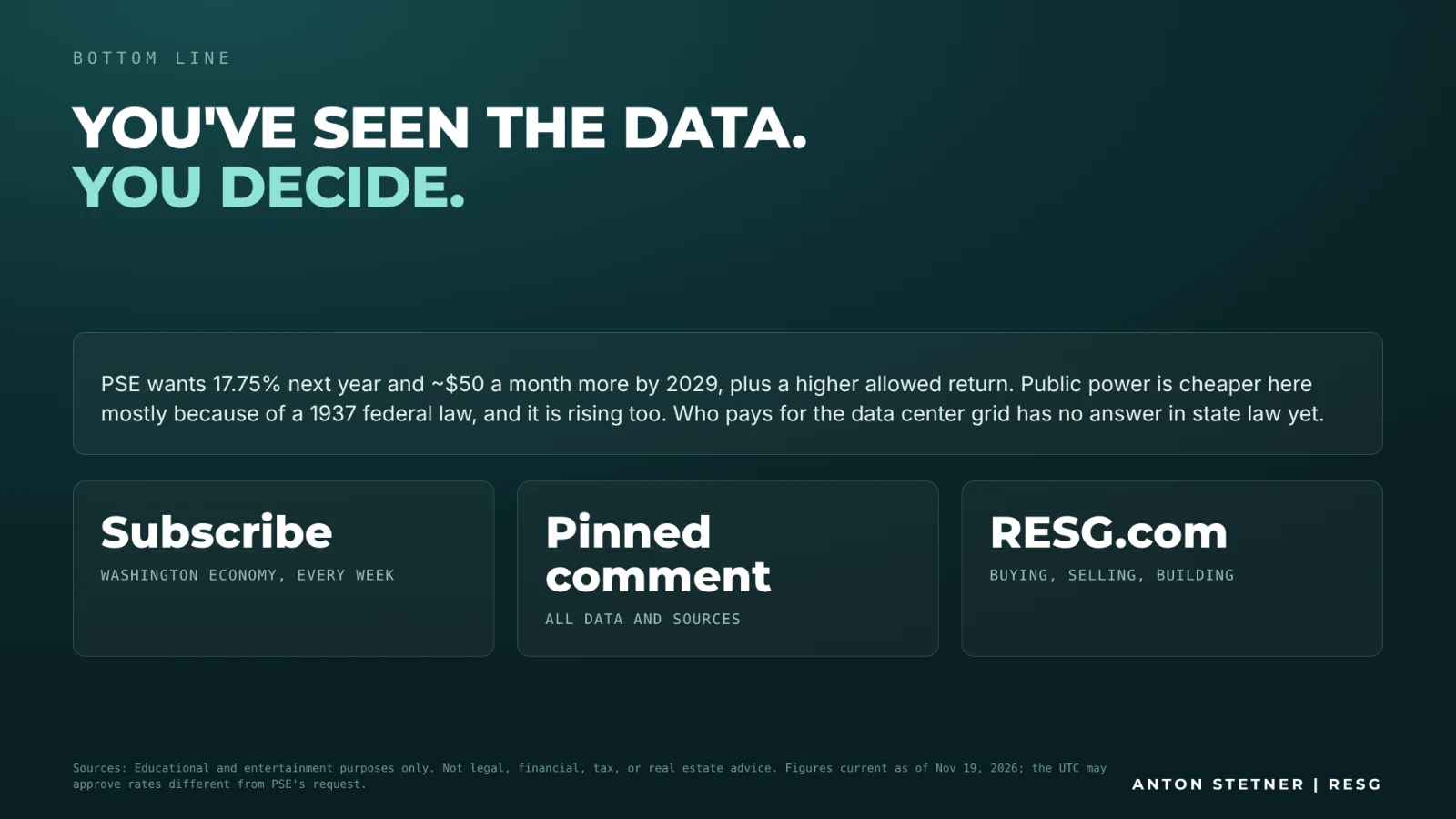
Anton And then in February, the new rate hikes will take effect, and Seattle City Light will start their new hike in January of this year. So the bottom line, PSE wants to make eighteen percent more on you. They want to make about fifty dollars a month more. I think this is something that people should be paying attention to. I think as Washingtonians, we have to start saying to all this stuff, to the taxes, the regulation, to the BS, to the utilities, no more. It's unaffordable. You're driving out the middle class. You're driving out business. We need the middle class so people have babies. They have their white picket fence. They have their dog, and they grow up here. We have strong communities and taxpayers for the future, and we attract businesses.
Anton And I believe, as you're buying a home, you need to figure out what the utilities are. This is the first time I've really started thinking about this in the last couple of years. It's like utilities are starting to become so expensive, and property taxes. P.S. I'm going to do a property tax episode. A lot of you have requested that. That one is coming. I'm just trying to decide if I want to do that as a live stream and have you involved in it, or if I want to do that as a podcast, or if I want to do that as standalone. I'm kind of leaning towards standalone right now, where we'll do one for Snohomish County, one for King. What's affecting property taxes, why they're going up, and how you can fight it. So if you think that's a good idea, let me know, and let me know what your big questions are on utilities. We'll drop the comments, the pin comment. We'll have copied all this data, all this information, so you can go see the data for yourself. You can decide what to do. I'm Anton Stetner.
Anton Hit us up at rsg dot com. Go fight with them before your utility bills skyrocket, and we will see you in the next one.
For general education. Utility figures are examples and may change. For an individual property or account, check the utility’s tariff and current service charges. Terms · Brokerage disclosures
Ask a question
Chat uses Functional cookies. This choice also allows optional video embeds when you press Play.