0:00Why housing reform has not solved affordability
Washington has passed all of these laws about creating more units, ADUs, DADUs, middle housing, and yet the housing crisis still continues. The first-time buyer can barely afford a property, especially with these high interest rates. And today's guest knows all about the gap between policy, land development and actually getting the product to the market. I've got my friend Mike Appleby back with us today, and we're going to discuss, really what's happening. Mike's a long-time real estate investor, a housing advocate, and quite honestly, one of the most knowledgeable people in our local real estate industry. And we want to know what's going on with policy, with land use, with housing regulation.
So last time on a previous episode, you and I both know Ryan Gillis. We went into the developer math, and today we want to go a little bit more upstream. We want to talk about the codes. We want to talk about the application. We want to talk about before all of that is happening to try to figure out what's happening before we even get into the developer math. And by the end of this, Mike's going to leave us with, hey, here's some things you should be looking at. Here's some opportunities inside of land development and real estate investing, and here's some of the policy things that we're working on. If you own a property here in Washington State, this is the podcast for you. I'm Anton Stetner. We do land development, new construction. I get to hang out with my friends, and we want to show you how these things are actually being implemented. Mike.
Multiple laws have been passed here in Washington State to create more affordable housing or to create more housing. Why are we running into this constant issue of there not being enough supply, but things have not also fundamentally changed in price?
2:00Homeownership and the missing entry point
It's interesting. Thanks for doing this podcast. Yeah, because I think it's important that we kind of keep this. We boil it down to keep it simple for everyone to understand what they're doing. I think some of these laws that we've changed, that we've endorsed, that we've sponsored, that we have tried to be part of, is everything about trying to add value in a market that's been very difficult to add value to a single-family house. And when we talk about housing, I think it's important to talk about homeownership and not just housing.
Because one of the biggest pitches we've had to do is we need to create homeownership options for everybody in the marketplace, and if I take a look at the math, and again, I'm going to just kind of use round numbers because I don't have it exactly in front of me because it changes month by month. Yeah, but if we're taking a look at my pod, my group of my demographic as being almost 50% of our buyers and almost 50% of our sellers, something's broken. And I shouldn't be that guy, and we shouldn't be that guy.
But when we look at kind of the overall picture of where we're at, millennials literally should be 40 to 45 percent of our market, and they're literally 25 percent of our buyer pool. So that tells me we've lost that group right now. The attainability, affordability, whatever you want to use for a number or a word, it isn't there right now, and it isn't there for that group. So we've spent, as you mentioned, an enormous amount of time over the last five, actually the last twenty years, but weren't very successful, and I don't think were very sexy at the legislature over the last twenty years. But all of a sudden, in the last three or four, when housing homelessness and other issues came up, that it allowed us a platform to kind of move forward to cover a lot of other people within our market. But the key for us and a lot of this.
We can create all kinds of housing. We can create apartments. We can create that. That's a simpler play, but it's the idea to take our individual home and create additional opportunities to create homeownership, and we're trying to create it at a price range that allows people to enter the market, a lot simpler than they have in the last few years. We've figured out that the point of entry, obviously, in the marketplace, is super difficult right now. And we're not serving our public very well. How's that? Our citizens haven't been served up until the last year or two, in a way that they can enter the marketplace. And I'll give you a good example. Yes. So when I came into the marketplace to buy a house, That it was probably about eighty five or so. We didn't have any money, and you know you were getting out of college, and trying to decide what you were going to do. We entered the marketplace.
On an apartment rehab condo, it'd be what we would call a three-story woody walk-up, which was a three-story walk-up the outside, and then we were buying what used to be an apartment building unit, and now we were maybe buying a two-bedroom that was 900 square feet or a one-bedroom that was 700 square feet, and we'd get in for like 70 grand. Yeah, and then we'd live in that for five years, and then we'd be up about 120 grand. Well, that built my equity. That got me started in the homeownership idea, and it also showed me that I could be successful in investing in real estate. So it kind of got my appetite a little bit. It allowed us to, form families sooner. In 1996, I was looking at it the other day. In 1996, I think it was under 36 years old.
Like twenty six percent of all the home equity in the entire country was owned by thirty six and under. Really, and now if I look at it now, thirty six and under.
It's completely the other way.
Maybe four percent. Yeah, maybe four percent. So that's telling me where we have not served our citizens well in understanding what's necessary to allow people to be involved in wealth building because the number one wealth builder in the entire middle class, which is about half of our population, entire country, is owning a home. Absolutely. And now what we've done now though is to not to drift too far, obviously too far from your question. We've created some opportunities to create some smaller homes, and created some opportunities for people that have existing homes to take a look at. Okay, well, really now, what I really have is not so much a home.
I may have an opportunity to build two DADUs there, or sell my property based on the valuation of my house and two DADUs, or three townhomes. Or it's allowed us on infill, without restrictions, without CC&Rs in our subdivisions, to take a look at a different way of how we're going to value our home. And now that's changed forever. I think that's one of the biggest changes that just happened, is our single family home, isn't so much a single family home anymore. It's an opportunity to create three or four homes on the same site, depending on the lay of the land that you have. So that's one of our that's one of our biggest changes and opportunities. And I think it's made the huge change for the value of our real estate brokers. They have the opportunity to look at that and decide. Oh, hey, you know what? What I can tell someone here has now changed my consulting ability.
Has become much more important for my seller and my property owner.
7:35State reforms and local implementation
So you're referring to specifically like ADUs, middle housing, and those laws. Now, as that got passed, how many years are we already into that? And is it bringing the amount of affordability and inventory? That we had hoped for on the legislative side, and then what's been the pushback from the cities and the counties in regards to it?
A good point because what's happened is a lot of them really didn't embrace it. They had to do it. So they knew the state law was coming around, and by the end of their ten-year comp plan update, they had to do it. So the larger counties, King, Pierce, Snohomish, they all had to meet it by a certain date, and they've got their House Bill 1110. They've got their House Bill 1337, which were the middle housing and the DADU laws. And again, we're still sponsoring and trying to motivate our legislature to add other ones as well as we see the need arise. So it depends on whether they embraced it or not. Your jurisdiction. And depending on what county you're in, we really did, and we helped sponsor some things that are going to help in the future.
That we're going to talk about here, which are probably three or four things here as we move on, that are the opportunities to actually profit or truly be a true real estate investor and not just wait for appreciation to take care of you. Because right now, appreciation is taking care of no one. Yeah, and we're just not getting there. For three years, we've called it the Great Pause because we've been in a pause. And every time I talk to someone that's a prognosticator, or when I look at everybody, they say, "Well, we're 12 to 18 months out between, from getting past this pause," and I'm asking, "Well, what is it that's going to change in the next 12 months that's going to get us there?" Yeah, I have no guarantees from anyone. I feel like the market has reset, and we're sliding forward based on the reset, and I don't know that other than, I would just tell you as a real estate investor.
I think I'm guaranteed appreciation because I bought something, and depending on what market I bought in, I can appreciate better in some markets than others. Like when we look around Snohomish County, we figured out a long time ago that Edmonds continues to be able to increase its value, and I think in the last year we saw maybe a six percent increase in value. And even though that sounds kind of paltry.
Well, when the rest of the county was down.
That's that's the way I look at it. You pick markets that make the most sense. Understand that there's a limited amount of supply. There's a need for people to want to be there, and if my 50 and over buyer is my number one buyer, I go find a town like that. Like one of the sleepers in the world to me is Anacortes. I mean that should be a market that moves forward. And as we develop out Mukilteo on the waterfront, I think you'll see some growth there as well. So in the next five years or so, we should see some change in Mukilteo as well. Some of the cities.
Went ahead and made it difficult.
This is where it was going to go.
The way they codified this, all of the changes.
10:50Lot coverage, height limits, trees and costs
So I want to set this up because I think this is super important for people to understand. When policy advocates like Mike go to Olympia and they work with the people who write these laws, and they get, the middle housing and the ADU bill to come through, and some of the, Stuff about the mixed use where it doesn't have to now always require so much retail, because they didn't pencil, and you know we get some of these wins. The city or the county can now decide that yes, I'm implementing it, but they can put all these roadblocks in the way. They can prevent some of this reform. So how are they doing that? What do those roadblocks look like? And then how is this now rubber meeting the road? For example.
That's a perfect segue into this. They look at it like this sometimes. If you're going to set up an ordinance or a law that's going to truly serve your citizens and serve your community, then set it up. Follow the way it was set up and understand why it's being set up. Don't try to control the holy heck out of every bit of it. And the way that we fight, or the way that some of them have stopped it, for example. If we're dealing with residential lots and I want to put two DADUs, two detached accessory dwelling units on a property, and then I have a certain amount of lot that I'm probably going to have to cover with those structures. Yes. But for example, some of the cities have left it out in their single family law and left it at thirty five percent lot coverage. So what they're really telling you is that you're not going to get two, you're going to get one, and then we're going to also retract it back to say okay, twenty five percent height.
Or excuse me, 25 foot height, as opposed to the 35 which most counties have. So you can squish the height, squish the lot coverage, and never really allow this thing to reach its full potential. And I think that's a lot of what we're doing. And at the same time, I'm going to pass more tree ordinances, and I'm going to pass more tree ordinances. It says that you got to keep 30 percent of trees. No matter where they are on the lot, as opposed to just saying, " Okay, I'll pay to have those trees removed. I'll pay to play, or I'll remove that tree and I'll plant three others over here, all healthy trees." And so, if I say, " Or what about even.
The idea of like a giant tree bank, where we plant these giant beautiful forests and the city buys into it because some of the trees that they identify as like, oh, it's an ugly tree, it's broken." It's gonna fall down in a windstorm. We just fought on one like this. The dang thing had been struck by lightning. Okay, it's basically getting ready to fall on the neighbor's home. And the reviewer is arguing like, no, this is. I was like, you need to come on site. I want you to look at this tree. This is the definition of an unhealthy tree. That is an example of a hazard. Now I love my trees, so if I needed to, and that's the requirement, cool. Let's plant one that's going to work, or put one into a beautiful tree farm.
I think it's a great play. Shoreline used to have one that said, "Hey, if you're going to remove trees, we can go over into a native growth area in a park, and we can replant in those areas to enhance an area that maybe been damaged and taken advantage of 50 years ago. That probably should be some kind of native growth area. We'll replant there. We'll replant them in parks and things like that. Then they change their ordinance. I'll give you a good example. We had a we had a six-unit townhome that were involved in." And I was a lender on, and participated in, and had two trees on it. The neighbor and I shared a tree, so we got that one removed through an agreement with them, and paid. And then we had this weird laburnum tree, which is just kind of a scrap tree on the edge of the property. It took us four years to get past that tree, And I kid you, we could have… It was kind of a scrappy, kind of a funky tree. And if you know what they are, they have like little poisonous pods they drop and.
And it was just kind of almost an accidental tree, but this thing sat right on the edge of the drive lane that we needed to get into the six units. So by the time were done, they said, "No, you have to keep ten percent of all trees, and that's ten percent of one tree is a tree." So we'd already removed one that was halfway on and off. The sad thing about this is, I now by having trees on my property or planting trees, and again, neither one of us are tree killers. We spend our whole lives here. We like living in this community.
That now I'm being punished, and it's a taking of my real estate.
So taking of your property rights.
Which is exactly where we're headed here. There should be a balance in all things. If we have balance, it always works out well. If one group takes advantage of the other, it never works out well. On this one tree, it took us four years. We spent fifty thousand dollars on a steel plating drive over drive lane and put it on individual pods. This is an eleven dollar tree. We could have easily put three very healthy trees in the planting strip or in front of the building that would have enhanced the look of the building and the area, and got rid of this nasty tree. But now this poor nasty tree sits there. It's got a fifty thousand dollar plate around the bottom of it, so water can get through and nothing can be touched in the root ball. And I kind of look at how did that serve the public? How did that serve your citizens? That fifty grand had to be added to the cost.
Of those homes that were being built, and I mean, there's a million examples like that because the tree codes wandering around and being reestablished all over the place, no different than critical area ordinances. Say I bought my property 20 years ago, and I have no wetlands on my property, and I don't have anybody near me. But now I've gone from you know 20 years ago when it was a 50 foot setback, now it's a hundred. Now it's a hundred and fifty, and it could be three hundred feet. Well, now if it goes that far, now I've lost the entire value of my property because now a buffer that doesn't even exist on my property, or excuse me, a wetland that doesn't even exist on my property, now encumbers me. I'm getting geeky technical a little bit, but the truth is, you shouldn't lose your established property rights by somebody keep changing rules as you went along.
There are so many people that I've worked with. I mean, by the hundreds, that their family owned this property. Their grandparents owned it. Their parents lived there. Now it's been dropped down to the estate, and the kids are trying to go. Okay, well now we paid property taxes on this as developable for the last forty years, and now you're telling me I can't get that anymore. So there, we're losing our balance, is what I'd say. But that's not fair to people that have invested and spent money. And have spent their whole life on those properties. So there's some things that we are losing. That how you ask, you ask how it gets stopped. It's things like that advancing without any input because most of us don't know enough about those kind of things when it comes to the changes going on in the city. It's a two hundred page document. We don't understand really what's happening. We go around and advocate for property owners, and we advocate for future homeowners.
To have the ability to use the property that's infill, because if we're going to draw lines around the cities and the counties that stop us from in developing any further out, then we have to maximize where we're at. And I think it's more important. We shouldn't have the choice of an apartment or an apartment. To live in the future, and that's where greater densities. I'm looking out 20 years from now for my grandkids, past my kids. What their choices will be, and I feel like a single-family home and homeownership has a target on its back in the state that we need to figure out how to balance that. Does that make sense?
Absolutely. I want to cap this off, and I want to come back to one thing: the single-family home is literally on the endangered species list. Yes. The Growth Management Act is controlling and preventing that single-family home. What I think, though, that, And I've said this before, so I want to reiterate this. Unfortunately, this is some good ideas and good policy that has now drifted too far into ideology, that then directly conflicts with economic realities. And those economic realities are very simple: we are not building enough housing to keep up with population, and two, because we can only build large apartments.
We are now starting to miss out on family formation, which is our next generation, which is our strong middle class, which is our next communities, and the next taxpayers. We have to get this figured out, and this is why I brought Mike back again, because I'm very passionate about this too. Mike and I are both passionate about this idea of homeownership, attainable homeownership, not affordable housing. Affordable housing means a roof over your head. So I just wanted to kind of cap that off, but I want to circle back to the, to the density, the issues, the blocking. What we see over time is it's a form of NIMBYism, yeah. And they use code and this stuff to protect that. You mentioned, like people should pay attention.
20:31How owners can stay involved and protect their options
How would they get involved? How would they pay attention to this? How would they protect their property rights, or their land, or their setback, or their trees in the future.
Well, you have to stay involved with your community, in other words, your jurisdiction, your city or your county, and you can put yourself in to be notified. Most people involved in a city are supposed to be notified if there are going to be hearings or changes. It's hard to be that land use geek. I mean, you got a life. You have kids. You have a job. You've got you know other things you have to do in your life, and they kind of derail and start over again, and kind of go, okay, I got to figure out a hundred-page document. Impossible. I wouldn't do it. I don't know any media people that would, but there has to be people that actually are fighting for property rights. And when I say fighting, I got to be careful about that word because it's it's more just advocating to make sure that we're not going backwards because it's been a death by a thousand cuts.
Over the last twenty some years, because it feels like we never get a win for homeownership, we slowly but surely kind of decay our ability to create this product, and then we aren't expanding our ability to have land to actually add to the pie as well. So it's been difficult. Yeah, there's there's a number of ways that you slowly but surely lose your value, but there are ways that we did in this last go around. In the different ordinances and laws we've been working on, we spend a lot of time with advocacy with our politicos and our electeds, and more than anything, we spend our time either through Project 42 or through Affordable Housing Council or through our state board with BIW or Master Builders of King and Snohomish County to educate electeds. It's I didn't realize until I'd been in the game for a little while that everything land use wise is politics.
And it's super important that we continue to educate and think about this for a minute. I've got seven people on a city council. One works for the school district. One's an insurance agent. One has the teriyaki shop. One, just pick a business. They all have different businesses. They're not land use experts, and they're getting fed a certain agenda by the staff of the city. But they need to also get input from you, the citizen, saying you know what does this do to me, and hey, I don't know that I appreciate what's going on here. I need a balance. There's, I can get structured, internal people that are involved in working for the municipality, but I need input from my citizens to tell me I don't feel comfortable with what's happening here.
So you're right. Without getting the sign and going anarchy and you know chasing your council members down, I think it's more important that you do have some input into changes, or understand from somebody that would be on your side as a property owner to make sure that you understand whether your property rights are decaying or that you're adding value. There are some cities in this county that do a fantastic job of understanding the needs of their citizens.
And then there are others that probably pay a little bit too much attention to staff. I'm not saying staff doesn't know, but they're following the line of the law, and it doesn't allow for some flexibility in how we actually move forward with our property and how we actually turn our real estate into an investment beyond just appreciation. So I don't know if I know the answer.
No, you're answering it great. I want to throw in an idea here. Ladies and gentlemen, when you own a piece of land, when you own a house and it's got trees on it or wetlands or setbacks, I want you to protect your property rights. Like Mike said, we're going to throw a checklist into the pinned comment of things that you can do to protect your property rights. Things that you can go through and check for. Number one, number two, that includes just using the land.
So an example, because Mike and I have done a lot of land development over the years. We've been involved with a lot of clients. When you stop using the land for whatever you were using it for, you may be losing the right to use it. That buffer, because let's just say you know there was a a creek or a stream, and for fifty years you would use the land up to twenty five, thirty feet away from that. Well, that is clearly what you've been doing. And you're not encroaching into that buffer, but now all of a sudden, if you stop using it, you may lose twenty, thirty percent of your land, in a taking, in a policy change, because you're not quite paying attention to it. So one, we'll put that checklist in there. Two, hit that subscribe button because you guys know that I want to share these things with you. I'm all about Washington State, about showing you the data, about how to do it. Share this with someone who needs to understand how their land.
Is working for them, or quite possibly working against them. Next, I want to move over into like policies. So, out of these things that we have passed, what policies are creating or laws creating this real opportunity for homeownership? And is there things that are that we still really need to do that we're not quite there yet? Like the condo one is kind of the ones I'm thinking on. They're not quite there yet.
26:10Critical Area Site Plans and the Edmonds example
Yeah, I think there's a few things. I mean, going into a different type of property separation, you know. There's one thing you always can do, and most most people don't know. If you own real estate that's near some type of critical area, remember. Right now, we're going through a critical area ordinance update through Department of Ecology, and what the definition is, and the definition is didn't really change, but it keeps moving anyway.
And the goalpost keeps moving.
That's about it. I get fatter and slower. It feels like just as if I was going to. Throw it into the football kind of idea. Takes me longer to get to the goal line now than it did before, and it probably takes me four tries.
But I think if you take a look at, like, there's a CASP that you can get recorded, a critical area site plan that you can go through, and I can tell you that I've used that a number of times. We bought five acres down in the Edmonds area, and we bought it from someone that had recorded a CASP, a critical area site plan, locking in the ability to have twenty-five foot setbacks from a wetland area—they were really managing their investment correctly. And a critical area site plan, if you record that in most jurisdictions, it locks in whatever the setbacks are with the critical area ordinance as at the time that you had it recorded, and you went through the jurisdiction to get it recorded. So on that piece, I think the setbacks were twenty-five feet.
And it looked wet to everybody, just because there was a stream running right on one side, and it was somewhat timbered. But when you went through and you saw the CASP recorded, it was at twenty five feet. Now those people ended up selling it to us for about a million six, I think. And if they hadn't sold it at a million six, today's value would have probably been about four hundred. Wow! Because the wetland setbacks had changed that dramatically over the last 20 years. That their real estate investment would have dropped immensely. So that's one way that I create an opportunity to not have to worry. I can move to Las Vegas. I can decide to sell it 10 or 15 years from now, and not have to worry about laws changing on me. The things that I would look at, the time we've spent, and what I look at is some of the things that I think we can make. It's really hard in real estate right now, especially if you're a home builder.
To make money, it's very difficult to put finished product out there right now and go. Okay, this was a good idea because you've dropped twenty percent, and that's normally twenty to twenty-five is what you're trying to make on a project by the time you get done three and a half years later. So, and in some markets.
That is a gross margin, not a net margin.
28:51Play one: backyard DADU condominium opportunities
Yes. You have to pay some other people out of that. So I would tell you that there's about three things that I think, in a small way, make sense. The DADU condo option, which you're allowed two DADUs, detached accessory dwelling units, two attached, one of each, whatever, on your existing property. I've seen that in a number of sites. There, for example, if I if I'm older, I'm older, not there yet, but I'm older, older, and if I'm at that number and I want to age in place, yeah.
But I really need to get some money out of my property. It was my number one investment that I had. I have the ability now to go ahead and condo my lot. Maybe cost me ten grand to put the condo map and plans and you know that stuff together. It's not as complicated as people make it sound. I can literally start selling my backyard. Everett's a great example. We've had 260 DADU permits, either in application or done since we started this process of going in. And Everett was. Really out front with it. For example, they had like six thousand lots that had alleys attached, and then they had a lot of other properties that this could actually be done to based on access. And so we had gone in and figured all that out. And now we've had probably a hundred homes sell in North Everett that never would have sold, never would have sold unless there was the ability to do this and investors could step in and actually find a way to build.
Detached accessory dwelling units and sell them.
Revitalizes the front unit, which then builds beautiful product in the backyard. So you're taking parts of Everett, and I love Everett, so it's not negative. The parts of Everett needed to be revitalized, and they embraced it, breathing life into it.
Thank you. And they embraced this early, and they worked with us a number of times. What I find with cities and with counties. If they try to make these rules in a vacuum, I don't know how many times we've said because we meet with all the cities and counties pretty regularly, just kind of going on housing updates and what we think we'd like to work with them and what is their plan and how do we involve ourselves. If I'm going to make a cake, I should probably know what the people want of the cake that I make, right? I don't think a lot of us want a sawdust cake.
Yeah, it doesn't make sense. But do I want a chocolate cake? Do I want something like that? Yeah, I think I should probably ask the consumer or the citizens what makes sense. Ah, you've got the ability on this for to allow someone to age in place, stay in their home, pay their heat, groceries, prescriptions, all the things they want, and literally say, "Hey, you don't use that carport; it's just a mess. Your backyard's a foot high." But I'll pay eighty grand for your backyard, yeah. And then you can age in place. That eighty grand at seventy-five years old, that's life-altering. So that's one opportunity that we have. People actually can, don't have to buy the house. They can just buy the yard, and/or people can call that part of their investment. What we found is, let's say I was going to pay five hundred thousand dollars for that property. I sell the backyard off.
And if I want to resell the house, we found it sells for closer to 475. So it's not that far off of the original value. Yeah, about a five percent difference between. Yeah.
Thank you. In the removal of the primary structure.
Because it didn't really have a lot of value in the back. There's a couple other things that make sense to me right now, and this isn't geekdom. This is like, we're not going to hit a lot of home runs. The, People coming in and buying our land aren't paying the same value because they're having trouble selling the back end of this product right now. So if there's no money in selling the back end.
32:47The construction market and the cost of waiting
Let's Mike is being a little bit light on the selling of the back end, and so no, no, we need to be really clear about this because I want our listeners, our subscribers, those of you that hit hype, I love you, the to understand what this means. How bad is that? The new construction market right now.
Well, whenever markets go into what we'll call the pause, yes, or a shift like this, the things that sell are middle of the road. The things that are naturally the everyday two-story detached home. It's been unique in the last year that the high end. Now, if someone had come to me and said, " Mike, I got a plan. I'm going to build two million dollar specs."
You even say you're crazy.
Yeah, you just go well. Just give me the money now, and let's just burn it. But right now, that is actually the market. Depending on the market you're in, that's the market that's actually playing because those folks that are buying that high-end house, they aren't looking as closely at the interest rates and things. They can afford what's going on, and so I would, I would tell you that depending on the kind of product you're building, I think you'd be lucky to make five to ten percent. On the single family, after you've spent four years trying to get there, the townhome market, you're making probably nothing.
You're probably losing money on the townhomes today.
There's a large cut of the existing product that's in the marketplace right now that's going to go to rental, and stay there for the next two, three years while it's in a pause and wait till this market changes, and then move forward and try to sell the product then. But right now, it's probably going to enter the rental pool. The thing that's actually working—it's hard to create a townhome land development and vertical, and then rent it to make sense on a day-to-day basis. You're just trying to find a way to pause to get through this. Yeah, I would tell you it's difficult right now because of the amount of capital it takes to do apartment buildings. But we're going to see a change coming there. We're going to start seeing modular apartment buildings being done.
It still works to do apartment buildings based on what we're getting for rents. It really does still work, but it's a small crew of guys that are out there doing it because it's a big play, and it's not like I can go invest half a million dollars and go try to make a hundred grand. It's more about investing twenty-five million dollars. Yeah, and so it's a different game there. So apartments are still working on a cash flow basis. It was weird. I was talking to a couple of clients the other day and friends.
And talking about what would you have done if you had done this twenty years ago? What would you do?
They said I'd have done apartments twenty years ago. I look back on how many foreclosures we've seen in the foreclosure market with apartment buildings, and how many apartment building guys didn't get through the market. Other than the big guys in Seattle or the big guys in Bellevue, the four to five to eight hundred units. Probably some of those got it got really stiff for them, but our guys up here are still in the game, yeah. And they've done apartments and been successful and got a permanent loan locked in and kept moving forward. I think it really depends again on what your strategy is and what your play is, but that's a different pool. The everyday person can still make money in real estate in what they're doing, and without drifting too far off of your question.
36:22Play two: rural acreage and DADUs
I'll hit two other things that I think make a lot of sense. We came up and sponsored an ordinance in rural Snohomish County that if you have two hundred thousand square feet, and again, remember we're in a market that we're hitting singles, and we've got to stay in a market that actually makes sense to hit singles for a while, because you try to make wages in tough markets, and then you try to hang around and wait for the good market, and be able to expand on your wealth then.
And ladies and gentlemen, I want to point something out. A single can be hit by a first-time homebuyer, by a small investor, so everyone really pay attention to this right now because this applies to the whole gamut. What Mike is talking about.
Well, I take a look at a guy that's managing his own rentals on single-family, and I had a gentleman here in Everett that had been a client for years, and he probably had about a dozen rental houses in Everett. Yeah, and I remember he kept tapping on me: When are you gonna be done with the ordinance? When are you gonna be done with the ordinance? And he's staying in touch. And then I bothered to look a little closer and say, Oh, okay, now I know why he's interested. There's a great investment value in it. So he's got the ability. So now, literally, he could go back in on like ten of his residences, his rentals. That is. And again, you're you're managing rentals with the idea that you're going to make wealth or income off them at some point. You're not in love with it.
And so I figured out that he could get about twenty DADU lots, off of his rentals, and throw seventy-five thousand dollars a unit. So you do ten thousand dollars a condo to get it recorded. You at one time, maybe not today, you got seventy-five thousand dollars per side for those two extra units, and you still had your rental house. You're still going to rent it for the same amount of money. That's not going to change. But he gained some equity immediately when we pass the ordinance. So it's being in the right place at the right time and understanding what's going on. I've made everything we've made, other than in apartments, off changing the use of property. Yeah, and that's that's the key to just saying appreciation is yours no matter what because you own it. But being smart enough to understand how to change the use and what to do with it. The rural DADU, we're the only county in the state I think that you're allowed to condo a rural DADU.
So what you can do is if you have two hundred thousand square feet.
Now which is a standard five acre lot, five acre lot in the R five zoning.
I've never figured out that somebody can't figure out the math that five times forty three five sixty is about two hundred and twenty thousand square feet. But to the county, two hundred thousand square feet is five acres. But we're not going to argue because we get a win out of that. So what would happen is that I would take maybe an acre of that, cut off a one condo lot on one acre. And our rural DADU ordinance allows us to build a 1,200 square foot DADU on that lot. And so you put in a 1,200 square foot DADU. You could put in an RV garage. You do a two-car garage, a three-car garage, whatever. Sell off the four if you chose to. But more importantly, let's say I bought it for three hundred thousand. A four and a five-acre lot is going to sell for exactly the same, literally.
So what I want to do is I want to sell off my four that I bought. Let's say I paid two hundred and fifty for it. I want to sell off the four for two hundred and fifty, and then I want to keep the one. Well, I know that's going to sell for about one hundred and fifty. It literally will. So that's a ten thousand dollar condo investment. If I want to take it one step further, farther, whatever, I can build a house on that at about twelve hundred square feet. My math says that. I made one hundred and fifty off the lot, just automatically by recording the condo. But I have the ability on that other house to probably sell it for what do you say, seven hundred, seven fifty?
Depending on the area, but yes, six and a quarter to seven fifty.
I probably make another hundred thousand. So that's a small play, a small way to go about. And again, in markets like this, you take advantage of what's going on. And you try not to put all your marbles out on the table. You wait for the opportunities to come up. That's another play that you can use besides the condo. The other one is in Snohomish County. Once again, now again, that last one I told you about. We just passed a new house bill 1345 that allows for rural DADUs, and a residential and a principal residence, on one acre. Now that law didn't allow for condo.
41:00Play three: duplexes, DADUs and paper development
So it won't play as well in my scenario, but in Snohomish County you can, and we've got 8,000 of those five-acre lots. So the third one that I'd look at is inside the urban growth boundary. Right now, the way we've set up these changes through middle housing and through the DADU ordinances, I can put a duplex. I only have to have like a 9,000 square foot lot. And in the county, I can cover the lot with 50% structures. So I go find just a regular lot inside the urban growth boundaries. In the county jurisdiction, I can put a duplex on there. Let's say 1,900 square feet a side, two car garages. I'll put that on the front. Then I have the ability to put two 1,200 square foot DADUs on the back, or in the front, or on the side, wherever. And then I can actually build those out and sell those at whatever. But I don't have to go that far. I should be able to, sit in my beanbag chair in my basement and do this. And so basically, I need to have a surveyor.
A real estate attorney that does condos, a biologist and maybe a geotech, and that's about as far as maybe an engineer for utilities. But the real play is, I just go and make sure the utilities work. Then I record the four-unit condo, just the map. It doesn't take land use. And then I let's say I buy that lot for two seventy-five. I know I can sell that all day long at four to four and a quarter, depending on location. So now I've not gotten my feet dirty, but I've been a… And here's the other thing: it doesn't take two years; it should take you about four months. Does that make sense? Yeah, it's quick. Those three things on paper—that's the old paper developer style, just like the paper condo and the paper rural. I'm really just doing something on paper and doing some consulting work, and those are three ways that I know that you can create opportunities.
Back in the day before the market shifted in '07, we had I think somewhere around 200 spec builders, and then went to 19. And if I were to look around right now and look at how many guys we have that build over 15 houses a year in Snohomish County, six, yeah, eight tops. And so now all of a sudden the small investor. The flip guy — they can't find flips anymore. This is what he's doing. He's finding a way to reinvent himself. But I see this way as being a great opportunity for somebody to go in without having to say, " I'm all in." I'm at the hundred thousand dollar table and I'm all in. I could be at the hundred dollar table and just kind of play the game and stay in it. And let's say I did one or two of these a year. Pretty good living for four hundred grand.
43:49Bonus play: the two-lot split
Extremely good. Let's throw in the fourth one that's coming next year. Yeah, explain the lot splitting bill, the old school two lot short plat, so people can kind of be mentally thinking about an opportunity that's going to show up for them next year. Hey, by the way, this is us showing you what's coming in the future through land use and creating an opportunity for you just next year.
Yeah, we just had a meeting yesterday with the county, the county, Snohomish County. Yep, all of the counties have to come up with this, and the jurisdictions have to do this new lot split. And so.
When Mike says jurisdictions, he's referring to the cities.
Cities. We passed a law, the lot split law, that is an abbreviated process for doing a two lot short plat. And here's what the cool thing about this is: if I were to let's say you had a really large home, yeah, but you had a half acre of land. And there are a number of those around the county, and if what I had to do before was I had to sell you my house and my land, I don't want your house. Let's say the retail value of your house by itself is a million and a half. Problem is, I was only going to give you maybe a million, maybe because I got to fix it up, I got to develop it, I've got to clean it up, and then I've got to have closing costs on the way back out, and I can't afford to put that much cash.
I really wanted just your big yard to put four lots on. Well, now this actually works really well for school districts, churches, people like that have large holdings of land and don't want the land anymore; just want the church. So what we're able to do, and the county told us they literally could get this done in two to three months. So it's just a paper short plat. You keep your house. I just get to buy your yard. It's a very simple approval process. I turn in my map. They approve the map and the concept of what I'm doing. Within a couple of months, I can record the map and then I can buy your yard. And then that's actually a legal short plat, not a condominium. You keep your house, go sell your house for a million and a half. You just got eight hundred thousand for your lot plus a million and a half. So let's say you got two point three million. What I would have paid for it at the best was probably.
A million plus six, probably about a million six. Yeah, does that make sense?
So just just a skosh over the fair market value.
Yeah, I the holding cost and everything else that goes on, prime plus one is like eight percent now. That's not and prime plus one, not many guys get it. So I guess I'm going that's an ordinance that we've just approved in the city of Everett. And that Snohomish County were right on the verge of getting this done. And again, when we met with the county and their staff yesterday, they—I was actually unbelievably surprised that were going to be able to get it done. So now I can make a deal with an owner, or anybody. I mean, can make a deal with an owner, or you as a broker. You could go to that owner and say, "Look, stay in your house. Let's get this done. Let's sell the yard next door, since that's way too much property for what the house needs." Yes.
Let's maximize the value for your yard that you've paid taxes on for 25 years, and then let's absolutely maximize the price of your house and sell them separately. And it really only takes a few months to get it done, and maybe about five to ten grand. So I think that's the play for a lot of real estate brokers if they're trying to figure out. Because again, if I'm a small guy trying to do four lots, you know this, Anton. I can't pay you a million to a million and a half for that house. I won't do your deal. There's not enough money in it. To make me take that kind of risk, and then I'm probably under the old short plat law, two years, yeah, easy, yeah, probably about two years plus all the real estate development and the frontage that I would have to take. So thanks for bringing that up because that's gonna maybe that's not a maybe that's a bunt single or a hit by pitch, maybe that's not exactly the single that I was talking about that you're bang bang, but it allows opportunities for sellers to actually get the market value of their property that they've owned for years.
And it allows other people to not have to take risk that's unrewarded. And in this market, we need to look for those opportunities.
48:06Feasibility, consultants and hidden project risks
I love it. That was golden nuggets, ladies and gentlemen. Let's talk about like what are the hidden pitfalls? What are the things that like they just kill these types of projects? CC&Rs, setbacks, things like that. And then we talked about those opportunities, but are there other opportunities that you see coming in the future? After we talk about this idea of like, hey, pay attention to these hidden pitfalls. These are problems.
So what I would start with is, don't ma and paw this deal, Don't try to bareback it and try to figure the whole thing out yourself. There's enough qualified individuals out there that are planners, processors, and people like that know how to do this. We need to make sure that the feasibility process is done really, really well. It's no different than building a house on sand. You need to know whether that's sand or whether that's hardpan. Why go put all that money and time and effort into the top of that property when it's going to sink on you later? If you do your feasibility correctly, if you use the correct people that understand the jurisdictions and understand the laws and the rules, yeah.
You're pretty solid up now. There's going to be some things that always go wrong, no matter if you're a genius or you do this for a living every day.
Thank you. Never know. I mean, we've hit a Volkswagen before under the property because nobody knew, and we've done testing and everything. But if you get below a certain depth, you're going to find stuff. So I meant more as far as understanding the rules and the jurisdiction that you're involved in, without a doubt. The geotech process is important to understand. Without a doubt, you need to understand the setbacks and whether the rules and the laws are changing. I finance my son and his projects, and I had made a phone call the other day that said, "Hey, you know the critical area ordinance in Snohomish County. You know it went through, but it didn't go through. It got an appeal. Do you have all your rural cluster subdivisions? Do you have them submitted? Because."
When this appeal's done, I have a feeling they have a chance of doubling up on the setbacks on wetlands. Wow! And I don't know of a fifty, seventy, eighty-acre parcel in out in the rural area in the R five zone. I don't know one that doesn't have a quarter wetland. Of course. So it's important that you understand that, or you hire people that understand what they're doing, and you know those people. You know what you're doing. I know what I'm doing. But if it's a jurisdiction I don't know very well, and let's say it's been a few years since I've been there. And now I've got a new planning director, and now I have a new planning staff, which in almost all cases you do. I need to get somebody that really understands that as a business. So don't try to do it bareback. Don't try to figure it out on your own. That's the collision that I see for most people. I don't know how anymore. Well, I used to in the day because I'm a car guy. I can't fix transmissions and things anymore. Yeah, I'm not going to buy something that's a project and go. Well, yeah, I'll just fix the engine and.
I'll get that redone, and I'll put new pistons in, and I'll redo the tranny, and everything will be fine. I'm going to make a mess out of that. I'm going to curse and swear and bust my knuckles up, and every other stupid thing that can go on. And then I'll order the wrong parts, and this thing will turn into three years, and it'll be a mess. And then I'll never do it again, and my wife's yelling at me because the garage is full of oil, and the house is a mess. And so I don't want to do that. I just want to hire somebody that really understands their job. No different than hiring a broker like yourself or someone that goes, "Okay, I really get this stuff, and I have connections on who I can get you to that gets this stuff even better." So I understand the concept, but the minutia is what gets you. The distance of sidewalks to put in, the length of a road, the width of a road, the setbacks from the property depending on the height of the structure. There are so many things that I've never been a.
An advocate of doing my own dental work. Does that make sense? I'm not going to touch that. It's your turn. You go do it. I hate going there, so let's just close my eyes and have you practice what you practice. And I look at that no different than anybody else. If you own a convenience store, the last thing you should do is land development and think you can just figure it out yourself. Don't walk into the counter and just try to figure out well the county said this or the city said this. They said that, but that's in a perfect scenario. And so you need to have people around you. So those are usually the pitfalls I run into. Without getting too geeky and small time technical, it's just not understanding what I can do because a lot of times I got an acre, I can cut that up into eight properties or into eight separate lots or units. There's not a lot of one acres just hanging around waiting for you to buy.
Normally, if somebody brings you something like that and you're not a normal real estate investor, there's something going on with it, and there's a whole lot of things that are going to make that four units, and that's what you don't want on the small projects. If you thought you were going to get four units and you get two, you're way upside down. You can't get out.
And I want to share an exact example of this. So, I do projects also for investors and for other people. A gentleman is paying me to do a PRD for him in the city of Marysville, and this is why you have to have the amazing consultants. They go, oh, by the way, not only is there the wetland buffer setback, there is a setback from the edge of the wetland buffer into the lot. No jurisdiction does that, okay? Because the first setback should be enough, and Marysville was like, oh, there's an additional 15 feet on top of that.
So what we do when we get each one of these comments, one we run them through AI now. That's kind of fun. And then two, but we sit down with all the professionals on a Zoom together. We work through each one of them individually with that specific professional, and we address it to figure out how we're going to solve it. And we come up with plan A, B, C, and sometimes D on how to solve that issue. And we realize, oh, we can do some buffer averaging. We're gonna move this lot up. We'll plant some trees over here, and we'll just shift the plot just slightly. And we're gonna move the buffer line slightly by doing some restoration work and some buffer averaging. But without all of those consultants on the same call, and them being just like the dream team, A players, you just lost a building lot. Well, that building lot is worth.
Somewhere between a hundred and sixty grand, one hundred and fifty grand in the raw to two hundred and fifty, three hundred thousand finished. That's a lot of money. But if the professionals aren't there guiding the way, you're just like poof, there goes another one. Oh, there's a there's another tree.
It's funny you say that. Your goal is to make twenty five percent on let's say the number might be in the raw five hundred thousand. Yeah, and that's just for the approval process. If you lose twenty five percent of the property, what did you just do?
55:19Evaluating a home for its development potential
You took a long, sweaty walk, and all you got out of it was a shower at the end. So we've all done enough of those projects. So what happened? What used to be is okay. This doesn't work right now. We hang on, and time helps you. I think the key to what you just talked about is: is it the same price to have these consultants sit in on a Zoom and do your feasibility and then hire them to do the property as if they didn't sit in? It's the same price. So why wouldn't we consult like anybody else for something that's going to probably be the largest investment we'll ever make in our life? I think what I want to do is not scare people today. I want to help them see the opportunities that are there, and that there is money to be made. But more importantly, is your house is no longer just a house. With these middle housing and DADU ordinances and the other ones we're passing, it is a change of use opportunity that you just got for free and you didn't know about it.
And now, just understand your real estate brokers understand this now. What's been going on? I've done two hundred classes probably for the real estate community, and I know you do them and you do the podcast. Thankfully, for the community to understand, to get to a bigger number, it's important that they talk to a professional, and it's important that they understand. Now, well, you mean really? I mean, when this law changed, I just grabbed a hundred grand extra. Yeah, you did because it's not just a house anymore. It might be three other lots, and at fifty thousand dollars a lot, okay, I drop my house price a little bit, but I drop my house price fifty, and I add one hundred and fifty, or I go ahead and record the condo myself, and I take the value all out of it, and you know again, if it's a rental property, do I care? Yeah, no, because it's a real estate investment, and again, I've been blessed a thousand times over. I'm a knucklehead from Lynnwood.
I you know it's not like you grew up with this thing, but appreciate that. But everybody that wants to spend the time to understand this, the best thing I can say is, don't be a surgeon. Know a good surgeon, and that's the best way to go. And I think you are a great source for that. If people reach back out to you, you can help direct them in a direction or talk to your real estate broker. They all understand what's going. Most understand what's going on, and. We got, we got a nice hit when we change these laws for just regular homeowners that are involved in subdivisions that don't have CC&Rs, obviously. And I probably look at, I want to say five properties a day, for clients and friends to say, okay, yeah, this was something you can do. About half of them, you can't do anything. The other half, there is value there, and the value might not be there right now, this year. But understanding that.
You do have value now, and if you time it right, you'll do really well.
Exactly. I we just talked to a gentleman that had called in because of the podcast, and he said, " Hey, can you look at my property in Tacoma? And it's in Browns Point. I mean, beautiful. And he bought it in 2020, and he's like, 'Well, I thought we would just build a house on it, and then all of these new changes have happened. ' " And now I have all these new opportunities, and he said, "Would you evaluate it for us?" I said, "Absolutely." So we're going to run through. We're going to do the evaluations. We're going to look at multiple different ways to try to figure out what's its highest and best use. What are the multiple exit strategies, and what's going to be happening here? And he says, "what do I owe you for this valuation?" And I said, "Oh, you don't owe us anything. This is kind of a simple one. Like if they get really in depth, or we've got a full appraisal, it, yeah, I'm going to charge you."
We do that for you know for attorneys and developers all the time.
But this one I was like, " Hey, just give us the opportunity to list it or to sell it or to help you buy another one in the future, and then leave me a good review." He's like, " Are you serious?" I was like, " Yeah, it's not. This isn't rocket science, but so few brokers play in the land development space. So, what do you think, like?"
But it's not really the land development space, not anymore. Yeah, it's really every broker needs to understand this process because if somebody comes to me and I'm a broker and says, "How much do you think my property's worth?" You need to take it through the drill of whether what is it going to sell for as a resale, what's it going to sell for as development value. Now, if I'm going to go in an interview, if I'm if I'm going to if I'm going to sell my property and I interview three people. And those three, two of the brokers come in and go, yeah, it's going to be sell for seven fifty. It's just the whole market's at seven fifty around here. And the third guy comes in and goes, well, what you really have here is a house, but then you have enough real estate, and then you have the ability to put a driveway or the length to get a driveway in. So it looks like I can get three more lots back behind. Who am I going to list with? Exactly. And I think you can get eight seventy five. Well, somebody just gave me a true analysis of my property, not just throw a resale value out there.
And that's kind of what I do for a lot of the real estate brokers around. I shouldn't say I, but I can direct them in a direction that can get them the idea of where they can find this. And I think that's an important distinction. If I want to be the smartest guy I can be in what I do, so I think it's a skill set that all brokers should understand. That once again, you don't have to truly understand the entire consulting business, but you need to know people that you can talk to that can help you evaluate whether it can be done or not. I just worked with a guy up in Anacortes the other day, and he goes, I did a class, and the guy goes, I think I'm trying to figure this out. My wife and I are, I can't remember what age we're, but older than me, thankfully. There are very few of those guys in the room anymore, so it's always like I want to take you aside.
And he was going. We're trying to figure out what to do with this property. And then I look at the property on an aerial. We just did a quick Google search, and I said, "Well, your house sits here. You've got a driveway coming down the side. You've got more property along the side of the driveway. The new ordinance they just passed up there. We could knock in two DADUs on that side. As a matter of fact, you don't even have to do them. You can just condo map it. And I guarantee you, there's enough guys in town here in Anacortes that will buy those condo lots from you." And you don't use that side of the driveway anyway. You just got to mow it like a monkey all the time, and just try to keep the grass down. And so, he's on it. That's awesome. He's going to do that. He's going to make an extra hundred and thirty thousand dollars.
What are the fixes that we need for housing to have more units, to be more affordable, to be more efficient? In the creation of units.
I think some of us overthink this, but the weirder thing about this marketplace is, and I talked to — I mean, we probably work on eighty percent of the new construction up here. And when I talk to them about you know where their number is, again, we don't do this. We don't risk our entire net worth to just have a job. It has to be if you're going to take that kind of risk with your family's wealth and everything you own and. It has to be an income producer. Yes. When I look at what I've seen lately, maybe it isn't housing. Maybe it is housing in this market, as opposed to homeownership, on where I think an opportunity is. But to restate your question again, so I well.
Just like what are the three fixes or the things we need to do. for affordability, for more units being created, for maybe speeding up the process, making it more efficient.
1:03:09Comprehensive plans and changing density
We've got so we just passed our ten year update. Yeah, and some of the smaller counties are going through theirs now. It goes large counties, then small counties, and then smallest counties, and so they have they've got every ten years go through an update. So if you just own real estate, yeah, that doesn't have CC&Rs. The city and the county are required to go through, and come up with a 20-year population projection from the Department of Commerce, and they go through this 10-year plan by state law through growth management. And the good thing about this is sometimes you just make money by standing still. So they go through and figure out: okay, the state tells them, here's your 20-year population projection.
And they take a look. The city takes a look at all their zoning and says, "Okay, if that twenty-year population growth shows up today, do I have enough zoning to be able to handle a place to put a roof over everybody's head?" So the city, every ten years, now it depends on the city and what kind of growth pattern they're having, but they go in and rezone large chunks of their property to add density. So if I was four units an acre and now I'm six, did I make money? I just stood along the freeway waiting for the bus to come by, and I jumped on the bus. So sometimes it's just about owning property and understanding that owning property near high traffic areas is going to work better for you. That's probably one of the ways that I would say probably is the fastest. We're not going to get rid of urban growth boundaries. Those are going to stay. So we know that our supply of land is always going to be limited.
Artificially massively pinched.
Thanks. So I, without doing the anarchy thing again and saying government intervention, they are the laws. I don't see them ever changing in our lifetime, and I don't think you beat your head against the concrete to try to get around it. So you just go with what you've got, and try to work within the system you're given, and that's one of the ways I think people don't understand that the change is coming. Just wait for it. Sometimes.
1:05:16Form-based codes and permit predictability
How can we make, Land development and permitting stuff more efficient. How can we make that process better?
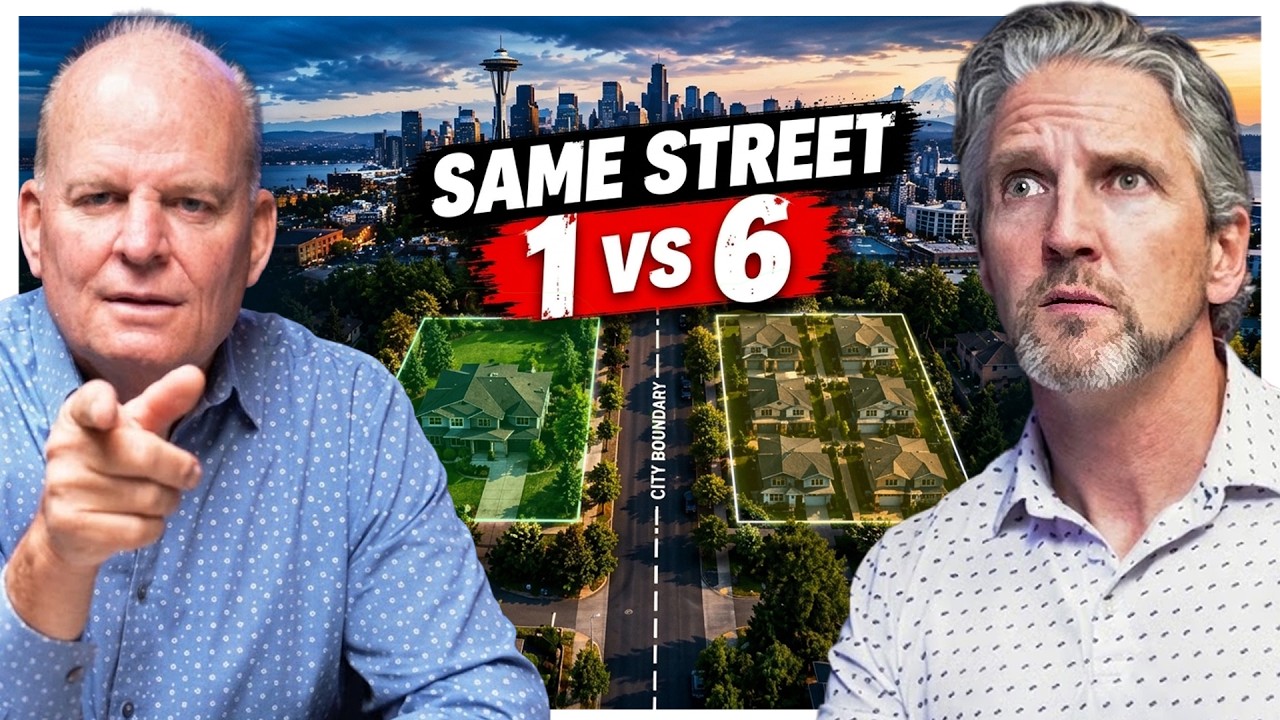
Well, right now it should be efficient because they're the slowest they've been in over twenty years. There's you know when we meet with the jurisdictions, they're they're in a struggle. They're in a struggle to get permits in. Efficiency, we're working on an ordinance right now in Snohomish County that I was trying to get introduced at the state level that we'll still work on, which is basically every jurisdiction, every city, and every county. Has a completely different planning model. Yes, they follow all different sets of rules. Yeah, but we're trying to run one that basically says, "Hey, we should all be under the same planning rules. You guys are all in the same country. Your cities bump into each other and your roads attach. So why shouldn't you have? I remember, for example, on one side of the street down in Lynnwood, I could only do one house."
But on the opposite side of the street in Mountlake Terrace, I could do six. How, because of the separation of a road, did it become that my house is worth that my property is worth that much less? Why can't you guys get your codes all on the same page? Why do you have such turfdom? We should be able to go to a planner, or I should be able to go to the county or the city and know that no matter what size piece of property I have, I should be able to just draw a square box on that lot, look at the zoning. And say, okay, I can get six units in there. Now it's up to me to figure out how to fit them in there. Does that make sense? Yeah, it's called simple. It's called form-based code, and that would be super simple. You're talking about processing time. You're talking about feasibility. You're talking about understanding what I'd have here. Simplest play in the world. And I've never understood why we try to make this so difficult for our citizens and our property owners. That's that's one of the ways to do it.
They try to set state laws that limit the amount of time for the applications. Good luck.
Yeah, it's not doing anything.
It didn't do anything because they get to put a pause every time they send it back to you and ask for changes, and so then it just keeps.
Rejecting the application and saying it's incomplete. It's incomplete.
And until it's complete, the ticker doesn't start, right? So now they're going to be unbelievably compliant because of the lack of business that comes in right now for permitting. Everybody's going to be as compliant as they possibly can. Even they're even short-staffed right now.
1:07:40Jobs, rents and the outlook for housing
And in closing, yeah, isn't that lack of permitting, that lack of land development, what does that mean for future values? What does it mean for future rents? What does it mean for future opportunities?
I think the best way to look at that is, when we're not buying homes, we're renting homes, right? And I mean, I love my kids, but I don't need them in the basement forever, and I love them from a distance. Obviously, our kids are all moved on, and our kids are older. But I look at it a little bit that way. In a market that isn't selling homes, I'm going to be renting homes, so rents are going to stay pretty solid. I don't know that we have a fantastic job market, but we've got one right now. I would lean on this one thing to keep in mind. If the tech market could solid up, if the job market in the tech industry could solid back up.
Snohomish County and King County sales could go up as much as twenty percent. Wow! Just because I take a look at who's coming through all the new construction plats at like a million to a million six, that tech buyer has disappeared on us, and it doesn't have anything to do with their income, and it doesn't have anything to do with the house. It has to do with their insecurity in their job, H one visas. I'm sitting at Microsoft. They just let go of the pod next door to me, and now I'm sitting over here. That I immediately, I'm still making the same amount of money, but I all of a sudden put a pause on what I'm going to do until I find out for sure is my job secure. Is AI changing my industry? If we could fix that part of of the Puget Sound area and get the technology jobs solided up so people feel comfortable, you'd jump as much as twenty percent because that buyer again, that was our million to, we'll call it.
That was our million to two million dollar buyer all day long, two incomes at 180 thousand a piece, couple of car leases, some credit cards, and a rent payment on a house, or they won't sell their existing house, yeah, and go buy a bigger home, and put money back into markets to allow people to move forward. That's that's kind of a cautionary thing that I'd say. I feel like okay, how do how do we as a government or how are we as jurisdictions, how does the state or the federal government fix that insecurity in the job market? Is there a way to do that? Can we visas? You bet, we could do something there immediately, and some other things. And again, I'm not I'm I'm not exaggerating. I think it's probably easily twenty percent because that has fueled South Snohomish County and King County. If we didn't have the tech industry, where do you think our pricing would be right now on homes?
We'd be thirty-five percent lower, easy.
See, and I've said somewhere in that thirty percent. I've always felt like that was where it, and we wouldn't have anywhere near the kind of investment tools that we have in real estate right now. So that's one way that you kind of go, okay, maybe I can't touch that, but understand we're that close to something happening there, to get this bump back up again, and start to get some turnaround on what our listings are looking at, but. Yeah, and I appreciate what you're doing here because getting the word out in this type of environment where anybody can hear it, and I don't have to go read it, and I don't have to go to a presentation, right? Yes, and I don't have to take a weekend to go listen to it. I think this is important that we just all we can do is seed the idea. But again, this market, this next year, I think it's a great time to buy real estate because I think we're going to hit a low that we've been in, and it'll stay in a low.